
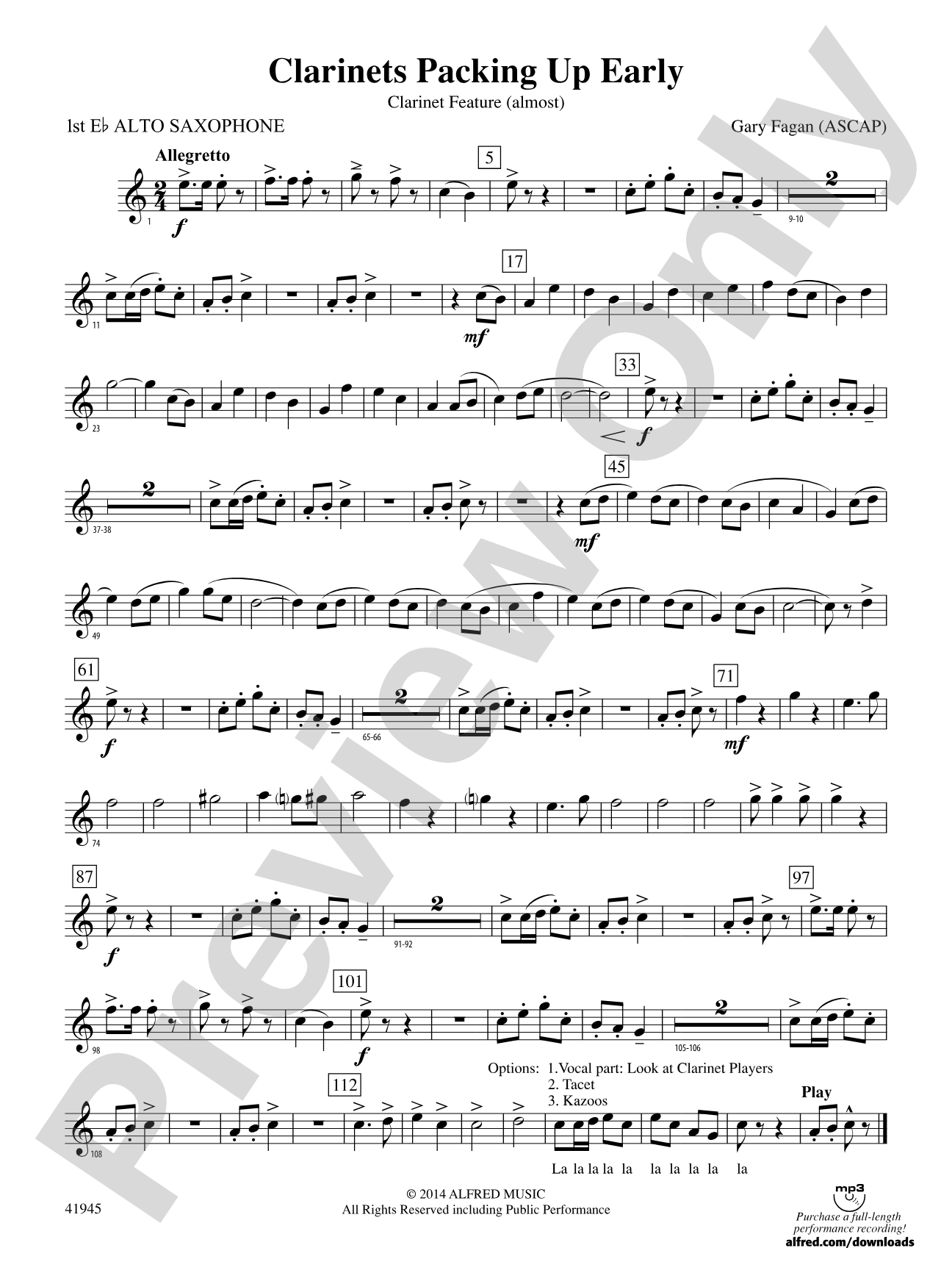

Clarinets Packing Up Early: E-flat Alto Saxophone
Clarinet Section Feature
By Gary Fagan
Grade: 2 (Medium Easy)
Item: 00-PC-0016427_AX1
$3.00
Pickup currently not available
Description
This novelty piece in rondo form features the clarinet section removing one section of their instrument at a time. As the piece progresses, the instruments become smaller and smaller until the main theme they carry is totally absent from the accompaniment part played by the rest of the ensemble. The creative possibilities with this piece are limited only to the director's imagination! (2:10)


Don't just read it, hear it, play along with it, and watch your students grow with it. In MakeMusic Cloud, Clarinets Packing Up Early: E-flat Alto Saxophone comes alive with professional accompaniment, adjustable tempo, and built-in practice tools that turn solo practice into real progress.
Open in the Player
Jump straight in and assign it today.
Start Your Free Trial
Open this title and explore the full library in minutes.
Sample Audio
1
Audio File
--:--
0:00
0:00
Sample Video
No sample videos found.
Additional Details
Series:
Young Symphonic
Publisher:
Alfred Music
Page Count:
128
SKU:
00-PC-0016427_AX1
More about this title
About the Composer: Gary Fagan

Gary Fagan brings four decades of band directing experience to his composing and arranging work. A graduate of Bridgewater College and James Madison University, he spent 36 years leading ensembles in Albemarle County before transitioning to university supervision and adjunct teaching in arranging at JMU. His music has reached stages from the Midwest Band and Orchestra Clinic to the White House, earning recognition as Central Virginia's Outstanding Middle School Teacher and multiple Outstanding Educator Awards.
Active as a clinician, adjudicator, and performing percussionist with the Charlottesville Band, Fagan remains deeply connected to the band directing community through MENC, the Virginia Band and Orchestra Directors Association, and his membership in ASCAP, Phi Beta Mu, and the National Band Association. His catalog spans concert band and string orchestra repertoire, informed by decades spent understanding what works in rehearsal and on stage.
Why we love this
This piece trades cuteness for genuine musical sophistication. Rather than simply shrinking the clarinet section, Fagan crafts a rondo structure that forces your ensemble to maintain compositional continuity while the primary melodic voice gradually disappears. The result is a novelty with real teeth—it demands your clarinets execute precise instrument disassembly, challenges your ensemble to lock in harmonically without their traditional anchor, and gives your program something genuinely memorable that isn't condescending.
What to expect
Playful and inventive. The rondo form gives it a familiar, accessible harmonic landscape, but the novelty twist creates genuine surprise and delight every time a clarinet player visibly reduces their instrument. There's comedy in the engineering and drama in the ensemble's ability to hold steady as the accompaniment shrinks.
Who it's for
Concert bands at the Grade 2 level looking for a showstopper that brings humor, creativity, and actual musical content to a concert. Your clarinet section gets to be the star of both the music and the visual spectacle, while the rest of the ensemble stays fully engaged in maintaining coherence as the piece unravels.
How to get the most out of it
- Establish a clear hand signal for each clarinet section member to know exactly when they're removing their barrel or bell; rehearse the mechanical choreography separately from the music until it becomes second nature.
- Work the ensemble's harmonic foundation during rehearsal by having the full band play the accompaniment parts without the clarinets, so every other section understands how to carry the melody internally once it vanishes.
- Time the clarinet disassembly during rests or held notes rather than during fast passages; this gives you clean breaks and prevents panic if someone's assembly is sticky.
- Record a run-through with all clarinets intact, then play it back during rehearsal so students hear the full shape before experiencing the gradual removal.
How to use it
Close a concert or rehearsal showcase with this piece to send your audience home smiling and talking. It works equally well as a spring pops concert feature or a winter band holiday concert moment that breaks the mood without losing musical credibility. The 2:10 duration fits cleanly into any program without demanding a full solo feature spot.
Skills your students will build
- Maintaining harmonic stability when a primary melodic voice is absent
- Executing precise rhythmic coordination during visual choreography
- Ensemble balance and blend without relying on traditional clarinet voicing
- Musical continuity and form recognition in rondo structures
- Listening across the ensemble to find internal melody lines