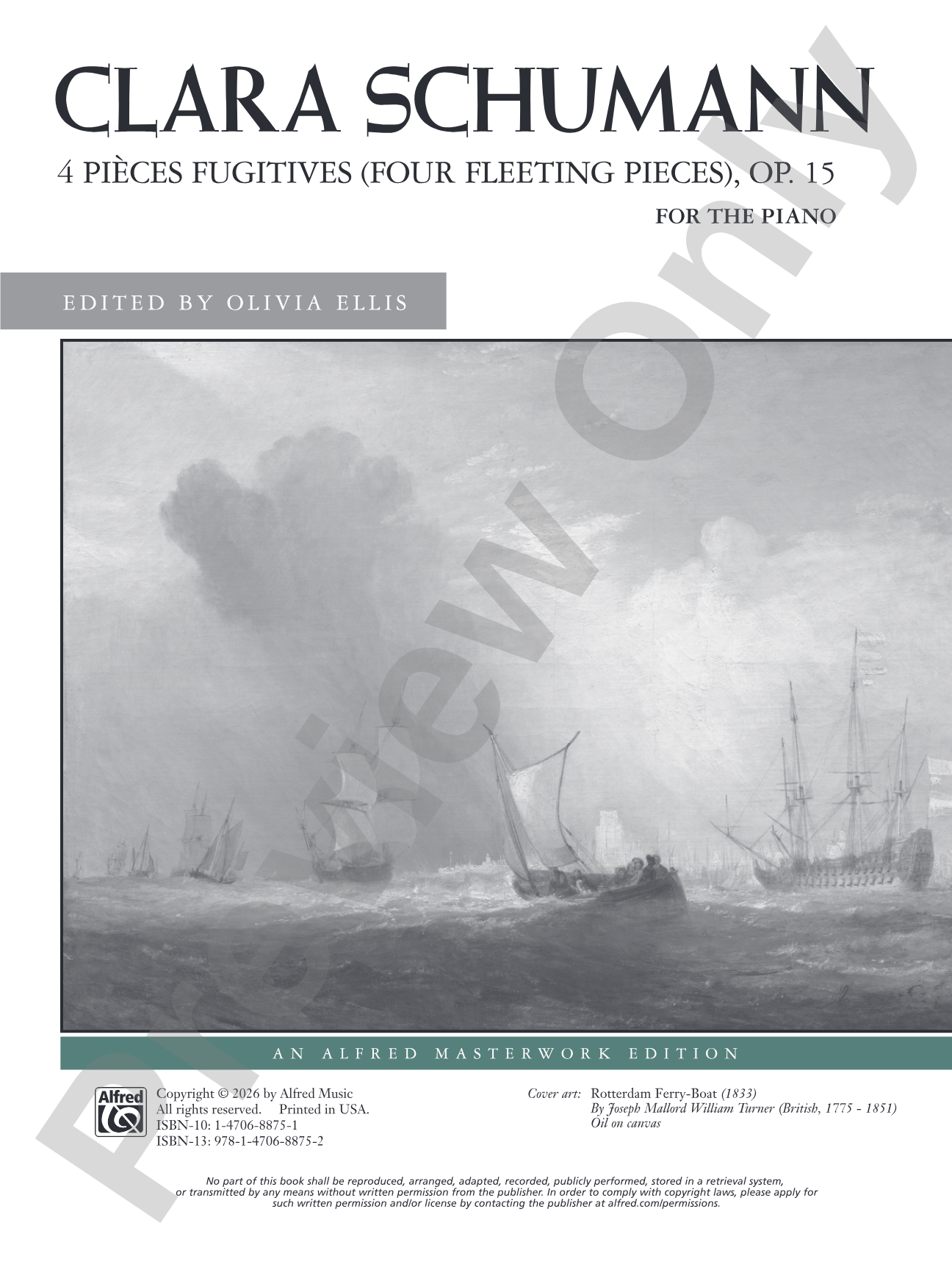
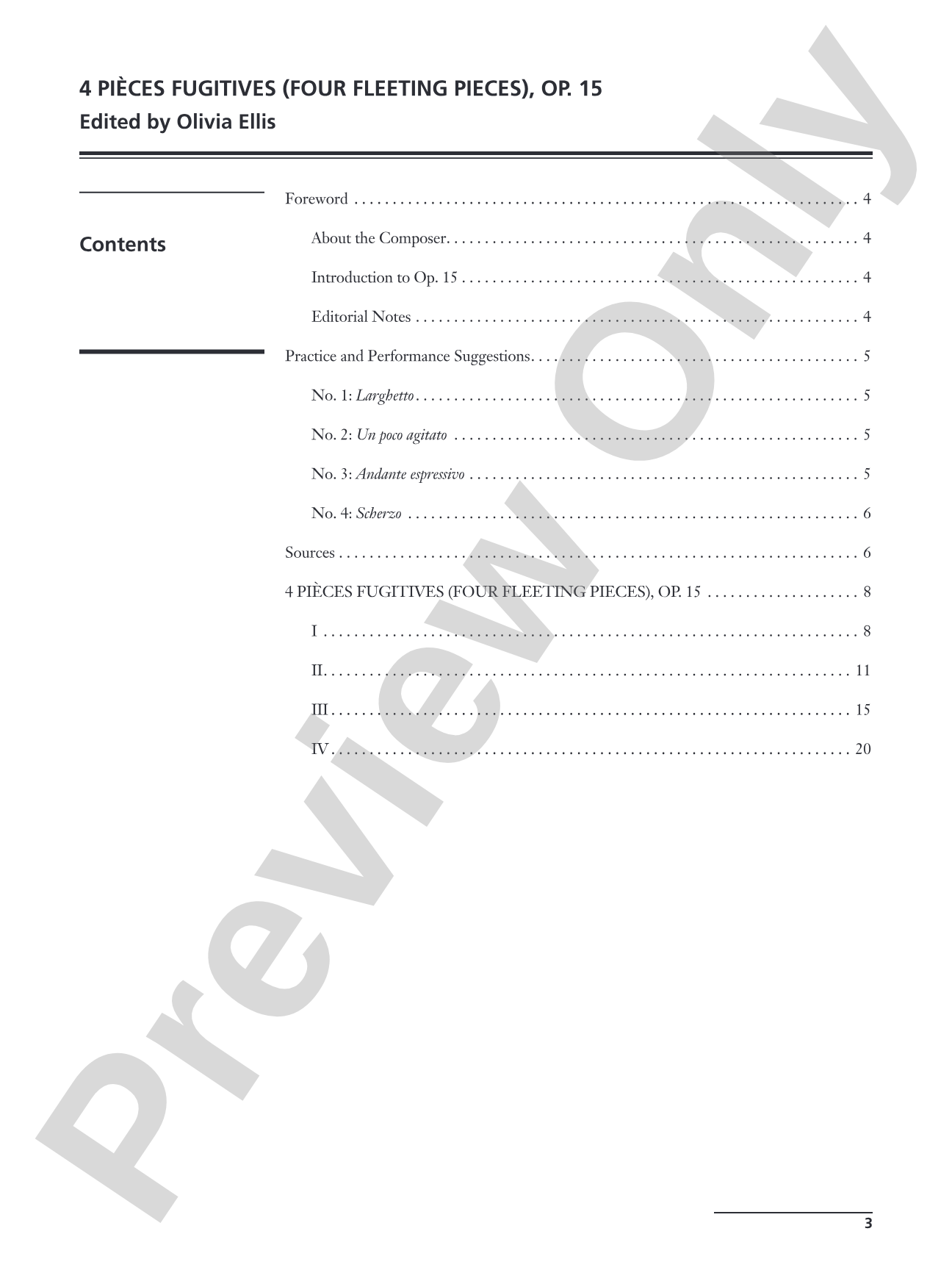
Clara Schumann: 4 Pièces fugitives (Four Fleeting Pieces), Op. 15: Piano
By Clara Schumann, edited by Olivia Ellis
Level: LI/EA
Item: 00-PB-0002710
Digital Download
$13.99
Pickup currently not available
Description
Clara Schumann was one of the nineteenth century's most celebrated pianists and a gifted composer whose music ranges from brilliant concert works to intimate character pieces. Her Quatre pièces fugitives, Op. 15, is among the finest examples of her mature compositional style.
Written between 1841 and 1844 and first published in 1845, this collection of four contrasting pieces explores a wide array of moods, complex textures, and pianistic challenges. From the songlike lyricism of the opening Larghetto to the spirited concluding Scherzo, the set offers late-intermediate to early-advanced pianists an engaging introduction to Schumann's distinctive musical voice and invites further exploration of her piano music.
Discover MakeMusic Cloud: thousands of interactive titles your students can play along with today.
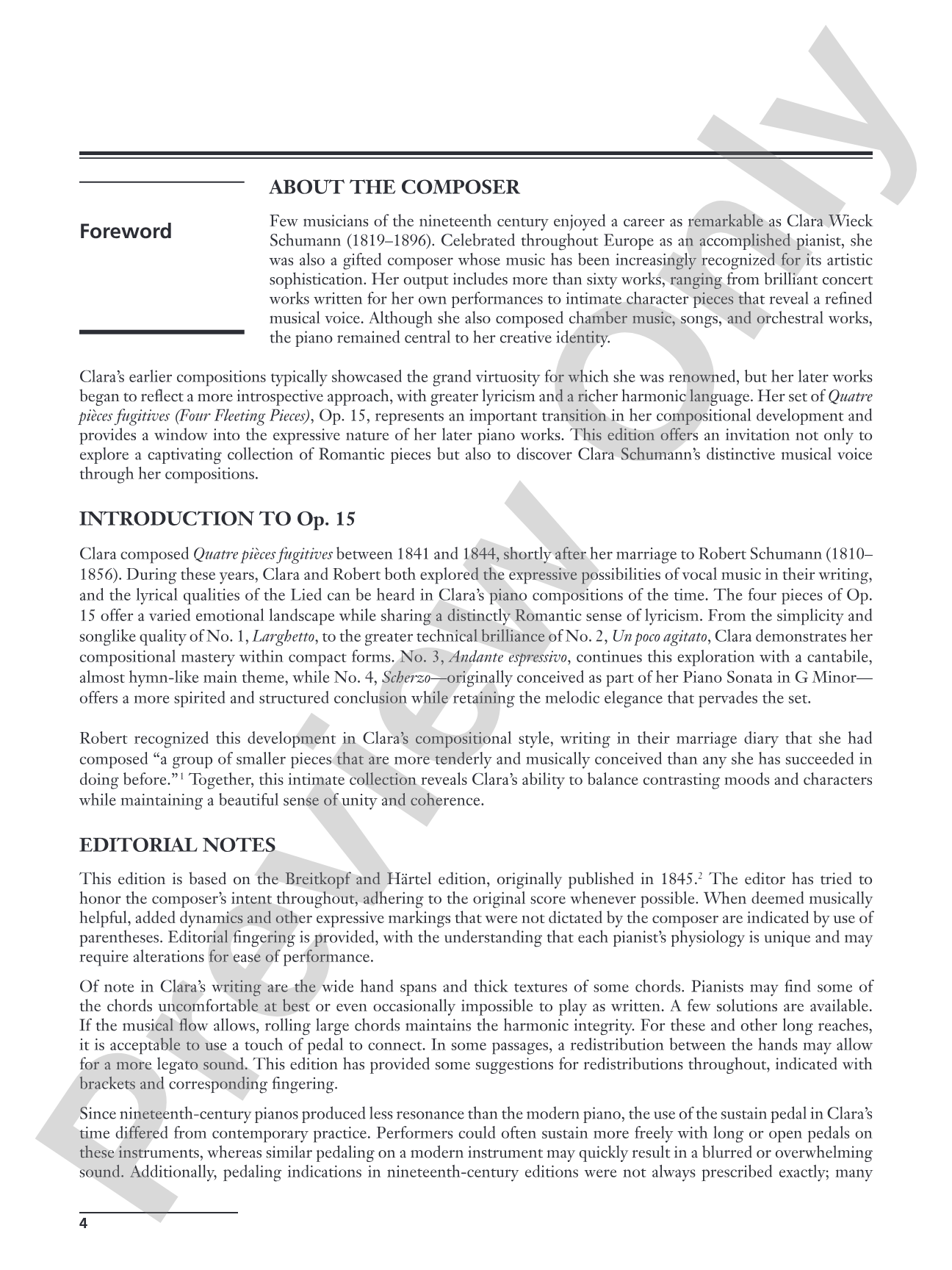
Clara Schumann stands among the most significant composer-pianists of the nineteenth century, yet her compositional legacy often remains overshadowed by her husband's fame. A virtuoso performer who commanded major concert stages across Europe, she brought both technical brilliance and intimate expressive depth to her own works, composing across genres from ambitious orchestral and chamber pieces to refined solo piano works that showcase remarkable harmonic sophistication and formal invention.
Her career spanned decades of professional performance and composition despite the formidable social constraints placed on women musicians of her era. The Pièces fugitives, Op. 15 exemplify her mature style: works that balance public virtuosity with private introspection, combining the pianistic fluency of a master performer with the compositional craftsmanship that earned her recognition as a serious artist in her own right.
Why we love this
These four contrasting pieces deliver substantial musical content without demanding the technical extremes required by showpiece repertoire. Each movement reveals something essential about Schumann's compositional approach: songful melody, intricate voice leading, and harmonic color that rewards close listening. A student who works through this collection learns what late Romantic piano composition sounds like from the perspective of a virtuoso musician who knew the instrument's capabilities intimately.
What to expect
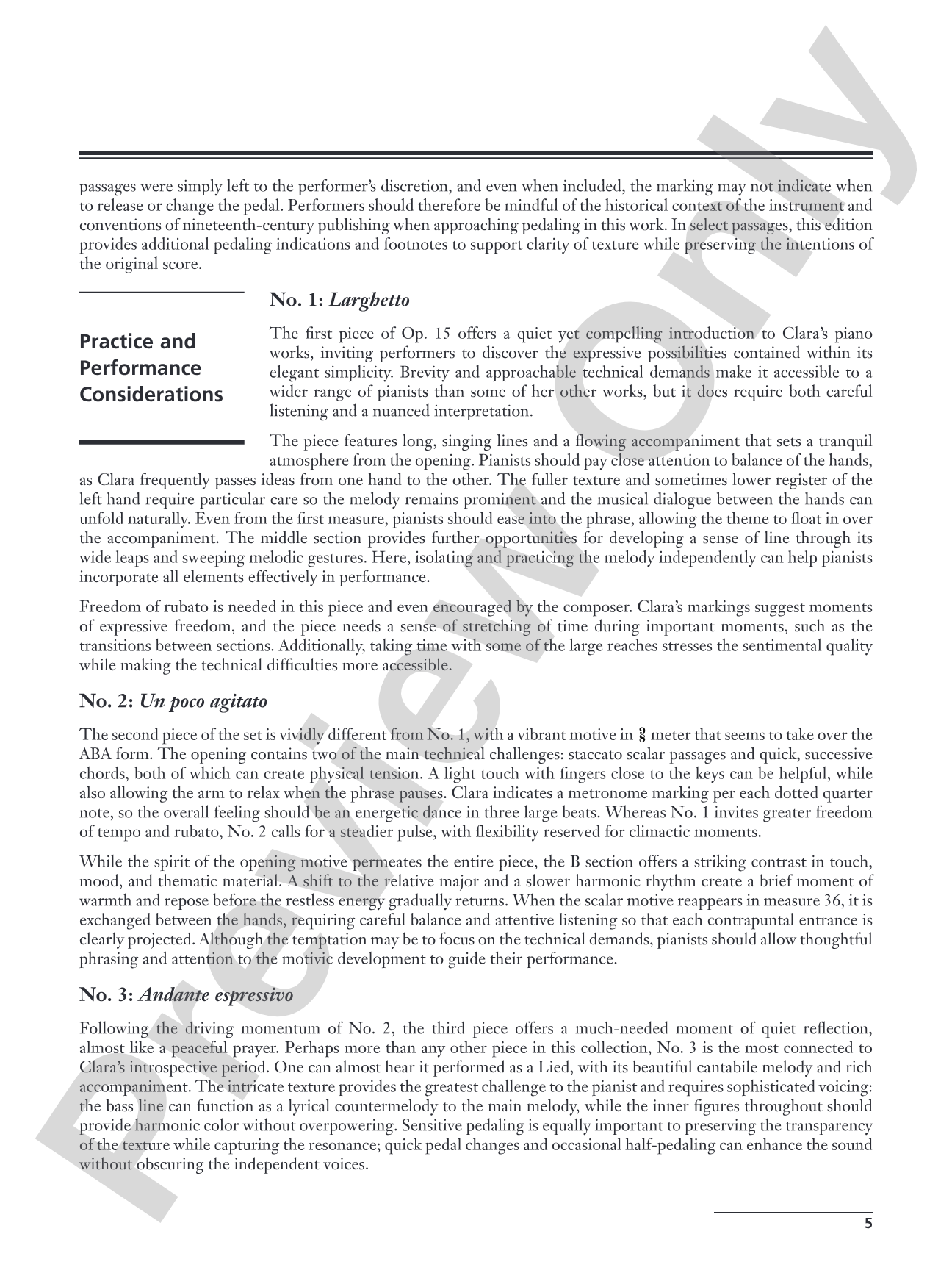
Moving through these pieces feels like overhearing intimate musical conversations, each with its own tone and urgency. The Larghetto beckons inward with lyrical grace; the remaining movements pulse with varied energy, from contemplative to briskly playful. Throughout runs a thread of sophisticated harmonic language and pianistic elegance that distinguishes Schumann's voice as distinctly her own.
Who it's for
Late-intermediate and early-advanced pianists seeking substantial Romantic repertoire beyond the standard pedagogical canon. Students ready to encounter genuine compositional complexity and performers preparing recital programs that honor women composers' contributions to the piano repertoire.
How to get the most out of it
Attend carefully to the accompanimental textures in the Larghetto; resist the urge to let them disappear into the background. These inner voices carry harmonic and structural weight that defines the piece's emotional landscape.
Find the pulse beneath the surface rhythmic complexity in the Scherzo rather than fighting against it. Once the underlying meter feels natural, the spirited character emerges without forcing.
Shape each four-bar phrase as a unit while preserving the larger arch of each movement. Schumann's sectional construction rewards both local detail and long-line thinking.
Allow time to settle into silence between movements. Each piece occupies a distinct psychological space; transitions need breathing room to acknowledge the shift in mood and character.
How to use it
Teach this collection as a unit within a semester devoted to Romantic piano works, or program individual pieces strategically across recitals to highlight the stylistic range within a single opus. The Scherzo works particularly well as a lighter character piece between weightier repertoire, while the Larghetto pairs naturally with other intimate miniatures in chamber or solo contexts.
Skills your students will build
Balancing lyrical melody against active accompanimental textures
Reading and executing complex rhythmic relationships across multiple voices
Interpreting Romantic harmonic language and recognizing tonal color through voice leading
Sustaining musical character across extended phrase structures
Navigating sectional forms that shift in mood and texture
You May Also Like
Scan to Complete Your Purchase
Use your phone's camera to scan the code below
You'll log in on your phone and the order will be added to your account