
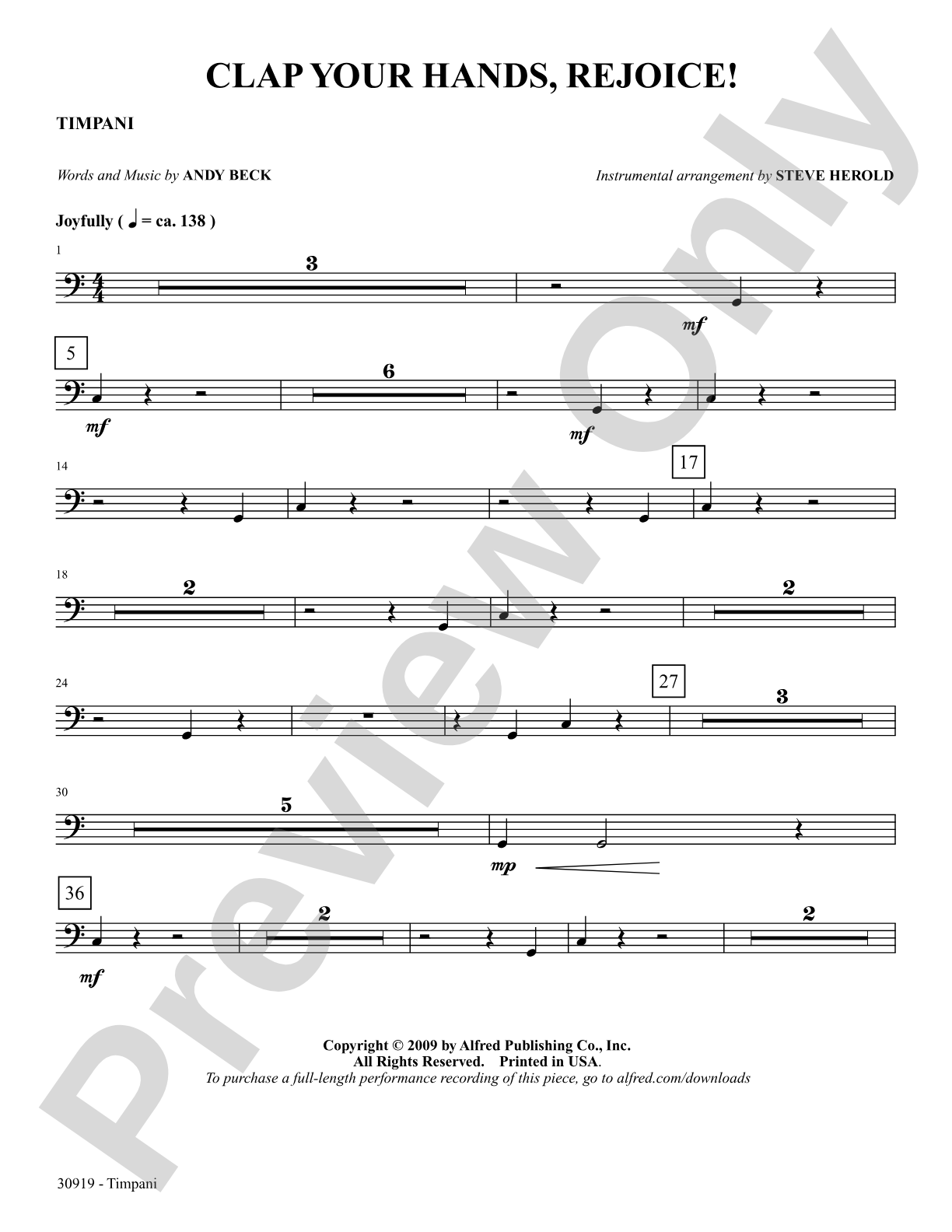

Clap Your Hands, Rejoice!: Timpani: Choral SoundPax
Words and music by Andy Beck
Item: 00-PC-0014307_TMP
$3.00
Pickup currently not available
Description
Joyful vocal phrases are punctuated with rhythmic handclaps throughout this thrilling concert and festival piece for developing choirs. A few optional cued notes introduce your group to simple triad singing, and a buoyant descant creates a third layer in the add-on ostinato section and at the triumphant end. SoundPax includes 2 tpt., bells, timp., sn. drum, tam., perc.


Don't just read it, hear it, play along with it, and watch your students grow with it. In MakeMusic Cloud, Clap Your Hands, Rejoice!: Timpani: Choral SoundPax comes alive with professional accompaniment, adjustable tempo, and built-in practice tools that turn solo practice into real progress.
Open in the Player
Jump straight in and assign it today.
Start Your Free Trial
Open this title and explore the full library in minutes.
Sample Audio
1
Audio File
--:--
0:00
0:00
Sample Video
No sample videos found.
Additional Details
Series:
Alfred Choral Designs
Publisher:
Alfred Music
Page Count:
28
SKU:
00-PC-0014307_TMP
Instrumentation:
SoundPax
More about this title
About the Composer: Andy Beck

Andy Beck directs choral publications at Alfred Music and has composed and arranged over 450 choral works currently in print. His catalog spans concert repertoire, vocal resources, and children's musicals, with widespread international performance documented on YouTube. He holds degrees in Music Education from Ithaca College and Northwest Missouri State University.
Beyond his publishing role, Beck works regularly as a guest conductor, choreographer, adjudicator, and clinician across the United States and beyond. He has served as commissioned composer and guest conductor for honor choirs and all-state groups throughout the Southeast, and performs as a tenor with the North Carolina Master Chorale Chamber Choir. His studio recording work for Alfred Music spans three decades, grounding his deep understanding of what works for singers of all ages.
Why we love this
Beck understands what makes a developing choir feel accomplished. The optional cued triad notes give singers a genuine harmonic challenge without overwhelming them, while handclaps throughout create a physical, energetic connection to the rhythm that audiences find contagious. The descant layer rewards groups ready to layer complexity while keeping others in a satisfying unison foundation.
What to expect
Celebration in motion. Joyful vocal phrases rise and fall while rhythmic handclaps anchor the groove, building momentum toward a triumphant finish. The addition of the descant and instrumental SoundPax creates a fullness and theatrical energy that makes singers feel part of something bigger than unison singing.
Who it's for
Developing choirs ready to explore layered harmonies and enjoy the physicality of staged movement. This piece works equally well for middle school through early high school ensembles seeking a concert showstopper that doesn't require advanced sight-reading or complex part independence.
How to get the most out of it
- Treat the handclaps as percussion hits, not afterthoughts. Work them into early rehearsals so the rhythm stays tight and crisp alongside the sung line, creating that thrilling punctuation the piece demands.
- Start the optional triad cues as written notes in rehearsal before introducing singers to the harmonic function. Many will gain confidence seeing the pitches in their music first.
- Balance the descant entrance carefully in the final section. The SoundPax instrumentation (2 trumpets, bells, timpani, snare drum, tam-tam, and additional percussion) can easily overshadow the uppermost vocal line if not monitored in full-choir rehearsals.
How to use it
Program this as a guaranteed crowd-pleaser midway through a concert, where its movement and energy lift the audience while giving your choir a chance to showcase developing harmonic skills. The 28-page score and movement staging suggestions make it ideal for a festival or concert where visual engagement matters as much as the vocal line.
Skills your students will build
- Basic triad singing and harmonic stacking through optional cued notes
- Rhythmic independence between sung line and handclap articulation
- Managing a descant line while maintaining a strong unison foundation
- Ensemble blend and balance across multiple layers of sound