
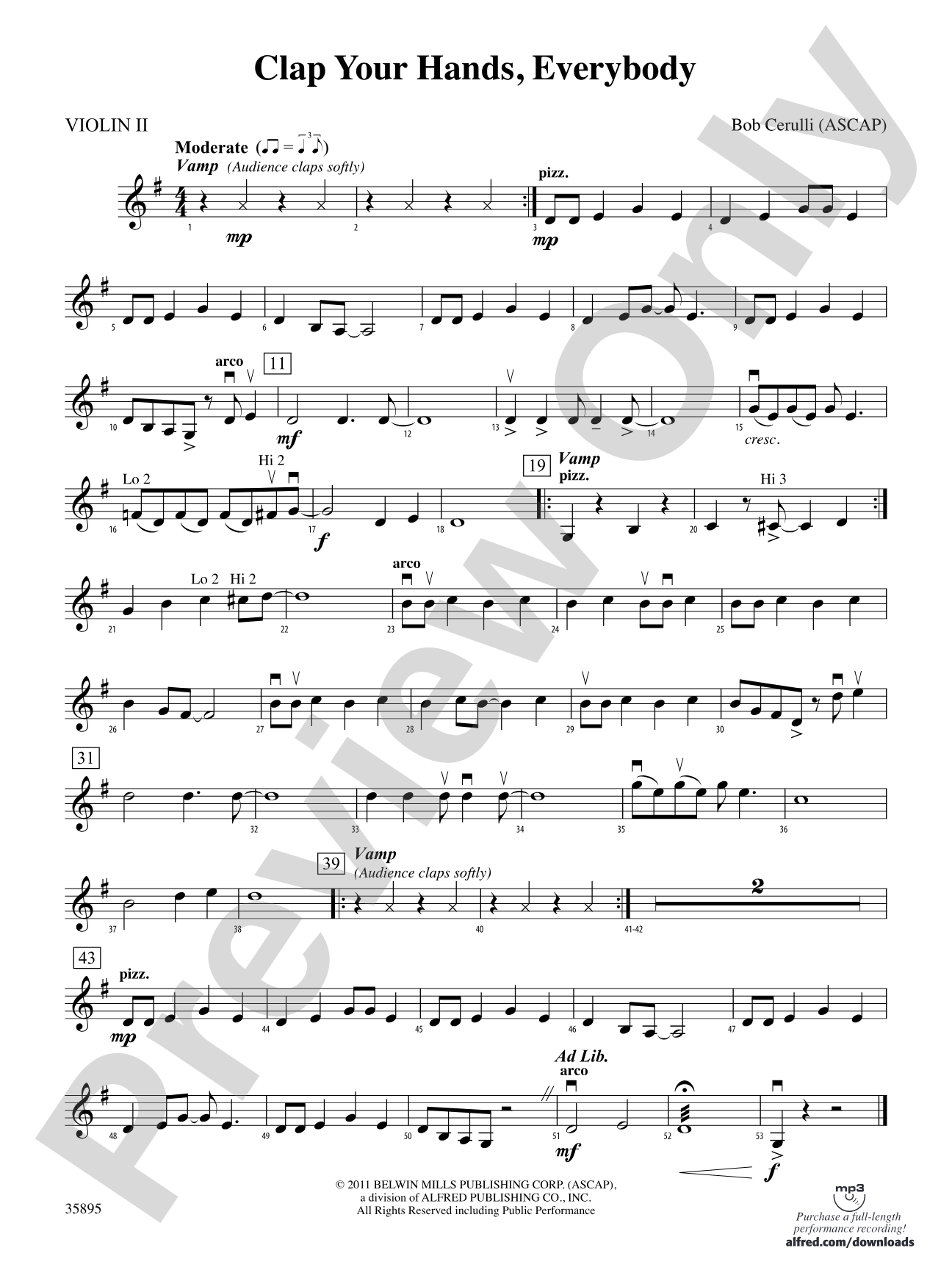

Clap Your Hands, Everybody: 2nd Violin
By Bob Cerulli
Grade: 2.5
Item: 00-PC-0014979_VN2
$5.99
Pickup currently not available
Description
Get the whole room clapping! This fun piece is designed to let the director interact with the audience and give the students, parents, and grandparents an opportunity to participate in the program with the ensemble. It has a blues feel and the director could turn this into an impromptu lesson on dynamics, the blues, or the different sounds of the strings: pizzicato, arco, and tremolo.


Don't just read it, hear it, play along with it, and watch your students grow with it. In MakeMusic Cloud, Clap Your Hands, Everybody: 2nd Violin comes alive with professional accompaniment, adjustable tempo, and built-in practice tools that turn solo practice into real progress.
Open in the Player
Jump straight in and assign it today.
Start Your Free Trial
Open this title and explore the full library in minutes.
Sample Audio
1
Audio File
--:--
0:00
0:00
Sample Video
No sample videos found.
Additional Details
Series:
Belwin Beginning String Orchestra
Publisher:
Alfred Music
Page Count:
72
SKU:
00-PC-0014979_VN2
Instrumentation:
string w/ vn 3
More about this title
About the Composer: Bob Cerulli

Bob Cerulli trained at the Curtis Institute of Music, where he studied double bass, and went on to earn degrees in music education from the University of the Arts and conducting from the College of New Jersey. His performing career included memberships in the Buffalo Philharmonic and principal bass positions with several regional orchestras, as well as freelance work across Philadelphia and Atlantic City with Broadway performers and film composers including Henry Mancini, Bill Conte, and Michel LeGrand.
Cerulli brings three decades of public school teaching experience to his compositional work, alongside his current role as Senior Adjunct Professor at Rowan College at Burlington County. He has conducted orchestral performances and reading sessions at regional festivals and has composed works for orchestra and chamber ensembles, including pieces premiered by Philadelphia Orchestra musicians.
Why we love this
Cerulli's background as both a long-time school music educator and accomplished orchestral performer means this piece genuinely understands what makes a string orchestra concert memorable. The built-in audience participation transforms a performance into a shared musical experience rather than a passive one, and the blues idiom opens natural conversations about musical style without requiring a lengthy setup.
What to expect
A relaxed, swingy piece with the laid-back groove of a blues feel that invites everyone in the room to participate. The straightforward melodic lines and varied string textures (pizzicato, arco, tremolo) keep the sound fresh and approachable, creating an atmosphere of fun rather than formality.
Who it's for
String orchestra directors teaching at the upper elementary through early middle school level who want to program something that engages the entire audience, not just listeners. It works especially well for end-of-year concerts, school assemblies, or family nights where you want young musicians and their community to feel part of the music-making together.
How to get the most out of it
- Prepare the audience ahead of time with a brief, informal introduction about what's coming. A simple explanation like "We'd like you to help us out" works better than no setup at all.
- Experiment with the dynamics marked in the score. Use this piece as a chance to show your students how the same melody sounds completely different when played soft versus loud, building their awareness of expressive control.
- Balance the pizzicato and tremolo textures clearly so that when you shift from one articulation to another, the audience notices the change in color. This makes the interactive moments land with more impact.
How to use it
Position this as a concert closer or a midprogram showstopper when energy needs a boost. It pairs well with more formal repertoire earlier in the concert, offering a tonal shift that gives both the ensemble and audience a chance to relax and enjoy themselves together.
Skills your students will build
- Pizzicato, arco, and tremolo articulation control
- Dynamic shaping and terraced dynamics
- Blues style and swing feel
- Performing with audience participation and maintaining focus
- Understanding and responding to conductor cues in an interactive context