Clair De Lune Sheet Music Preview

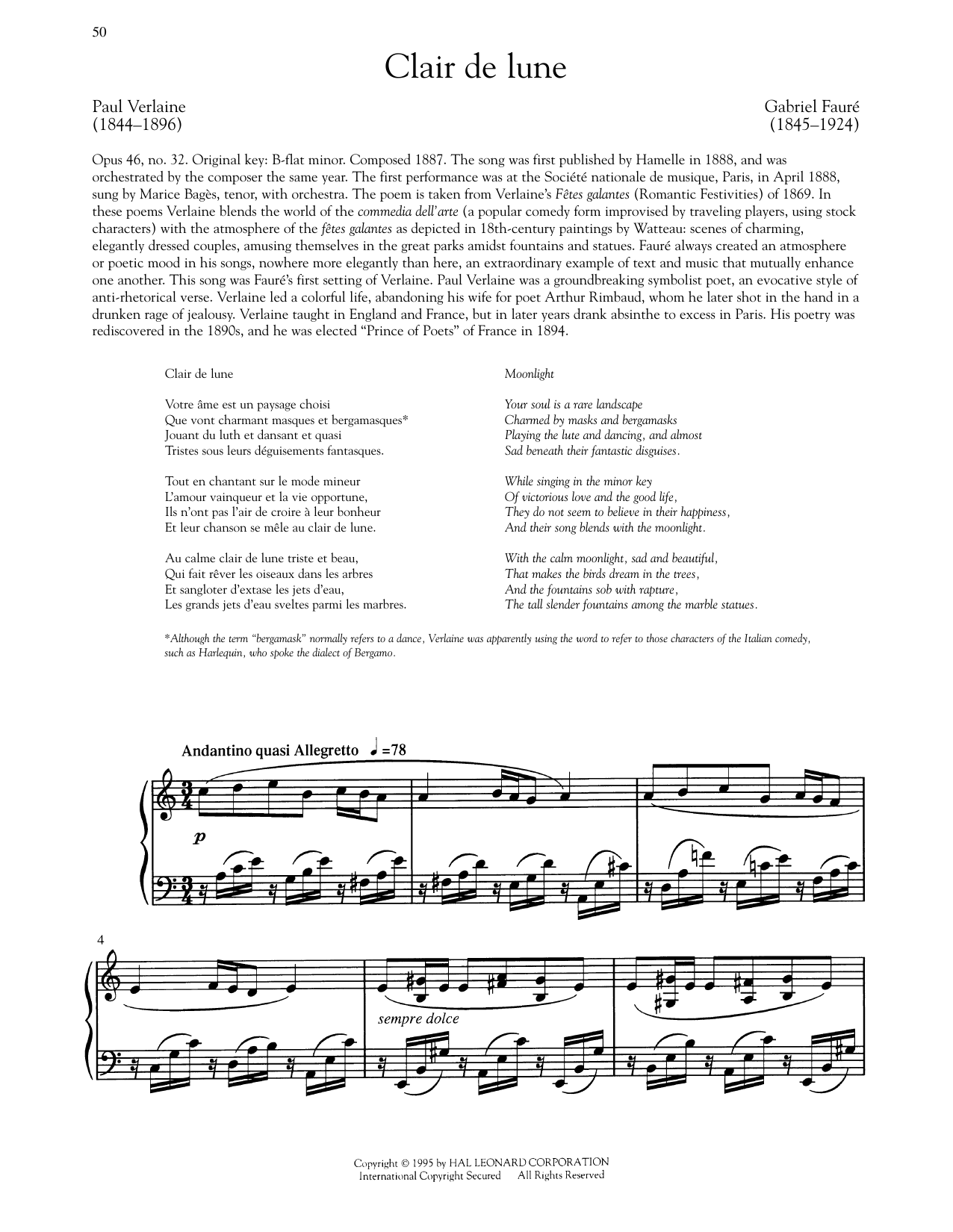
Clair De Lune: Piano Vocal

By Gabriel Fauré / As performed by Paul Verlaine

Item: 35-DS01823758

Digital Download
$5.99
Description

Clair De Lune: Piano Vocal isn't in MakeMusic Cloud just yet...but it could be. Let us know you'd like to see it, and you'll help shape what comes next. In the meantime, start a free trial and dive into thousands of interactive titles your students can play along with today.

Sample Audio
No sample audio found.
Sample Video
Additional Details
Publisher: Hal Leonard
Page Count: 6
SKU: 35-DS01823758

More about this title

About the Composer: Gabriel Fauré

Gabriel Fauré stands as one of the most refined voices in French musical Romanticism, a composer who elevated the art song to profound emotional and technical heights. His gift lay in matching exquisite harmonic language to poetry of genuine literary merit, creating works that demand both vocal sensitivity and pianistic sophistication from performers.

Why we love this

This setting captures everything that makes Fauré's vocal writing magnetic: the piano part breathes alongside the voice rather than accompanying it, and the harmonic language moves with such subtlety that students hear exactly how much color lives in thoughtful chord choices. Programming it signals to your audience that this is a voice recital moment, not background music.

What to expect

Moonlit and introspective, with moments of quiet yearning that never tip into sentimentality. The music unfolds like a conversation overheard in a garden at dusk, marked by restraint and emotional intelligence rather than grand gestures.

Who it's for

Intermediate to advanced pianists and singers comfortable with French art song conventions and willing to spend time on textual clarity and harmonic nuance. This pairing works beautifully for upper-level voice students building a recital repertoire or for pianists seeking chamber-like collaboration.

How to get the most out of it

  • Shape the vocal line in long phrases that follow the text's natural speech rhythms rather than punctuating at every bar line.
  • Balance the singer and piano as equal partners; Fauré's accompaniment contains essential harmonic and melodic material that frames the voice.
  • Attend to the harmonic rhythm in the piano part, which often moves more slowly than the surface note values suggest, affecting both tempo flexibility and rubato.
  • Explore the color palette available through pedal work in the piano; the sonority shifts substantially based on harmonic context and register.

How to use it

Slot this into a recital focused on Romantic song cycles or French vocal music, where it anchors a program with its harmonic sophistication. It also serves as an excellent closing piece for an intimate chamber concert, offering audiences a moment of reflection without demanding virtuosic display.

Skills your students will build

  • Interpreting text with harmonic awareness; hearing how Fauré's chord choices reflect the poetry's emotional arc
  • Coordinating rubato between voice and piano across extended phrases
  • Balancing vocal and instrumental lines as equal partners rather than soloists with accompaniment
  • Understanding French diction and its interaction with vocal line shaping
  • Reading and executing tasteful use of piano pedal within a chamber context

You May Also Like