Clair De Lune Sheet Music Preview

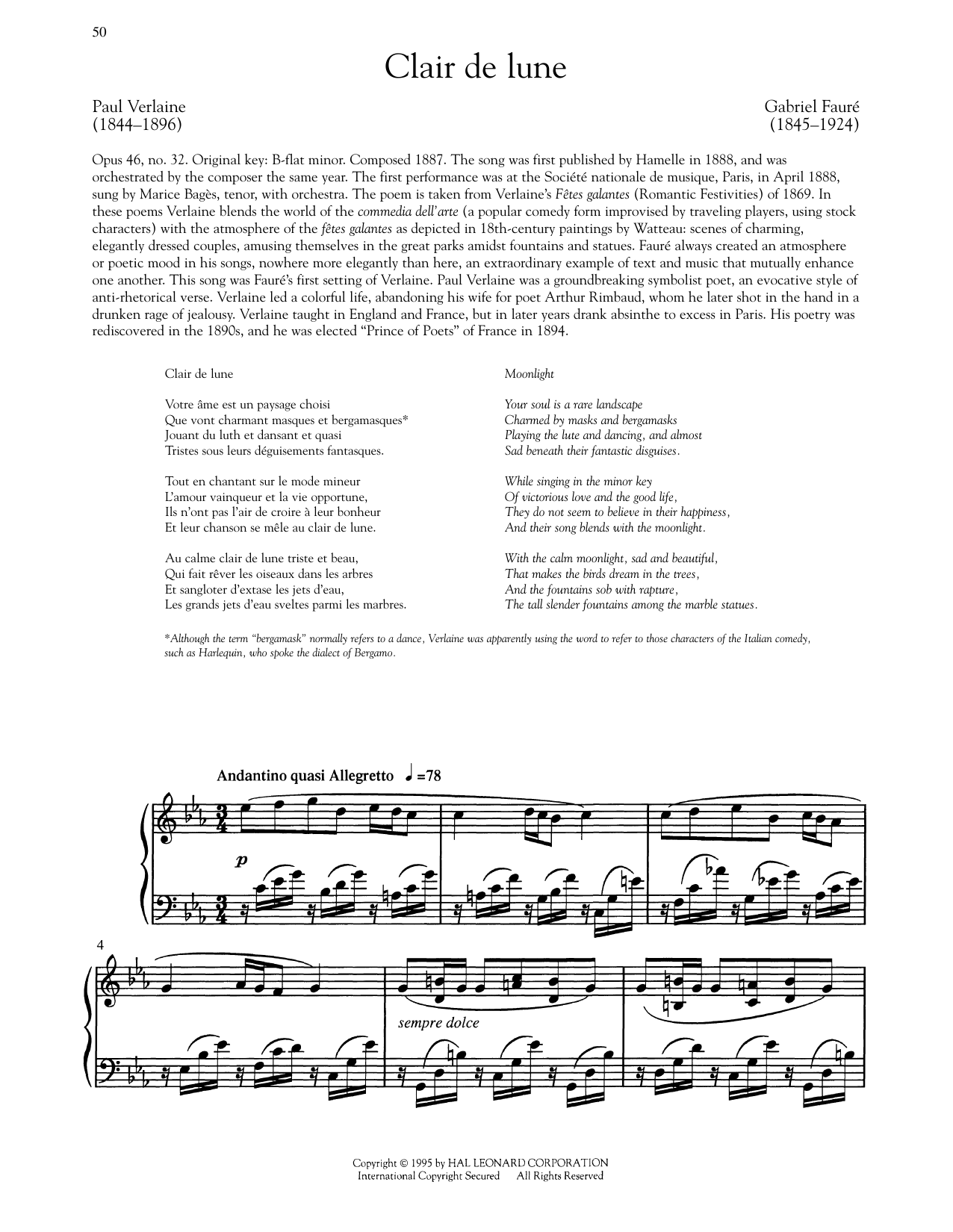
Clair De Lune: Piano Vocal

By Gabriel Fauré / As performed by Paul Verlaine

Item: 35-DS01822662

Digital Download
$5.99
Description

Clair De Lune: Piano Vocal isn't in MakeMusic Cloud just yet...but it could be. Let us know you'd like to see it, and you'll help shape what comes next. In the meantime, start a free trial and dive into thousands of interactive titles your students can play along with today.

Sample Audio
No sample audio found.
Sample Video
Additional Details
Publisher: Hal Leonard
Page Count: 6
SKU: 35-DS01822662

More about this title

About the Composer: Gabriel Fauré

Gabriel Fauré (1845–1924) was a French composer whose intimate approach to song and chamber music reshaped what art song could express. His melodic gift and harmonic refinement made him a central figure in French musical life, and his influence on vocal writing extends well beyond his lifetime. Fauré's songs demonstrate that profound emotion requires neither orchestral grandeur nor dramatic excess; instead, they reveal depths through restraint and elegance.

Why we love this

This setting captures Verlaine's moonlit poetry with a piano part that breathes alongside the voice rather than supporting it from beneath. The harmonic language feels both accessible and sophisticated, making it a piece that singers discover something new in each rehearsal. It belongs in every vocalist's repertoire precisely because it refuses to announce itself; its power accumulates quietly.

What to expect

Moonlight filtered through leaves, remote and intimate at once. The piano weaves around the voice like mist, and the vocal line floats without strain or effort, as if the poem is simply being remembered rather than performed.

Who it's for

High voice singers working toward art song maturity will find this piece essential. Teachers seeking repertoire that builds both technical security and interpretive depth can trust this song to meet students where they are and ask something genuine of them.

How to get the most out of it

  • Shape the vocal line with long phrases rather than punctuating every poetic comma; Fauré's accompaniment will handle the harmonic shifts that mark the text.
  • Balance the piano throughout. The right hand often carries material equal in importance to the melody, and clarity here prevents the song from sagging.
  • Approach the registral shifts with freedom. Allow natural breath points to influence your phrasing without letting them fracture the song's continuity.
  • Lean into the French language. Clarity of diction matters more than perfect accent; Verlaine's images deserve to be heard.

How to use it

Program this for a recital devoted to French song, or pair it with contrasting settings of Verlaine by other composers to explore different musical responses to the same text. It also serves well as an encore for a program that needs a moment of stillness without returning to the opening mood.

Skills your students will build

  • legit phrasing across the break between passaggio and head voice
  • text declamation in French with natural prosody
  • collaborative listening with an equal piano partner
  • sustaining line through harmonic language that doesn't follow expected progressions
  • interpretation of ambiguous emotional climaxes

You May Also Like