
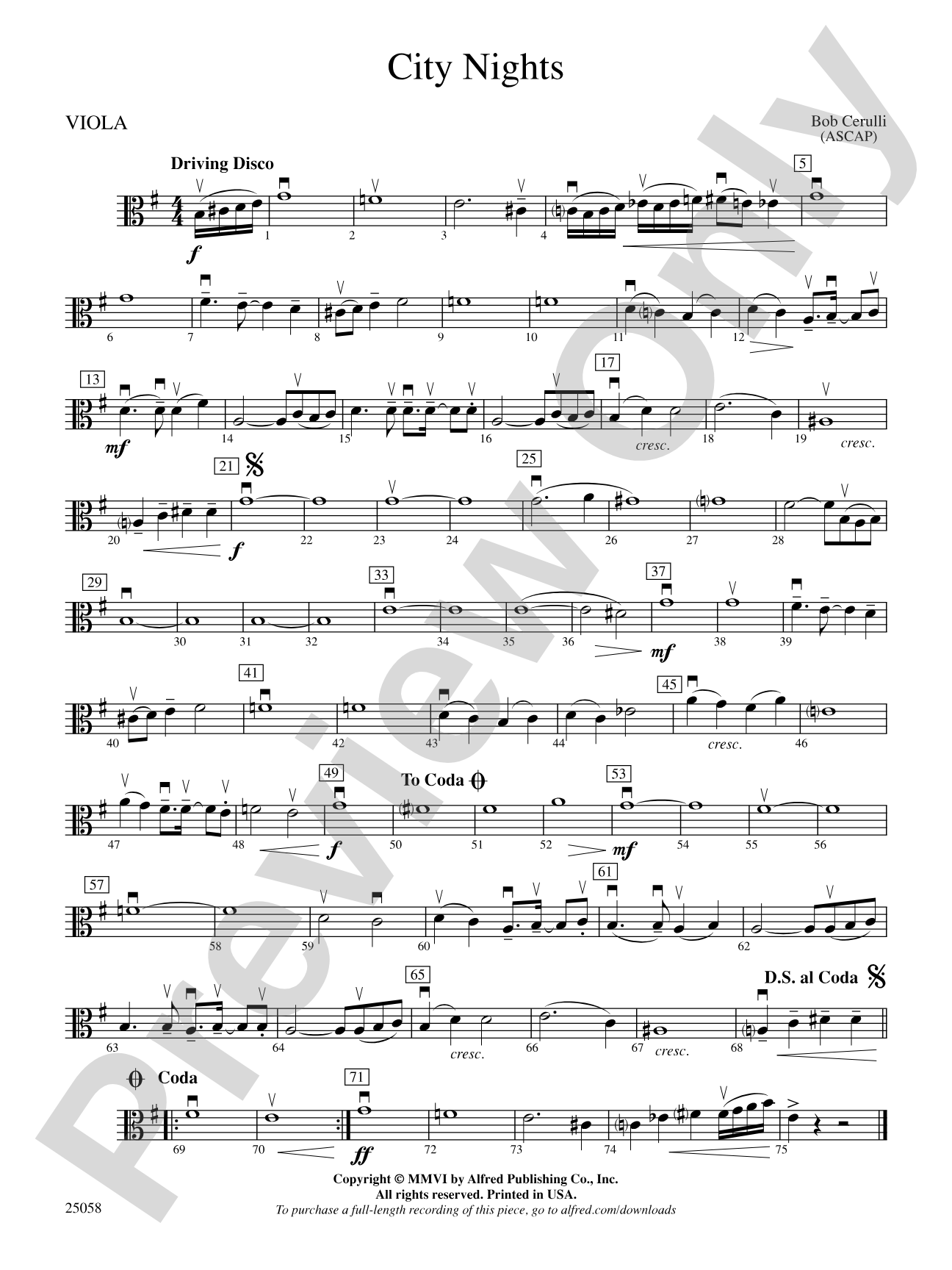

City Nights: Viola
By Bob Cerulli
Grade: 3
Item: 00-PC-0001019_VA1
$3.00
Pickup currently not available
Description
Disco dancing on Saturday night in the city! This original tune by Bob Cerulli can be played by strings alone or with any combination of winds.


Don't just read it, hear it, play along with it, and watch your students grow with it. In MakeMusic Cloud, City Nights: Viola comes alive with professional accompaniment, adjustable tempo, and built-in practice tools that turn solo practice into real progress.
Open in the Player
Jump straight in and assign it today.
Start Your Free Trial
Open this title and explore the full library in minutes.
Sample Audio
1
Audio File
--:--
0:00
0:00
Sample Video
No sample videos found.
Additional Details
Series:
Belwin Intermediate String/Full Orchestra
Publisher:
Alfred Music
Page Count:
160
SKU:
00-PC-0001019_VA1
More about this title
About the Composer: Bob Cerulli

Bob Cerulli's career spans performance, composition, and education across multiple contexts. He studied double bass at the Curtis Institute of Music under Roger Scott, then earned degrees in music education from the University of the Arts and conducting from the College of New Jersey. He performed as Principal Bass with several regional orchestras including the Greater Trenton Symphony and Delaware Valley Philharmonic, and freelanced extensively in Philadelphia and Atlantic City alongside Broadway performers and film composers including Henry Mancini, Bill Conte, and Michel LeGrand.
Cerulli's compositions have been performed by major ensembles; the Philadelphia Orchestra premiered his work Celebration, and Philadelphia Orchestra Principal Cellist William Stokking championed his Romance in D Major. For nearly three decades he taught music in public schools, and he continues as Senior Adjunct Professor at Rowan College at Burlington County, where he conducts orchestral reading sessions and performances at regional festivals.
Why we love this
Cerulli captures the infectious energy of Saturday night disco in a piece that actually works for orchestras of varying instrumentation. The flexibility to perform with strings alone or add winds in any combination makes this a practical choice for mid-level ensembles while maintaining genuine musical excitement. The novelty factor keeps students engaged without sacrificing the compositional craft that comes from a composer with serious orchestral and educational experience.
What to expect
Saturday night energy translated into orchestral terms: rhythmic, propulsive, and fun without ever losing musical focus. The piece radiates the kinetic joy of disco dancing in the city, with enough compositional substance that students feel they're playing real music, not novelty filler.
Who it's for
Intermediate orchestra directors looking to program something with genuine entertainment value that doesn't talk down to young musicians. This works for ensembles with mixed experience levels since the orchestration is adaptable, and it's equally at home in a concert setting or as a lighter moment in a longer program.
How to get the most out of it
- Lock in the rhythm section early in rehearsals. The disco groove is the foundation; once your basses, cellos, and low woodwinds establish the pulse, everything else lands in place more easily.
- Balance the string writing carefully. With 160 pages of score and parts, the string sections carry much of the melodic and harmonic weight; ensure they project clearly without overwhelming the texture.
- Lean into the stylistic context. This is disco energy, not concert hall formality; encourage articulation and rhythmic precision that brings out the dance quality.
- Use the flexibility strategically. If you're short on winds one rehearsal, run the string version and refamiliarize yourself with that arrangement; it teaches the core musical content without rushing.
How to use it
Program this as a contrast piece between more serious works, or use it to open a pops or family concert where lighter material sets a welcoming tone. It also works well as a reward piece once students have conquered more challenging repertoire, since the novelty appeal and stylistic clarity give them an immediate sense of accomplishment.
Skills your students will build
- Sustaining a steady groove while maintaining orchestral balance
- Idiomatic disco phrasing and articulation across ensemble sections
- Flexible ensemble arrangement (adapting to available instrumentation)
- Section coordination in syncopated rhythmic passages
- Dynamic control in repetitive, pattern-based structures