
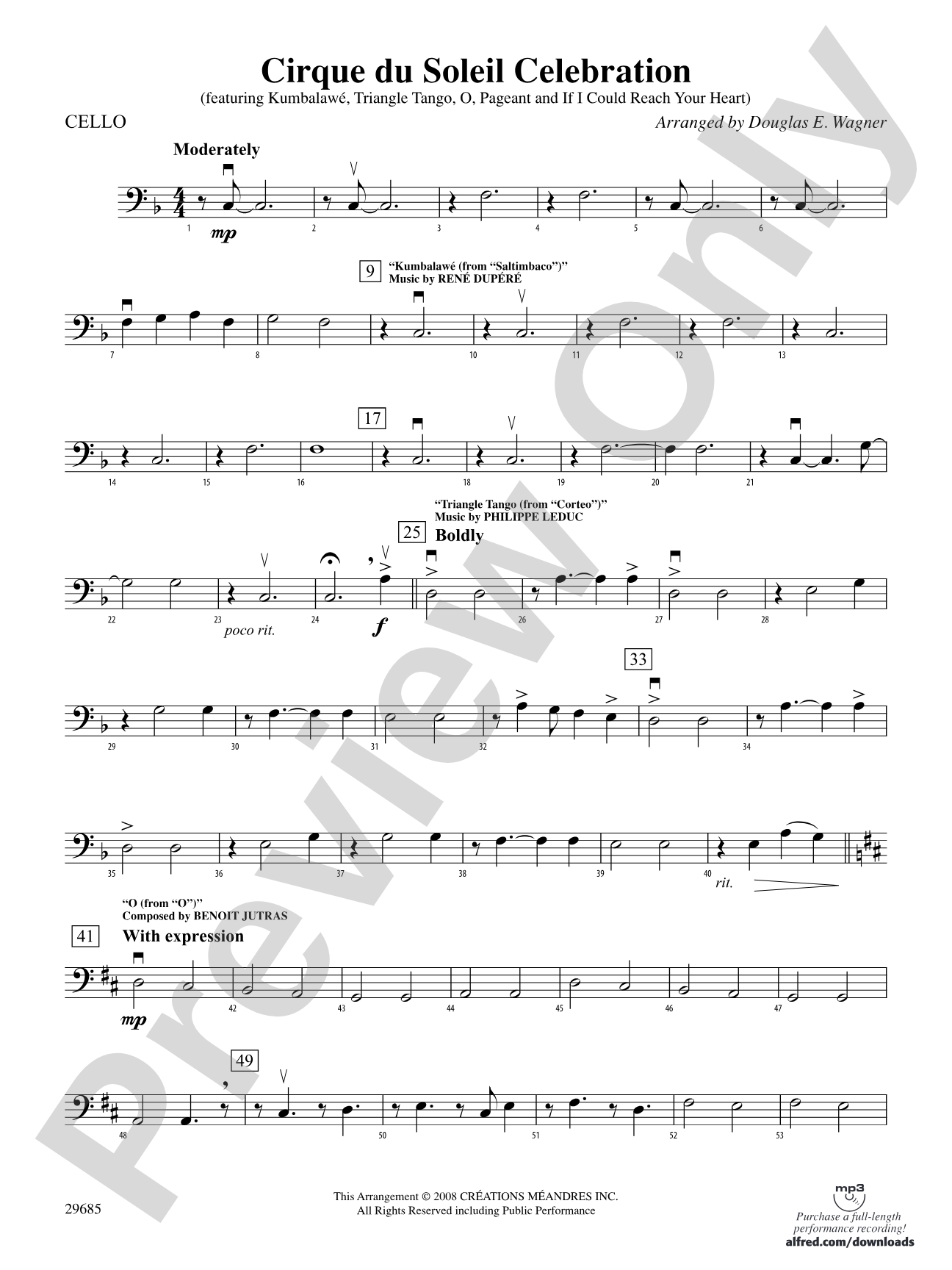

Cirque du Soleil Celebration: Cello
Featuring: Kumbalawé / Triangle Tango / O / Pageant / If I Could Reach Your Heart
Arr. Douglas E. Wagner
Grade: 3
Item: 00-PC-0015710_VC1
$3.00
Pickup currently not available
Description
Experience the magic and allure of Cirque du Soleil! Now for the first time ever, five diverse musical selections, "Kumbalawé," "Triangle Tango," "O," "Pageant" and "If I Could Reach Your Heart," are available in a dynamically scored medley for intermediate orchestra. The arrangement may be performed effectively with strings alone, or with strings and any combination of wind, percussion and keyboard parts, up to full orchestra. An emotionally charged experience not to be missed! (3:50)


Don't just read it, hear it, play along with it, and watch your students grow with it. In MakeMusic Cloud, Cirque du Soleil Celebration: Cello comes alive with professional accompaniment, adjustable tempo, and built-in practice tools that turn solo practice into real progress.
Open in the Player
Jump straight in and assign it today.
Start Your Free Trial
Open this title and explore the full library in minutes.
Sample Audio
1
Audio File
--:--
0:00
0:00
Sample Video
No sample videos found.
Additional Details
Series:
Pop Intermediate String/Full Orchestra
Publisher:
Alfred Music
Page Count:
238
SKU:
00-PC-0015710_VC1
More about this title
About the Arranger: Douglas E. Wagner

Douglas E. Wagner brought three decades of high school music leadership into his composition and arrangement work, building deep understanding of what student ensembles can achieve across all age levels. Based in Indianapolis, Wagner has published over 3,500 titles across multiple genres and ensembles since 1973, with his music performed in concert halls and on broadcasts worldwide. His output spans choral literature, concert band, orchestra, handbell, organ, piano, and vocal music, with more than seventeen million copies in circulation.
Wagner holds both undergraduate and graduate degrees in music from Butler University. His background as an educator and administrator directly informs his approach to arrangement: he writes music that respects the capacities of developing musicians while maintaining genuine artistic substance.
Why we love this
Wagner has threaded five iconic Cirque du Soleil moments into a single medley that works seamlessly whether your orchestra is strings only or fully instrumented. The Grade 3 scoring is genuinely intermediate without oversimplifying the source material; students engage with the theatrical character and emotional sweep of Cirque while staying grounded in technique they can master. Programming this gives you a contemporary showstopper that feels special without demanding virtuosity you don't have.
What to expect
Lush and playful by turns, this medley captures the visual wonder and emotional depth Cirque du Soleil builds into each show. You move from the exotic percussion sparkle of "Kumbalawé" through the tango's dramatic swagger, into the serene beauty of "O," giving students and listeners a complete theatrical journey that feels earned rather than cartoonish.
Who it's for
Intermediate full orchestras seeking contemporary concert repertoire that brings ensemble and audience energy without requiring advanced technical facility. Directors programming family concerts, pops series, or festival events will find this medley immediately engaging and flexible enough to adapt to whatever instrumentation they have available.
How to get the most out of it
- Balance the medley's tonal shifts by attending to dynamics between selections; each segment has its own harmonic world, so slight tempo breathing between pieces prevents them from blurring together.
- Lean into the percussion parts to clarify rhythmic character, especially in "Triangle Tango" where groove matters as much as pitch.
- Use optional wind and keyboard parts strategically rather than all at once; adding layers as the medley progresses builds momentum naturally.
- Pay attention to string articulation and vibrato choices to match the theatrical mood of each segment; "Kumbalawé" and "O" benefit from warmth, while "Triangle Tango" reads better with precision.
How to use it
Place this as an act finale or as the centerpiece of a themed concert pairing it with other contemporary world music or pop-influenced repertoire. Its 3:50 length and immediate accessibility make it ideal for building a "greatest hits" style program, and the flexibility of instrumentation means you can perform it early in the season to build confidence before tackling heavier literature.
Skills your students will build
- Balancing mixed orchestration (strings with optional winds and percussion)
- Navigating style changes and tempo/mood shifts within a single piece
- Reading parts that range from straightforward to moderately complex within the same work
- Responding to theatrical and programmatic music direction
- Maintaining ensemble cohesion across multiple distinct musical sections