
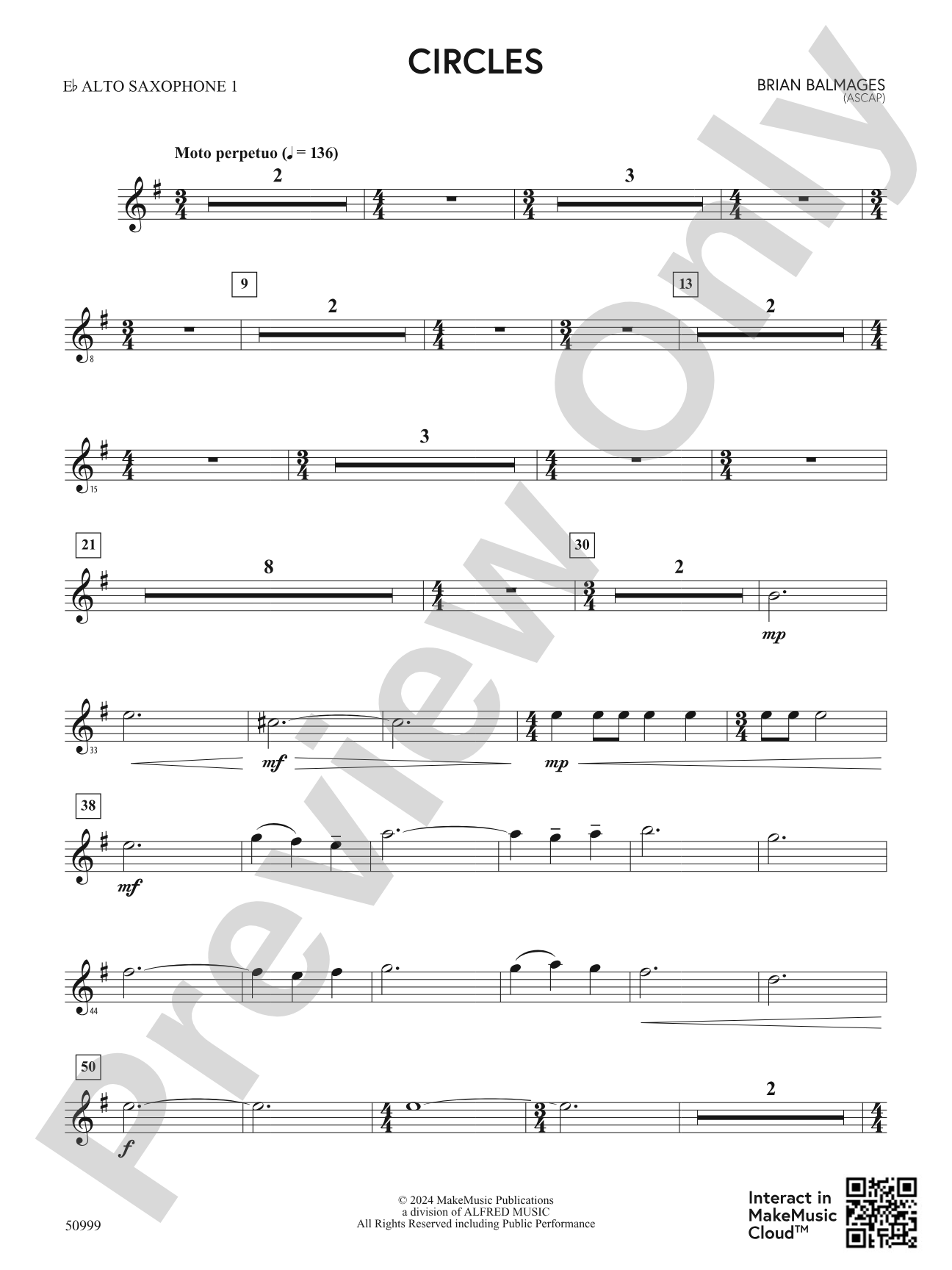

Circles: E-flat Alto Saxophone
By Brian Balmages
Grade: 3
Item: 00-PC-0019215_AX1
$3.00
Pickup currently not available
Description
Circles is a timeless, impressionistic work portraying a dark void with various colored circles aimlessly spinning around and gently colliding with each other. Brian Balmages uses wildly vivid colors throughout the work, which are incredibly unique for this level. Combine that with an extraordinary ending, and your audience is in for an amazing experience! (4:00)


Don't just read it, hear it, play along with it, and watch your students grow with it. In MakeMusic Cloud, Circles: E-flat Alto Saxophone comes alive with professional accompaniment, adjustable tempo, and built-in practice tools that turn solo practice into real progress.
Open in the Player
Jump straight in and assign it today.
Start Your Free Trial
Open this title and explore the full library in minutes.
Sample Audio
1
Audio File
--:--
0:00
0:00
Sample Video
Additional Details
Series:
MakeMusic Young Band
Publisher:
MakeMusic Publications
SKU:
00-PC-0019215_AX1
More about this title
About the Composer: Brian Balmages

Brian Balmages has established himself as a composer and conductor working across orchestral, band, and chamber music with equal facility. His works have been heard in major concert halls including Carnegie Hall, the Kennedy Center, and Sydney Opera House, performed by ensembles ranging from professional orchestras to school bands. He earned the A. Austin Harding Award from the American School Band Directors Association and won the 2020 NBA William D. Revelli Composition Contest. An elected member of the American Bandmasters Association, Balmages received the inaugural James Madison University Distinguished Alumni Award and was commissioned by the University of Miami to compose for the presidential inauguration. His music was performed at the 2013 Presidential Inaugural Prayer Service attended by President Obama and Vice President Biden.
As a conductor, Balmages regularly guests with all-state, regional, university, and professional ensembles worldwide. He has conducted at the Midwest Clinic, Western International Band Clinic, College Band Directors Conference, American School Band Directors Association National Conference, and international venues including Teatro dell'Aquila in Italy. He currently serves as Director of MakeMusic Publications and Digital Education for Alfred and MakeMusic.
Why we love this
Balmages crafts an unusually sophisticated sound world for Grade 3, deploying vivid orchestration and unexpected harmonic colors that students and audiences rarely encounter at this level. The journey from impressionistic darkness to an extraordinary climax gives your band genuine dramatic arc to shape, making this rewarding repertoire that respects young musicians' interpretive capabilities. It's also contest and festival ready, so you gain polished, stageable programming without sacrificing musicianship.
What to expect
A slow meditation on darkness punctuated by moments of gentle motion. Various timbral washes suggest colored shapes drifting and touching in an abstract space, creating an almost cinematic quality. The extraordinary ending arrives like sudden illumination, transforming the entire emotional landscape from introspective to radiant.
Who it's for
Grade 3 concert bands with solid fundamentals and openness to impressionistic color and form. This works well for ensembles that have learned to balance layered textures and respond to subtle dynamic and timbral shifts. Directors programming bands ready for contest or festival repertoire that stretches musical thinking beyond traditional forms.
How to get the most out of it
- Balance the spinning circles as textural layers rather than competing solo lines. Highlight the way different instrumental choirs pass the impressionistic material to create the sense of objects moving through space.
- Resist pushing the tempo during the build to the ending. Let the accumulation happen through density and orchestration rather than acceleration; this makes the final climax land with genuine impact.
- Shape the gentler collisions early in the piece with soft dynamic transitions and careful blend. These quieter moments establish the void before the ending transforms everything.
How to use it
Program this as a concert centerpiece capable of standing alongside more traditional Grade 3 fare; its impressionistic language and dramatic arc give audiences something genuinely memorable. It also serves contest and festival schedules exceptionally well, offering sophistication and maturity that adjudicators recognize and reward.
Skills your students will build
- Balancing multiple independent melodic lines within a single texture
- Responding to subtle dynamic gradations and timbral color changes
- Understanding impressionistic form and how climax develops through orchestration rather than traditional harmonic progression
- Listening critically to blend and intonation across different instrumental families
- Executing soft attacks and releases with precision and ensemble unison