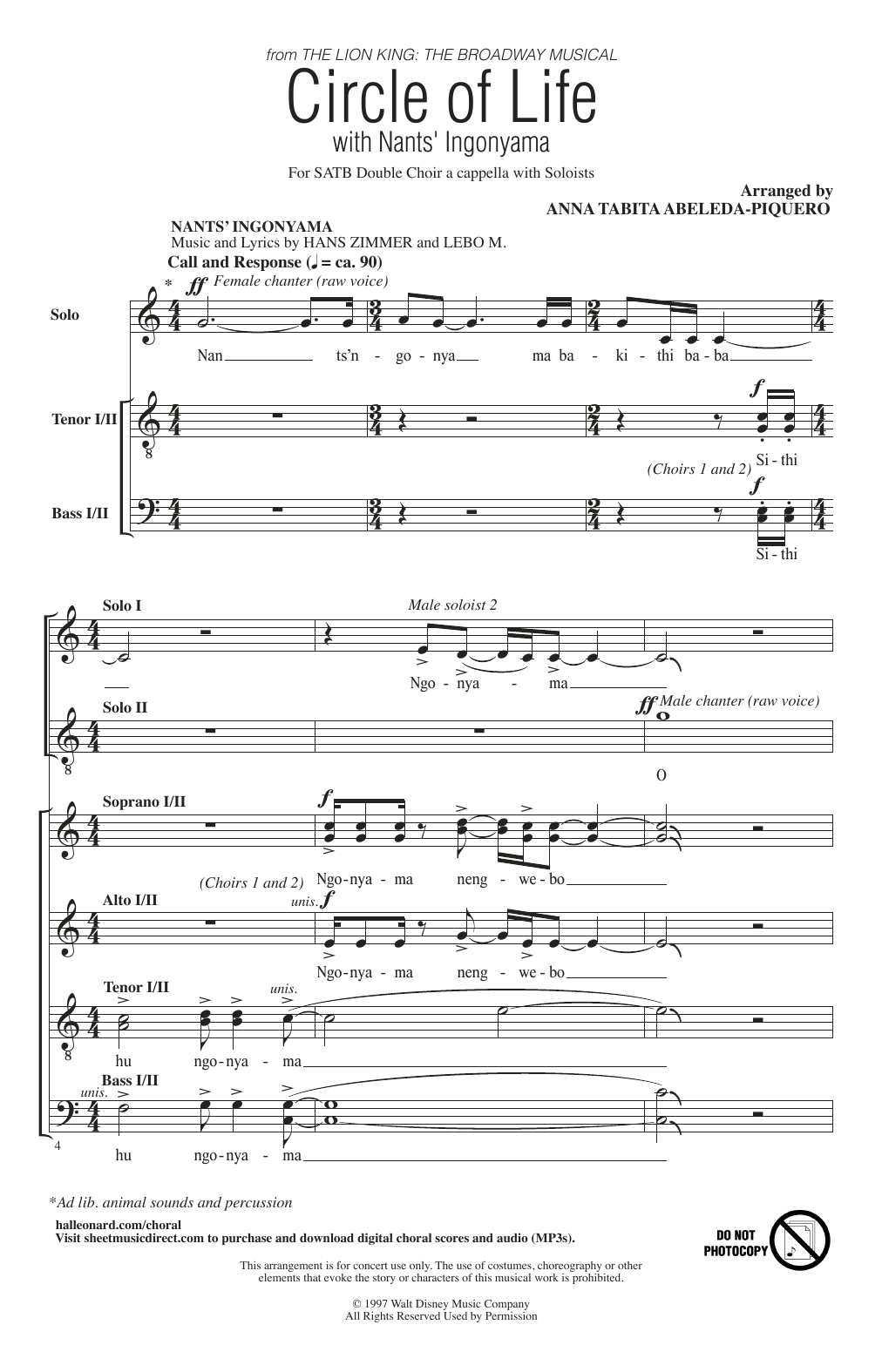
Circle Of Life with Nants' Ingonyama (arr. Anna Tabita Abeleda-Piquero) Sheet Music Preview

Circle Of Life with Nants' Ingonyama (arr. Anna Tabita Abeleda-Piquero): SATB, Double Choir Choral Octavo

Arranged by Anna Tabita Abeleda-Piquero

Item: 35-DS01817808

Digital Download
$3.50
Description

Circle Of Life with Nants' Ingonyama (arr. Anna Tabita Abeleda-Piquero): SATB, Double Choir Choral Octavo isn't in MakeMusic Cloud just yet...but it could be. Let us know you'd like to see it, and you'll help shape what comes next. In the meantime, start a free trial and dive into thousands of interactive titles your students can play along with today.

Sample Audio
No sample audio found.
Sample Video
Additional Details
Publisher: Hal Leonard
Page Count: 23
SKU: 35-DS01817808

More about this title

Why we love this

Abeleda-Piquero's arrangement honors the iconic opening while layering in the Zulu vocals that give the piece its cultural spine. The double choir texture creates genuine depth without asking for complex divisi work, and the a cappella setting means you can perform it anywhere, anytime, with instant impact.

What to expect

Opening with raw, primal Zulu vocals before the melody emerges feels like the curtain lifting on something vast. The double choir creates an almost orchestral fullness, with voices stacking and weaving in ways that feel both organic and carefully crafted.

Who it's for

Choirs with strong singers who can hold their own in divisi sections and an audience ready to be moved by something immediately recognizable yet culturally grounded. This works for high school honor choirs, college ensembles, and community choirs looking for a showstopper.

How to get the most out of it

  • Anchor the entrance of 'Nants ingonyama' with your deepest basses; let that phrase sit in the room before the sopranos enter with the familiar melody.
  • Treat the transition between the Zulu section and 'Circle of Life' as a moment of musical arrival rather than a gear shift. Shape the dynamic arch across both phrases as one long arc.
  • Blend the two choirs by rehearsing them separately first, then gradually combining them so each voice understands its role in the overall sonority.
  • Pay close attention to any rhythmic or textural shifts where one choir answers the other. These moments need clarity to land.

How to use it

Consider pairing this with other film music or global repertoire to create a thematic concert section. It's also strong enough to anchor a standalone moment of the program where you want the audience genuinely still before moving to the next piece.

Skills your students will build

  • Blending two independent choir parts while maintaining clarity
  • Singing in Zulu with accurate pronunciation and confidence
  • Managing dynamic control in an a cappella setting without instrumental support
  • Understanding call-and-response phrasing across multiple voice parts

You May Also Like