
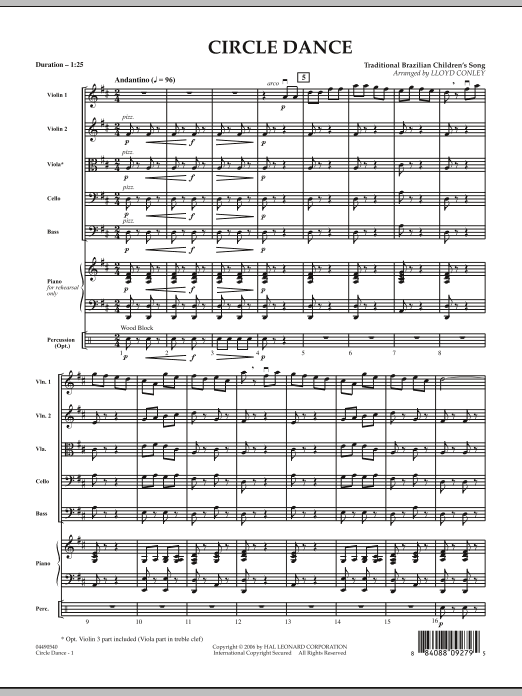

Circle Dance: String Orchestra Conductor Score & Parts
Arranged by Lloyd Conley
Grade: 2-3
Item: 35-PK00143332
$40.00
Pickup currently not available
Buy Extra Parts (Digital PDF Download)
| Product | Price | Quantity |
|---|---|---|
| Circle Dance - Full Score | $6.00 | |
| Circle Dance - Violin 1 | $7.00 | |
| Circle Dance - Violin 2 | $7.00 | |
| Circle Dance - Violin 3 (Viola T.C.) | $7.00 | |
| Circle Dance - Viola | $7.00 | |
| Circle Dance - Cello | $7.00 | |
| Circle Dance - String Bass | $7.00 | |
| Circle Dance - Piano | $7.00 | |
| Circle Dance - Percussion | $7.00 |
Parts Added to Cart!
Description
From veteran educational writer and teacher Lloyd Conley comes this solid teaching piece for developing strings, using a popular Early music dance form with strong intervals and great ensemble writing. Dur: 1:25


Circle Dance: String Orchestra Conductor Score & Parts isn't in MakeMusic Cloud just yet...but it could be. Let us know you'd like to see it, and you'll help shape what comes next. In the meantime, start a free trial and dive into thousands of interactive titles your students can play along with today.
Request This Title
Tell us you want it.
Start Your Free Trial
Explore everything that's ready to play right now.
Sample Audio
No sample audio found.
Sample Video
No sample videos found.
Additional Details
Publisher:
Hal Leonard
SKU:
35-PK00143332
More about this title
About the Arranger: Lloyd Conley
Lloyd Conley has spent decades writing music that meets students where they are. His arrangements and original compositions consistently balance pedagogical clarity with genuine musical substance, making him a trusted voice among string teachers and conductors who refuse to compromise on either front.
Why we love this
Conley understands that Grade 2-3 students need pieces with real musical architecture, not just note-reading exercises. Circle Dance delivers exactly that: a framework rooted in historical dance forms that gives shape to every measure while keeping the technical demands focused on what matters most at this level.
What to expect
Grounded and graceful. The early music idiom brings a quality of intentionality to every gesture, and strong intervallic writing keeps the harmony warm without overwhelming younger players. There's a sense of movement and purpose throughout that makes students feel like they're performing actual music rather than completing an assignment.
Who it's for
Developing string orchestras looking for Grade 2-3 repertoire that respects both their current abilities and their growing musicality. This works equally well for teachers refreshing their mid-year concert programming or directors building foundation skills in an expanding ensemble.
How to get the most out of it
- Establish a clear pulse before rehearsal begins. Having students conduct the main beat pattern themselves during the first run-through builds internal ownership of the tempo.
- Highlight the dialogue between sections whenever it appears. Asking which stands are answering which questions turns listening into an active skill rather than a passive habit.
- Balance the melody across your violin sections rather than isolating it to first violins alone. This distributes responsibility and prevents fatigue on any single part.
- Let the dance form breathe. Early music feels stiff when conductors rush; give each phrase room to settle before moving forward.
How to use it
Pair this with a contrasting Romantic or contemporary work to give your concert shape and historical breadth. At under two minutes, it also serves as an ideal opener for a spring concert, setting a clear musical tone before moving into longer or more complex pieces.
Skills your students will build
- Reading and performing Early music idioms (articulation, phrasing conventions)
- Sustaining clear tone while maintaining ensemble precision
- Listening for and balancing independent melodic lines across sections
- Understanding phrase structure through dance form conventions
- Intonation in intervallic writing with emphasis on thirds and fifths