
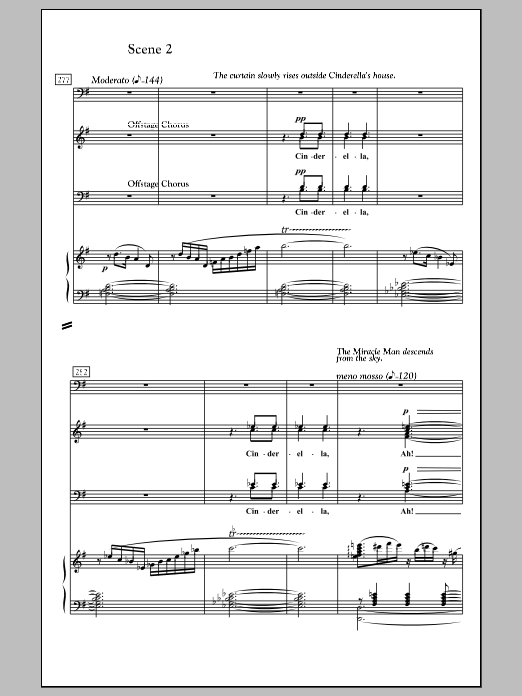

Cinderella and the Miracle Man: String Orchestra Conductor Score & Parts
Arranged by Jack Jarrett
Item: 35-PK00279225
$37.85
Pickup currently not available
Buy Extra Parts (Digital PDF Download)
Parts Added to Cart!
Description
The traditional Cinderella story, with the Fairy Godmother replaced by a baritone Miracle Man. Full Orchestra, ballet sequence, on-and-offstage choruses, magical effects. Duration: 80:00


Cinderella and the Miracle Man: String Orchestra Conductor Score & Parts isn't in MakeMusic Cloud just yet...but it could be. Let us know you'd like to see it, and you'll help shape what comes next. In the meantime, start a free trial and dive into thousands of interactive titles your students can play along with today.
Request This Title
Tell us you want it.
Start Your Free Trial
Explore everything that's ready to play right now.
Sample Audio
No sample audio found.
Sample Video
No sample videos found.
Additional Details
Publisher:
Hal Leonard
SKU:
35-PK00279225
More about this title
Why we love this
An 80-minute narrative work that gives string orchestras genuine theatrical ownership of a beloved story. The substitution of a baritone Miracle Man for the traditional Fairy Godmother opens up dramatic possibilities while the inclusion of ballet sequences, onstage and offstage choruses, and magical effects transforms a string orchestra into a complete musical theater force.
What to expect
A story told through shimmering string textures and sweeping orchestral colors, punctuated by moments of genuine magic. The baritone voice emerges as an agent of transformation, grounded in the orchestra's support. Moments of dance lighten the narrative, while the overall arc builds toward the familiar emotional satisfaction of the Cinderella tale.
Who it's for
String orchestras seeking a full-length theatrical work that doesn't require winds or brass. Directors wanting to give advanced students experience with extended narrative scoring, theatrical pacing, and collaboration with soloists and dancers.
How to get the most out of it
- Treat the baritone soloist as a true character rather than a voice floating above the orchestra; balance the vocal line so it drives the narrative forward while strings provide textured support, not accompaniment.
- Plan your staging for the ballet sequences well in advance. Coordinate with dancers or staging designers early enough that the orchestra's pacing accommodates movement without rushing or dragging.
- Use the offstage chorus moments to create spatial depth; positioning singers away from the main stage heightens the magical atmosphere and gives your string players visual focus points.
- Pay particular attention to dynamic control during the magical effects cues. Strings often carry these moments, so ensemble precision and careful attention to articulation will make technical effects land theatrically.
How to use it
This work functions as a complete concert event or the centerpiece of a spring season focused on narrative music theater. It also offers a compelling alternative to standard symphony programming when you want to showcase orchestral storytelling to a broader audience while keeping the musical demands within reach of developing string ensembles.
Skills your students will build
- Reading and executing ballet timing cues
- Coordinating with solo vocalists in extended passages
- Managing dynamic contrast across sustained string textures
- Ensemble balance across divided string parts
- Sight-reading theatrical notation and cueing systems