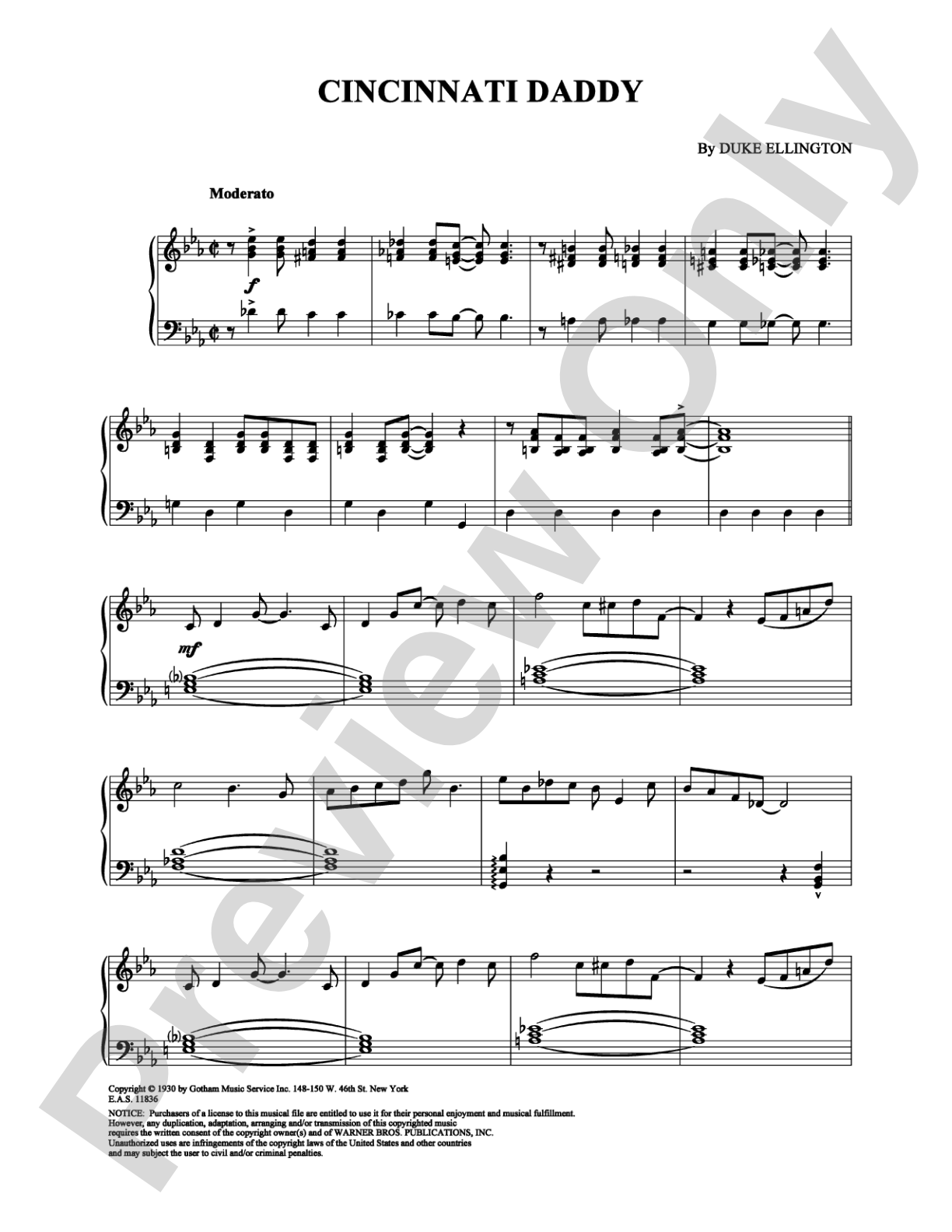
Cincinnati Daddy: Piano Digital Sheet Music

Cincinnati Daddy: Piano Digital Sheet Music

Duke Ellington

Item: 00-PS-0008198

Digital Download
$3.99
Description

Cincinnati Daddy: Piano Digital Sheet Music isn't in MakeMusic Cloud just yet...but it could be. Let us know you'd like to see it, and you'll help shape what comes next. In the meantime, start a free trial and dive into thousands of interactive titles your students can play along with today.

Sample Audio
No sample audio found.
Sample Video
Additional Details
SKU: 00-PS-0008198

More about this title

About the Artist: Duke Ellington

Duke Ellington (1899, 1974) fundamentally transformed what jazz could be. As a composer, bandleader, and pianist, he created a body of work that moved seamlessly between the dance floor, the concert hall, and the recording studio, elevating jazz to an art form that demanded serious musical attention. His harmonic sophistication and orchestral thinking influenced generations of composers across all genres.

For music educators, Ellington's catalog offers something rare: compositions that work equally well as teaching tools and as genuine artistic statements. His piano pieces reveal the mechanics of his compositional process while remaining deeply musical and rewarding to perform.

Why we love this

Ellington's piano writing speaks directly to the instrument's capabilities without requiring transcendental technique. This standard sits perfectly for pianists deepening their jazz vocabulary and understanding how a master composer shapes melody and harmony within the jazz idiom.

What to expect

Cincinnati Daddy swings with urbane ease, balancing humor and elegance. The tune floats above its changes with the kind of effortless swing that makes jazz sound simple until you sit down to play it, then you discover the craftsmanship underneath.

Who it's for

Jazz pianists building repertoire in the American standards tradition, ensemble pianists learning to accompany or solo over changes, and players seeking to understand how Ellington bridged swing-era composition with harmonic sophistication. High school and college jazz programs find this accessible yet substantive.

How to get the most out of it

  • Treat the melody as a vocalist would: lean into the phrases, shape the line for singing quality, and let the rhythmic variations breathe rather than rigidly metronomic
  • Pay attention to voicing clarity in the left hand; Ellington's harmonic language is intricate, and muddiness obscures the compositional wit
  • Experiment with the stride bass figures and comping rhythms; Ellington wrote them as frameworks, not inflexible rules

How to use it

Feature this in jazz band or combo settings as a solo vehicle or ensemble feature. It works as a duet with horns, a piano trio feature, or a lead sheet for improvisation study in classroom jazz ensembles. The familiar standard repertoire context makes it ideal for student recitals and informal jazz showcases.

Skills your students will build

  • Jazz phrasing and articulation over swing changes
  • Voicing jazz chords idiomatically for solo piano
  • Reading and interpreting Ellington's compositional style
  • Improvisation over a standard chord progression
  • Left-hand stride and comping patterns in the jazz idiom

You May Also Like