Cimarron Overture: 1st Percussion Sheet Music Preview

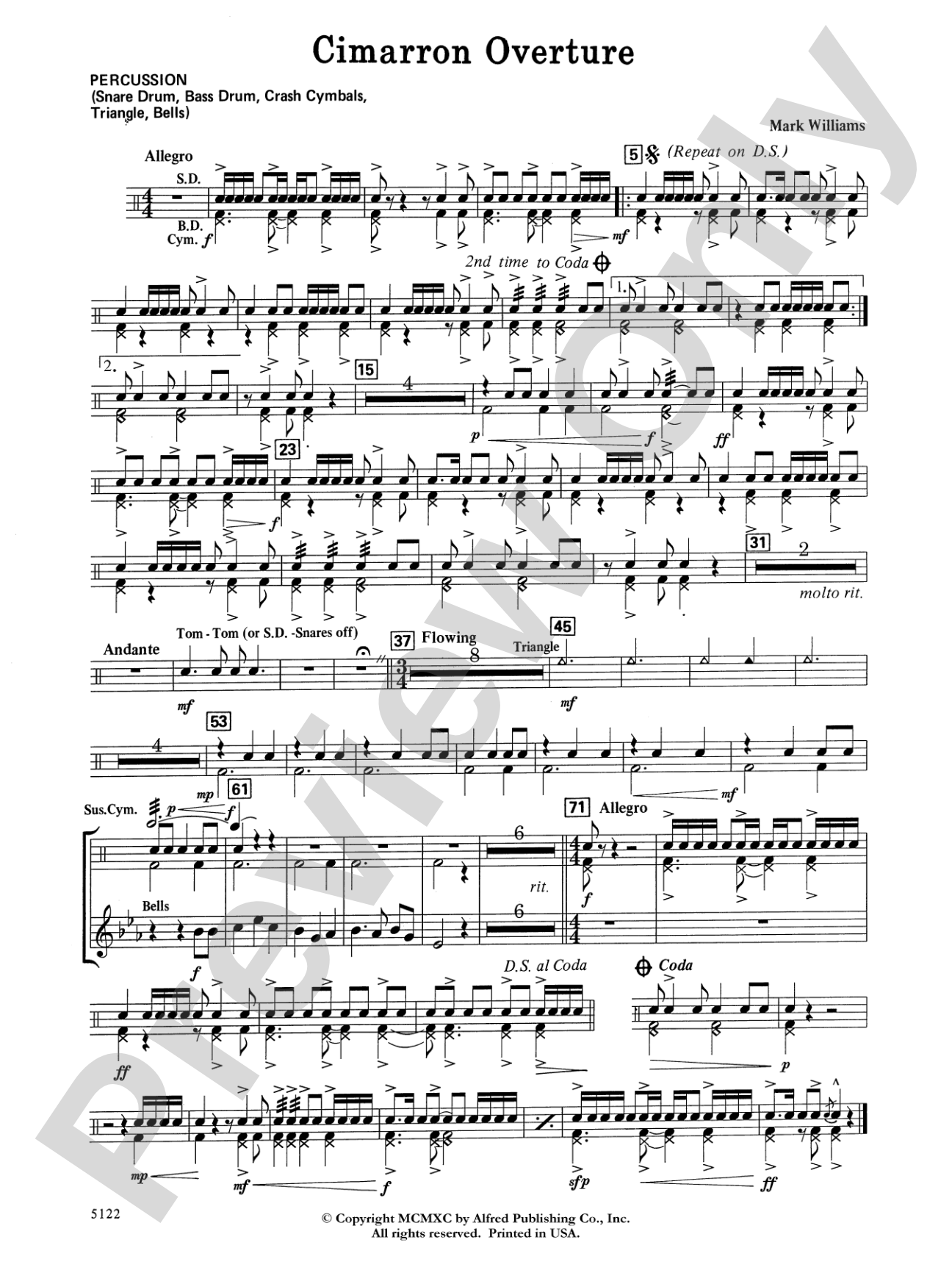
Cimarron Overture: 1st Percussion

By Mark Williams

Grade: 1.5 (Easy)

Item: 00-PC-0001870_PC1

Digital Download
$3.00
Description
A bright selection with strong melodic themes that will impress your audience and keep your students motivated during rehearsals. The first theme features an interesting syncopated pattern that is accented by fun-to-play percussion parts. The second theme is a flowing, reflective melody that is played by the oboe and supported by clarinets and triangle accents. The Allegro first theme returns and builds to a powerful closing. (Grade 1-1/2---Easy)

Don't just read it, hear it, play along with it, and watch your students grow with it. In MakeMusic Cloud, Cimarron Overture: 1st Percussion comes alive with professional accompaniment, adjustable tempo, and built-in practice tools that turn solo practice into real progress.

Sample Audio
No sample audio found.
Sample Video
Additional Details
Series: Contempo Series
Publisher: Alfred Music
Page Count: 112
SKU: 00-PC-0001870_PC1

More about this title

About the Composer: Mark Williams

Mark Williams

Mark Williams built his reputation as a prolific composer with more than 200 published works for school bands, orchestras, and choirs. A Chicago native who spent formative years in Spokane, Washington, he taught elementary band throughout the state while earning both his Bachelor of Arts in Education and Master of Education from Eastern Washington University. He performed bassoon professionally with the 560th Air Force Band and later served as conductor and artistic director for the Spokane British Brass Band.

Williams' influence extended far beyond the classroom. His collaborations on the Accent on Achievement Band Method shaped instruction across the country, while his work as a clinician and guest conductor took him to 34 states, five Canadian provinces, and Australia. His compositions garnered recognition including the Western International Band Clinic's Gralia Competition and multiple ASCAP Special Awards, establishing him as one of the most significant voices in school band literature.

Why we love this

Williams writes with the elementary and beginning band director in mind, and that practicality shines here. The syncopated first theme keeps students engaged with rhythmic interest that's accessible but not trivial, while the reflective second theme gives your ensemble space to develop musicality and control. The structure builds naturally to a satisfying close, making it a genuine crowd-pleaser without requiring technical complexity.

What to expect

Bright, energetic, and genuinely tuneful. The opening syncopation has a forward-moving swagger that commands attention, while the oboe melody in the middle section invites listeners into a moment of reflection before the piece surges back to life. The whole arc feels like a confident statement from a young ensemble.

Who it's for

This overture suits Grade 1.5 concert bands that are ready for structured thematic writing and layered orchestration. Directors programming festival or contest appearances will find a selection that showcases students' progress without exceeding their technical reach.

How to get the most out of it

  • Keep the syncopated opening theme tight and rhythmically clean; the fun lies in precision, not rushing the off-beat accents.
  • Feature the oboe soloist in the second theme and let the supporting clarinet and triangle parts breathe underneath rather than dominate.
  • Build the final return of the Allegro theme gradually across the full ensemble; avoid bringing everything in at once and instead layer sections to create momentum toward the closing.

How to use it

Program this as an opener or closer to a concert of Grade 1-2 repertoire; its clear structure and strong melodic content provide excellent bookends for a program. It also works well as a festival selection where judges appreciate writing that balances accessibility with musical substance.

Skills your students will build

  • Performing syncopated rhythms with clean articulation and consistent pulse
  • Balancing solo and accompaniment roles within the ensemble
  • Layering dynamics and orchestration to build momentum toward a climax
  • Responding to contrasting thematic material (energetic vs. reflective)

You May Also Like