
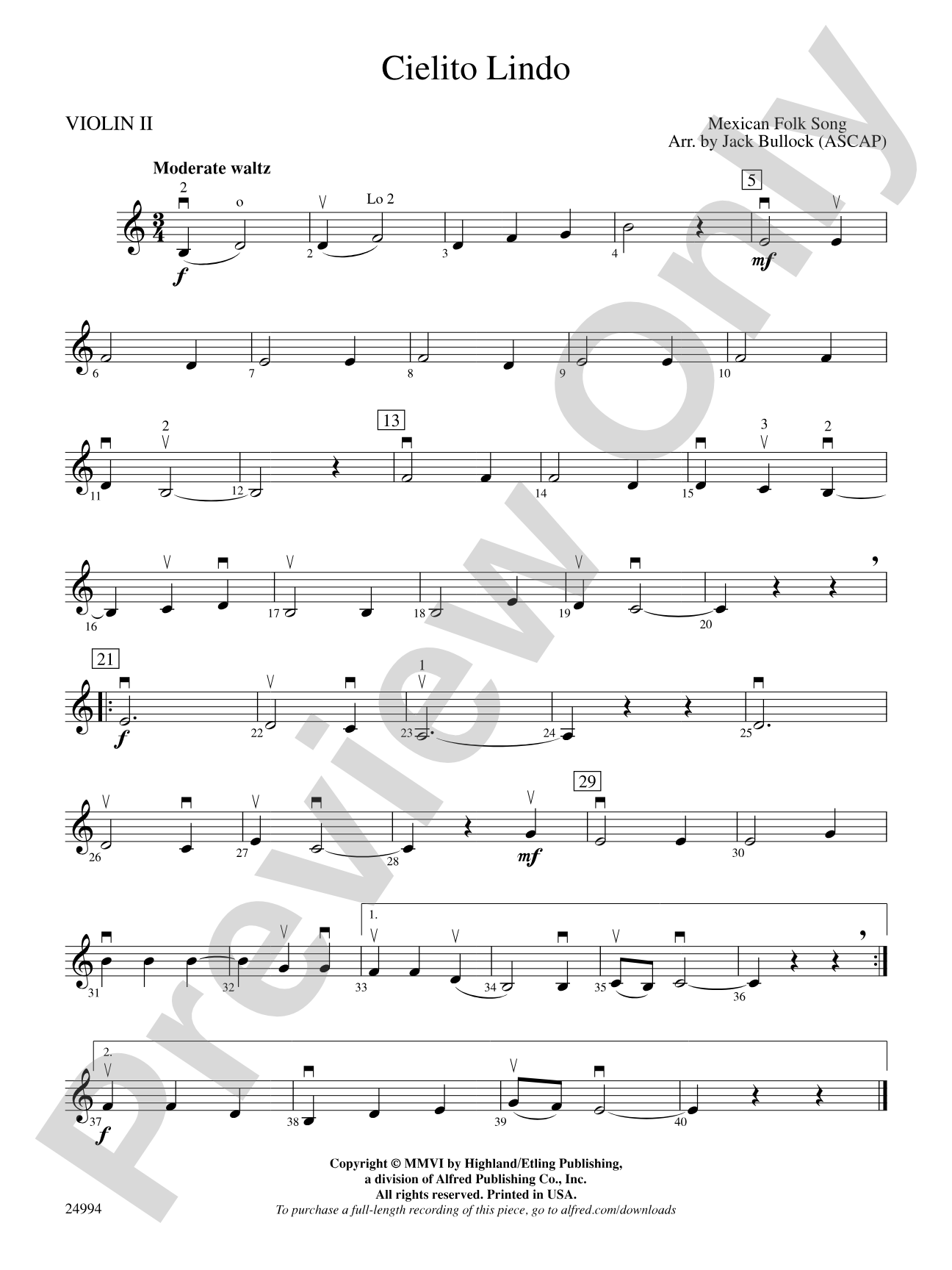

Cielito Lindo: 2nd Violin
Mexican Folk Song / arr. Jack Bullock
Grade: 1.5
Item: 00-PC-0000976_VN2
$5.99
Pickup currently not available
Description
This familiar folk song from Mexico, arranged for beginning String Orchestra, is a perfect work to introduce multicultural music in the instrumental music curriculum. The arrangement, which correlates with Orchestra Expressions™ Book One, can be performed effectively at different tempos from mm = 90 to 120, depending upon the ability of the performers. The moderately easy piano accompaniment is optional and can be performed by a student pianist if desired. Fun to play for the students and good performance music for parents at the next concert.


Don't just read it, hear it, play along with it, and watch your students grow with it. In MakeMusic Cloud, Cielito Lindo: 2nd Violin comes alive with professional accompaniment, adjustable tempo, and built-in practice tools that turn solo practice into real progress.
Open in the Player
Jump straight in and assign it today.
Start Your Free Trial
Open this title and explore the full library in minutes.
Sample Audio
1
Audio File
--:--
0:00
0:00
Sample Video
No sample videos found.
Additional Details
Series:
Orchestra Expressions
Publisher:
Alfred Music
Page Count:
64
SKU:
00-PC-0000976_VN2
More about this title
About the Arranger: Jack Bullock

Jack Bullock brings a performer's instinct and decades of classroom experience to every arrangement he writes. A trumpet player who performed with the Miami Philharmonic Orchestra and Miami Opera Company, Bullock spent 20 years teaching instrumental music in schools, including seven years as an assistant band director at Ithaca College's School of Music, where he later chaired the Music Education Department. His work shaped generations of students through both direct instruction and the curricula he helped develop.
With over 600 published works across concert band, orchestra, jazz ensemble, and marching band, Bullock has established himself as a prolific and trusted voice in music education publishing. He is a co-author of the Belwin 21st Century Band Method and contributed arrangements to Music Expressions, Alfred Music's innovative school curriculum. A member of ASCAP since 1980, Bullock has conducted clinics and workshops throughout North America and Europe, consistently connecting repertoire choices to what works in real rehearsals.
Why we love this
This arrangement respects both the melody's authenticity and your students' reading level, refusing to oversimplify either. Bullock's experience in the rehearsal room shows in how he voices the parts: every section has something to play, the rhythms sit naturally under the fingers, and the optional piano accompaniment gives you flexibility depending on who's available any given week.
What to expect
Bright and approachable, with a gently lilting rhythm that students recognize immediately. The arrangement preserves the folk tune's warmth while giving each section clear, playable lines that don't require advanced technique to sound musical.
Who it's for
Beginning string orchestras ready for their first dip into world music literature. This works well for middle school and early high school ensembles at the 1.5 grade level who have solid note-reading skills but limited experience with Latin rhythm and style.
How to get the most out of it
- Explore the tempo range of 90 to 120 BPM across rehearsals to match your ensemble's technical comfort. The slower tempo gives younger players time to track their parts cleanly; the faster tempo brings out the dance character of the piece.
- If you're using the optional piano accompaniment, decide early whether a student pianist will perform it. Having that part covered during rehearsals helps everyone lock into ensemble feel, even if you're still deciding about concert day.
- Balance the melody between first violins and violas in the early phrases. The folk tune is the anchor; other parts should support rather than compete, especially at this early level.
How to use it
Program this as a concert-opening piece or a spring family concert highlight that connects your orchestra to broader cultural traditions. It also works as a natural bridge in repertoire study, moving your group from standard orchestral pieces into multicultural and folk-based literature.
Skills your students will build
- Playing with consistent Latin rhythmic feel and pulse
- Reading ensemble parts that move between unison, octave doublings, and simple counterpoint
- Balancing melody and accompaniment within a string texture
- Adapting interpretation and tempo flexibility based on conductor choices