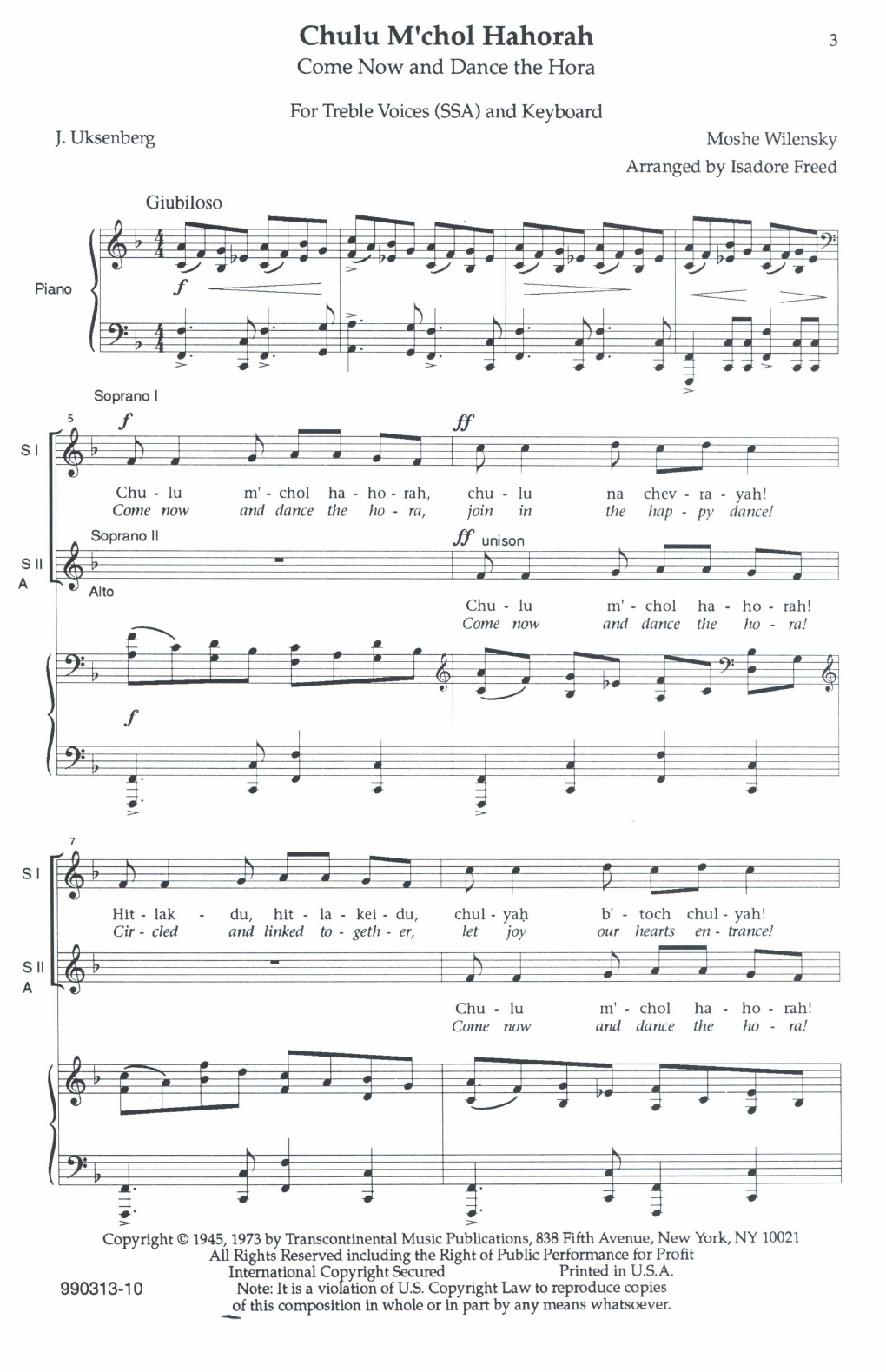
Chulu M'chol Hahora (Come Now And Dance The Hora) Sheet Music Preview

Chulu M'chol Hahora (Come Now And Dance The Hora): SSA Choral Octavo

By Moshe Wilenski / Arranged by Isadore Freed

Item: 35-DS00429349

Digital Download
$2.99
Description

Chulu M'chol Hahora (Come Now And Dance The Hora): SSA Choral Octavo isn't in MakeMusic Cloud just yet...but it could be. Let us know you'd like to see it, and you'll help shape what comes next. In the meantime, start a free trial and dive into thousands of interactive titles your students can play along with today.

Sample Audio
No sample audio found.
Sample Video
Additional Details
Publisher: Hal Leonard
Page Count: 11
SKU: 35-DS00429349

More about this title

About the Composer: Moshe Wilenski

Moshe Wilenski was a founding figure in Israeli folk music and choral composition during the mid-20th century. His work helped establish a distinctly Israeli musical identity by drawing from folk traditions, liturgical sources, and Middle Eastern influences, making his pieces essential repertoire for choirs exploring Jewish musical heritage.

Wilenski's compositions were designed for accessibility without sacrificing artistic integrity. His songs became standards in Israeli schools and cultural institutions, valued both for their melodic clarity and their ability to build community through group singing.

Why we love this

The energy here is contagious without being saccharine. Freed's SSA arrangement captures the infectious quality of the hora while keeping the vocal writing clean and the part independence clear, so singers feel like they're building something together rather than managing a technical challenge. For choirs wanting to perform Jewish repertoire with authentic spirit and modern accessibility, this is exactly the kind of piece that satisfies both audience and singers.

What to expect

Bright, propulsive, and celebratory. The hora's steady rhythmic pulse pulls the listener into motion while the melody sits warmly in the voice, accessible enough that singers can focus on ensemble blend and character rather than technical survival. There's a sense of invitation and inclusion built into the writing, as if the piece itself is calling people to join in.

Who it's for

SSA and SSAA choirs with some rehearsal experience who want accessible, joyful repertoire with cultural substance. This works equally well for high school or community choirs looking to expand their Jewish music collection or for any ensemble seeking a piece that energizes audiences and performers alike.

How to get the most out of it

  • Establish the rhythmic drive early in rehearsal by having the choir snap or clap the pulse before adding text; the hora's forward momentum depends on precise ensemble timing, not aggressive dynamics.
  • Balance the SSA voicing by checking that the soprano line doesn't dominate in unison passages; blend the three parts as if they're moving together rather than in layers.
  • Shape the repeating melodic sections with subtle variation in articulation or vowel color to keep the form interesting without altering the written notes.

How to use it

Position this in a diverse concert to lighten the mood and shift energy after heavier repertoire, or build a thematic program around Jewish cultural traditions where it can sit alongside liturgical works or other folk-inspired arrangements. Its 11 pages and moderate difficulty make it a strong choice for mid-season repertoire that doesn't demand months of preparation.

Skills your students will build

  • Secure ensemble rhythm in repeated sections
  • Blending three-part textures with balanced sonority
  • Stylistic interpretation of folk material
  • Text clarity and diction in Hebrew transliteration

You May Also Like