
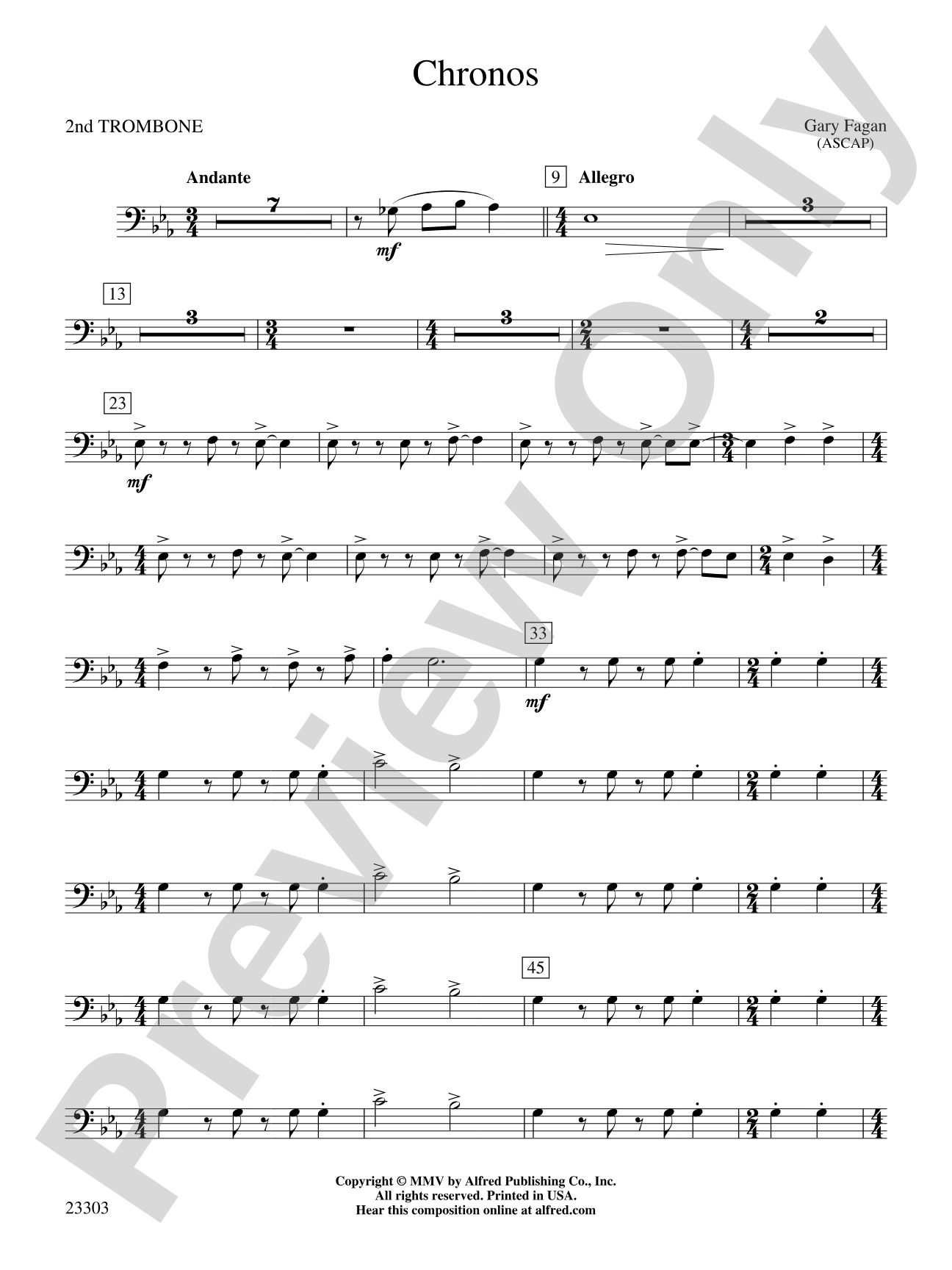

Chronos: 2nd Trombone
By Gary Fagan
Grade: 2.5 (Medium Easy)
Item: 00-PC-0000653_TN2
$3.00
Pickup currently not available
Description
Filled with syncopation and frequent meter changes, this powerful new work by Gary Fagan will leave your audience wanting more! While rhythm plays an important role, the contemporary melodies and harmonies add a fresh perspective. Great fun!


Don't just read it, hear it, play along with it, and watch your students grow with it. In MakeMusic Cloud, Chronos: 2nd Trombone comes alive with professional accompaniment, adjustable tempo, and built-in practice tools that turn solo practice into real progress.
Open in the Player
Jump straight in and assign it today.
Start Your Free Trial
Open this title and explore the full library in minutes.
Sample Audio
1
Audio File
--:--
0:00
0:00
Sample Video
No sample videos found.
Additional Details
Series:
Young Symphonic
Publisher:
Alfred Music
Page Count:
268
SKU:
00-PC-0000653_TN2
More about this title
About the Composer: Gary Fagan

Gary Fagan brings three decades of classroom experience to his compositions, having directed bands in Albemarle County for 36 years before transitioning to university teaching. A Bridgewater College graduate with a master's degree from James Madison University, he has earned recognition as Central Virginia's Outstanding Middle School Teacher and received multiple educator awards from the Virginia Governor's School and the Piedmont Council of the Arts.
Fagan's work has reached audiences across the country, from the Midwest Band and Orchestra Clinic to performances at the White House and a gubernatorial inauguration. Active as a clinician, adjudicator, and arranger, he currently serves as a University Supervisor at JMU and performs as a percussionist with the Charlottesville Band, where he also serves as Assistant Director. He holds memberships in ASCAP, the National Band Association, and Phi Beta Mu Bandmasters Fraternity.
Why we love this
Fagan writes rhythmically compelling music that engages students without demanding virtuosic technique, making this piece ideal for building confidence in intermediate bands. The contemporary harmonic language and syncopated writing feel current and energetic, yet the accessible Grade 2.5 level ensures your ensemble can execute his vision convincingly. Directors consistently find his work rewarding to rehearse because the rhythmic challenges drive musical growth while the melodic content keeps both players and audiences genuinely interested.
What to expect
Chronos pulses with kinetic energy driven by its syncopated figures and shifting meters, creating a sense of forward propulsion that feels modern and vital. The contemporary melodic and harmonic palette gives the piece an intellectual edge without sacrificing accessibility, resulting in music that feels both exploratory and genuinely fun to play.
Who it's for
Concert bands at the high school or advanced middle school level, particularly ensembles with solid fundamentals who are ready for rhythmic independence and contemporary harmonic language. This work also suits college and university bands looking for an accessible yet engaging opener or filler piece that reads fresh without excessive rehearsal demand.
How to get the most out of it
- Isolate the syncopated passages in sectional rehearsals before blending them into the full texture; have each section speak the rhythm aloud to internalize the forward momentum.
- Mark the meter changes clearly in the parts and conduct them distinctly so players understand where the pulse sits within each new time signature.
- Balance the contemporary harmonies by listening for vertical alignment in the wind sections; unison or octave doublings will sound muddy if intonation wavers.
- Record a run-through early and listen for drag in the syncopated sections; many groups instinctively slow down when navigating rhythmic complexity.
How to use it
Program this at the top of a concert to establish energy and signal to your audience that your ensemble embraces contemporary repertoire. It pairs well with more traditional works, offering a striking contrast in style, or can anchor a thematic program focused on 21st-century band composition.
Skills your students will build
- Reading and executing syncopated rhythms across multiple meters
- Maintaining pulse stability during frequent meter changes (e.g., transitions between simple and compound time)
- Balancing contemporary harmonic sonorities with accurate intonation
- Ensemble independence and rhythmic confidence in syncopated textures
- Interpreting contemporary notational and compositional conventions