
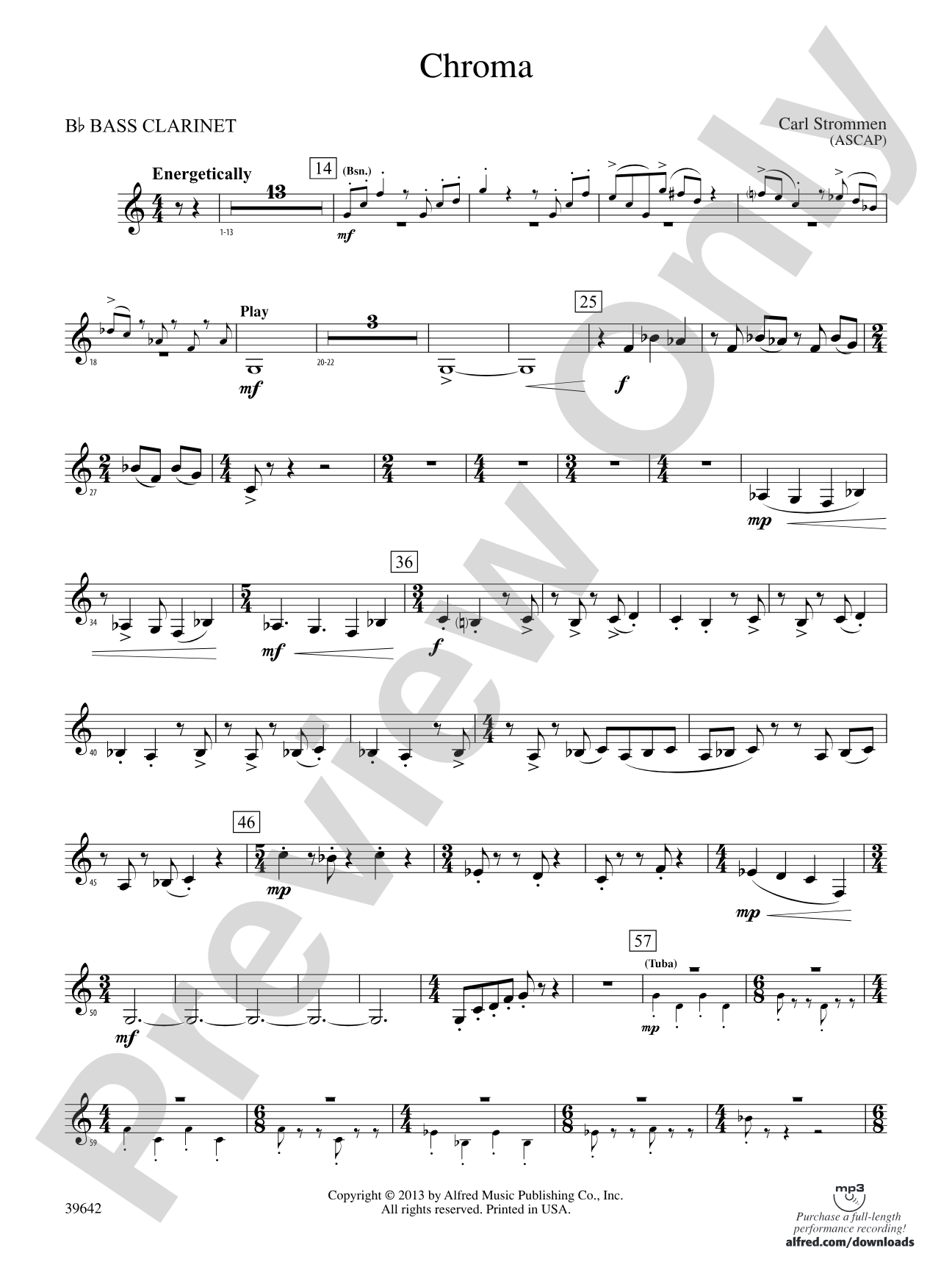

Chroma: B-flat Bass Clarinet
By Carl Strommen
Grade: 3.5 (Medium)
Item: 00-PC-0015916_BC
$5.99
Pickup currently not available
Description
The chromatic nature of this piece manifests itself in both tonality and color, with the main theme providing a unique "tone-row" quality. The colors presented throughout demonstrate vast contrasts between jazz, a playful circus atmosphere, and very dramatic qualities allowing the musicians opportunities to display a variety of styles and playing techniques. (3:10) This title is available in MakeMusic Cloud.


Don't just read it, hear it, play along with it, and watch your students grow with it. In MakeMusic Cloud, Chroma: B-flat Bass Clarinet comes alive with professional accompaniment, adjustable tempo, and built-in practice tools that turn solo practice into real progress.
Open in the Player
Jump straight in and assign it today.
Start Your Free Trial
Open this title and explore the full library in minutes.
Sample Audio
1
Audio File
--:--
0:00
0:00
Sample Video
No sample videos found.
Additional Details
Series:
Alfred Concert Band
Publisher:
Alfred Music
Page Count:
258
SKU:
00-PC-0015916_BC
More about this title
About the Composer: Carl Strommen

Carl Strommen ranks among the most frequently performed composer-arrangers working in bands, orchestras, jazz ensembles, and vocal groups today. His music appears consistently in concert halls, on television, and in film productions, and he maintains an active schedule as both a clinician and commission composer. His extensive catalog has earned him the ASCAP Standard Writers Award annually, reflecting the breadth and quality of his compositional voice.
A graduate of City College of New York, Strommen remains connected to music education as an adjunct professor of orchestration and composition at C.W. Post Campus of Long Island University. He divides his time between Long Island and Colorado, where he maintains close ties with family in Denver and Boulder.
Why we love this
Strommen crafts a piece that refuses to stay in one emotional or stylistic lane. The chromatic language and tone-row quality give the writing intellectual weight, while the shifts between jazz vocabulary, circus-like playfulness, and dramatic intensity keep both players and audiences engaged. A concert band that can handle this kind of tonal sophistication and stylistic range will emerge with genuine interpretive flexibility.
What to expect
Strommen creates a journey through contrasting moods, anchored by chromatic language that keeps the ear slightly off balance in the best way. One moment the band swings with jazz inflection; the next, a playful carnival energy takes over; then something genuinely dark and dramatic emerges. The effect is sophisticated without being austere, entertaining without being trivial.
Who it's for
Concert bands at the upper intermediate level who are ready to handle stylistic variety and chromatic harmonic language. This piece rewards directors who want their students to experience contemporary writing that stretches beyond traditional tonality while remaining musically accessible.
How to get the most out of it
- Pay close attention to the timbral shifts between sections. The contrasts between jazz idioms and dramatic passages depend on specific instrumental balances and articulations, not just tempo changes. Mark these transitions clearly in rehearsal.
- Approach the chromatic melodic material with precision in intonation. The tone-row quality relies on players hearing the subtle pitch relationships; sloppy articulation or wavering pitch will cloud the harmonic intent.
- Let the percussion drive the character changes. The "color" Strommen references is heavily influenced by how drums, mallets, and effects instruments shape each section's identity. Make these parts prominent enough for players to feel the stylistic shifts.
- Balance clarity with forward momentum in the faster sections. The playful circus atmosphere can tip into chaos without clean ensemble work and a steady underlying pulse from the rhythm section.
How to use it
This works brilliantly as a concert opener that signals "this year we're exploring new sounds." Pair it with other contemporary works to build a programming statement, or use it as a contest piece where its stylistic breadth and 3:10 length fit standard time slots. It also serves as an excellent vehicle for recognizing strong soloists within the ensemble, as Strommen writes exposed passages that showcase individual players.
Skills your students will build
- Reading and performing chromatic melody and harmony
- Distinguishing and executing contrasting musical styles (jazz, playful, dramatic) within one piece
- Balancing ensemble blend across timbral shifts and instrumental solos
- Intonation precision in non-diatonic harmonic contexts
- Stylistic interpretation and character work in contemporary music