
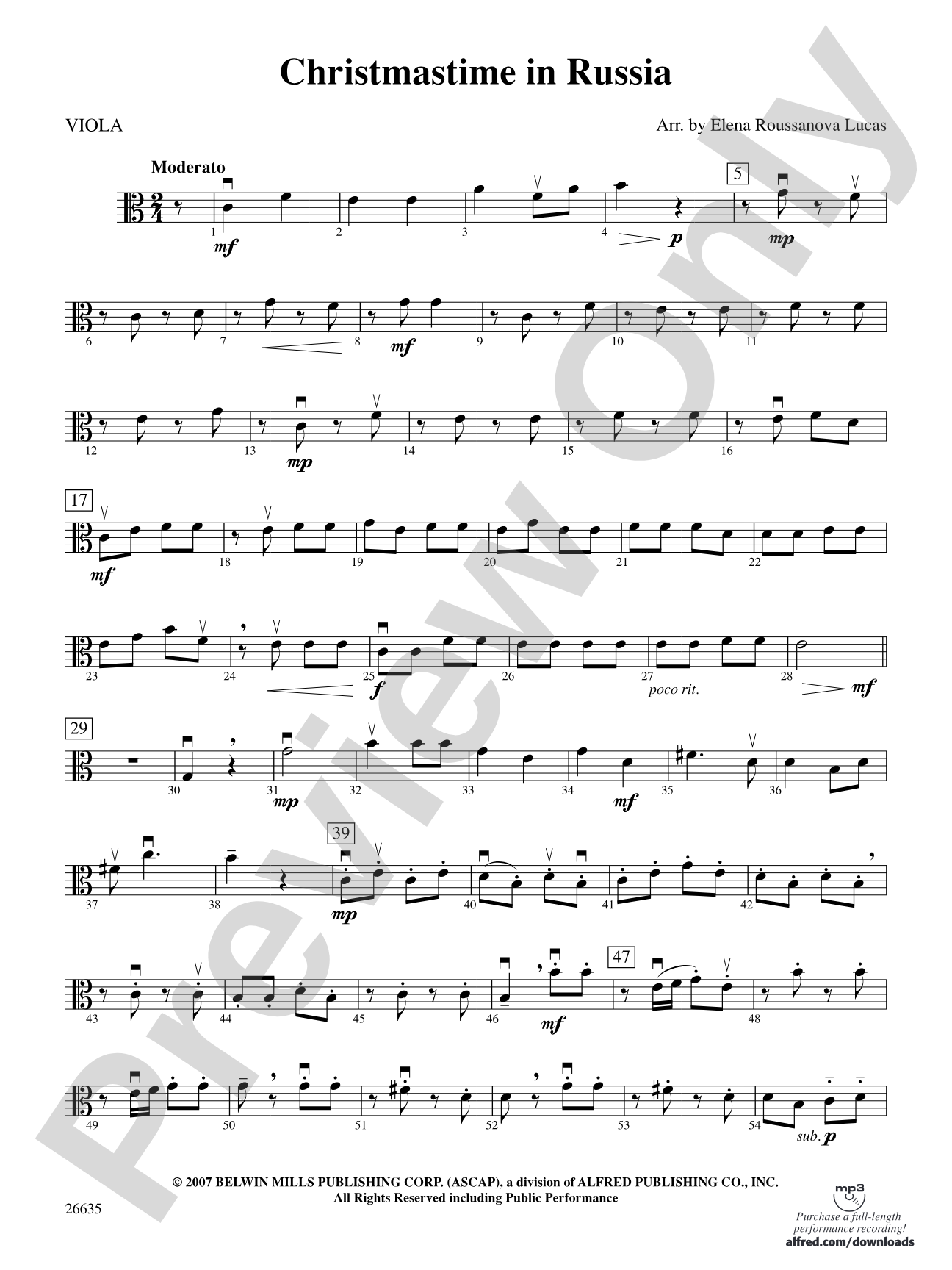

Christmastime in Russia: Viola
Traditional / arr. Elena Roussanova Lucas
Grade: 3
Item: 00-PC-0001138_VA1
$5.99
Pickup currently not available
Description
"The Little Forest Christmas Tree," "The Manger" and "Snowfall Blowing Along the Street" were familiar songs during the Christmas season when Elena Roussanova Lucas was growing up in Russia. An exquisitely crafted and heartfelt arrangement of these three traditional Russian holiday tunes genuinely reflects the composer's memories of Christmastime in Russia. This title is available in MakeMusic Cloud.


Don't just read it, hear it, play along with it, and watch your students grow with it. In MakeMusic Cloud, Christmastime in Russia: Viola comes alive with professional accompaniment, adjustable tempo, and built-in practice tools that turn solo practice into real progress.
Open in the Player
Jump straight in and assign it today.
Start Your Free Trial
Open this title and explore the full library in minutes.
Sample Audio
1
Audio File
--:--
0:00
0:00
Sample Video
No sample videos found.
Additional Details
Series:
Belwin Intermediate String Orchestra
Publisher:
Alfred Music
Page Count:
72
SKU:
00-PC-0001138_VA1
More about this title
About the Arranger: Elena Roussanova Lucas

Elena Roussanova Lucas grew up in Moscow, where she began piano studies at age three and entered the prestigious Central Music School prodigy program. She went on to study composition at the Tchaikovsky Conservatoire, earning the Red Diploma (Summa Cum Laude) and working under composers Tihon Khrennikov and Tatiana Choodova. She also completed piano pedagogy training at the Ippolitov-Ivanov Music College and holds membership in the United Russian Composers Union.
Her compositions have been performed by leading Russian orchestras including The Tchaikovsky State Orchestra of Moscow and The Radio and TV Orchestra of Moscow, as well as by international ensembles and soloists. Lucas presented a masterclass in composition at the Tchaikovsky Conservatoire in 2003 and has performed as a pianist throughout Russia, the United Kingdom, the Netherlands, and the United States, winning First Prize in a Russia-wide piano competition sponsored by the Russian Ministry of Culture. She has taught at Boston University.
Why we love this
An arranger with deep roots in Russian musical tradition brings genuine authenticity to these three beloved holiday songs. Lucas channels personal memory into the orchestration, creating arrangements that honor the original melodies while opening them up for string ensemble sound. The result feels intimate yet concert-ready, giving conductors a winter program piece that carries real cultural weight without requiring advanced technical demands from students.
What to expect
These three Russian holiday songs evoke snow-covered landscapes, intimate gatherings, and the particular nostalgia of seasonal music from another place and time. The arrangement carries quiet reverence alongside gentle warmth, inviting string players to discover the expressive depth in melodic simplicity. There is clarity in every line without the heaviness that often burdens holiday arrangements at this level.
Who it's for
String orchestra conductors seeking repertoire that bridges grades 2 and 3 winter concerts with cultural substance and genuine connection to holiday tradition. This works equally well for intermediate student orchestras and as a bridge piece in more advanced programs that value diverse cultural material.
How to get the most out of it
- Balance the melody between first and second violins to preserve the lyrical character of these folk tunes; avoid letting accompaniment figures obscure the primary line.
- Attend to phrase shaping across the section, especially where the arrangement moves between parts. These Russian songs benefit from singing tone and gentle rubato rather than strict metronomic precision.
- Shape dynamic arcs around the natural contours of each melody rather than holding steady throughout. Small, intentional crescendos and decrescendos enhance the warmth of the arrangement.
- Ensure cellos and basses provide a warm, resonant foundation; these traditional melodies gain depth when the lower strings are recorded and balanced generously in rehearsal.
How to use it
Anchor a winter concert with this suite as a centerpiece, or use it to open a program with cultural and seasonal substance. The three songs flow naturally together, making this an ideal choice for creating a cohesive thematic section alongside other world music or holiday material. At Grade 3, these pieces also serve well as a bridge between simpler seasonal fare and more complex concert repertoire.
Skills your students will build
- Lyrical phrasing and melodic line awareness across sectional parts
- Dynamic shaping and tone control in ensemble context
- Reading straightforward key signatures and time signatures with confidence
- Balancing melody and accompaniment in traditional folk song arrangements
- Cultural listening and expressive response to non-English-language music traditions