
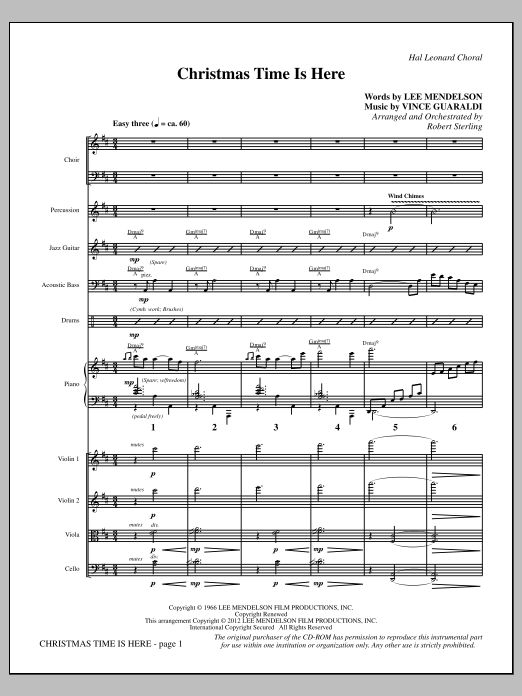

Christmas Time Is Here: Choral Instrumental Pak
By Vince Guaraldi / Arranged by Robert Sterling
Item: 35-PK00239030
$60.00
Pickup currently not available
Buy Extra Parts (Digital PDF Download)
Parts Added to Cart!
Description
The impeccable artistry of Vince Guaraldi's timeless classic from the TV special "A Charlie Brown Christmas" has truly become part of our shared cultural heritage! You can't help but lose yourself in the warmth of the lush jazz harmonies in this authentic setting.
Duration: ca.3:50.


Christmas Time Is Here: Choral Instrumental Pak isn't in MakeMusic Cloud just yet...but it could be. Let us know you'd like to see it, and you'll help shape what comes next. In the meantime, start a free trial and dive into thousands of interactive titles your students can play along with today.
Request This Title
Tell us you want it.
Start Your Free Trial
Explore everything that's ready to play right now.
Sample Audio
No sample audio found.
Sample Video
No sample videos found.
Additional Details
Publisher:
Hal Leonard
SKU:
35-PK00239030
More about this title
About the Composer: Vince Guaraldi
Vince Guaraldi (1928–1976) was a pianist and composer who fundamentally changed how jazz could function in visual media. His work on the Peanuts television specials, beginning with "A Charlie Brown Christmas" in 1965, demonstrated that jazz harmony and small ensemble writing could carry genuine emotional weight in film and television scoring. His approach prioritized melodic clarity and harmonic sophistication over complexity, making his music accessible without sacrificing artistic integrity.
Guaraldi's legacy extends far beyond the Peanuts franchise. He was a skilled improviser and bandleader who understood how to balance written arrangement with space for interpretation. His scores became textbooks for music educators teaching how to combine popular idiom with classical structure, and his influence on subsequent composers working in television and film scoring remains substantial. For school musicians, his catalog offers a masterclass in elegant voicing and tasteful orchestration.
Why we love this
Sterling's arrangement captures the serene, almost reverent quality of Guaraldi's original while giving your jazz ensemble real work to do. The chord voicings demand precision from your harmonic instruments, and the laid-back swing feel teaches ensemble members how to sit comfortably behind the beat without dragging. It's the kind of piece that sounds simple until you try to execute it, which makes it perfect for building ensemble maturity.
What to expect
Quiet contentment. The piece settles you into a gentle swing groove that feels like sitting by a window on a cold December evening, watching light snow fall. Guaraldi's harmonies are always one step more sophisticated than you expect, creating a sense of wistful sophistication that never tips into melancholy.
Who it's for
Jazz choirs and concert choral ensembles looking for holiday programming that moves beyond standard fare. Intermediate to advanced groups will find the harmonic language engaging without requiring virtuosic technique. It works equally well in December concert settings and in non-religious holiday celebrations where musical substance matters.
How to get the most out of it
- Let the rhythm section establish the groove first. Spend rehearsal time getting the piano and bass locked into the same relaxed swing feel before layering vocals and strings on top.
- Emphasize the warmth in the lower register. Keep horns and strings from brightening the sonority; Guaraldi's original thrives in a softer, more intimate dynamic world.
- Shape the melody with restraint. The tune's beauty comes from its simplicity, not vibrato or dramatic phrasing. Let the harmony do the heavy emotional lifting.
How to use it
Position this early in a holiday concert to set a sophisticated, calm tone before moving into livelier material. It pairs beautifully with other jazz arrangements or with traditional carols rearranged in a modern idiom. The piece's moderate duration makes it an ideal opener that doesn't demand audience attention to the same degree a longer feature would.
Skills your students will build
- Singing and playing through jazz chord changes (ii–V progressions and extended harmonies)
- Executing a steady swing feel with proper rhythmic placement
- Balancing individual parts to support overall harmonic blend
- Responding to subtle dynamic and tempo cues in a small ensemble context
- Interpreting melody with restraint and taste rather than technical display