
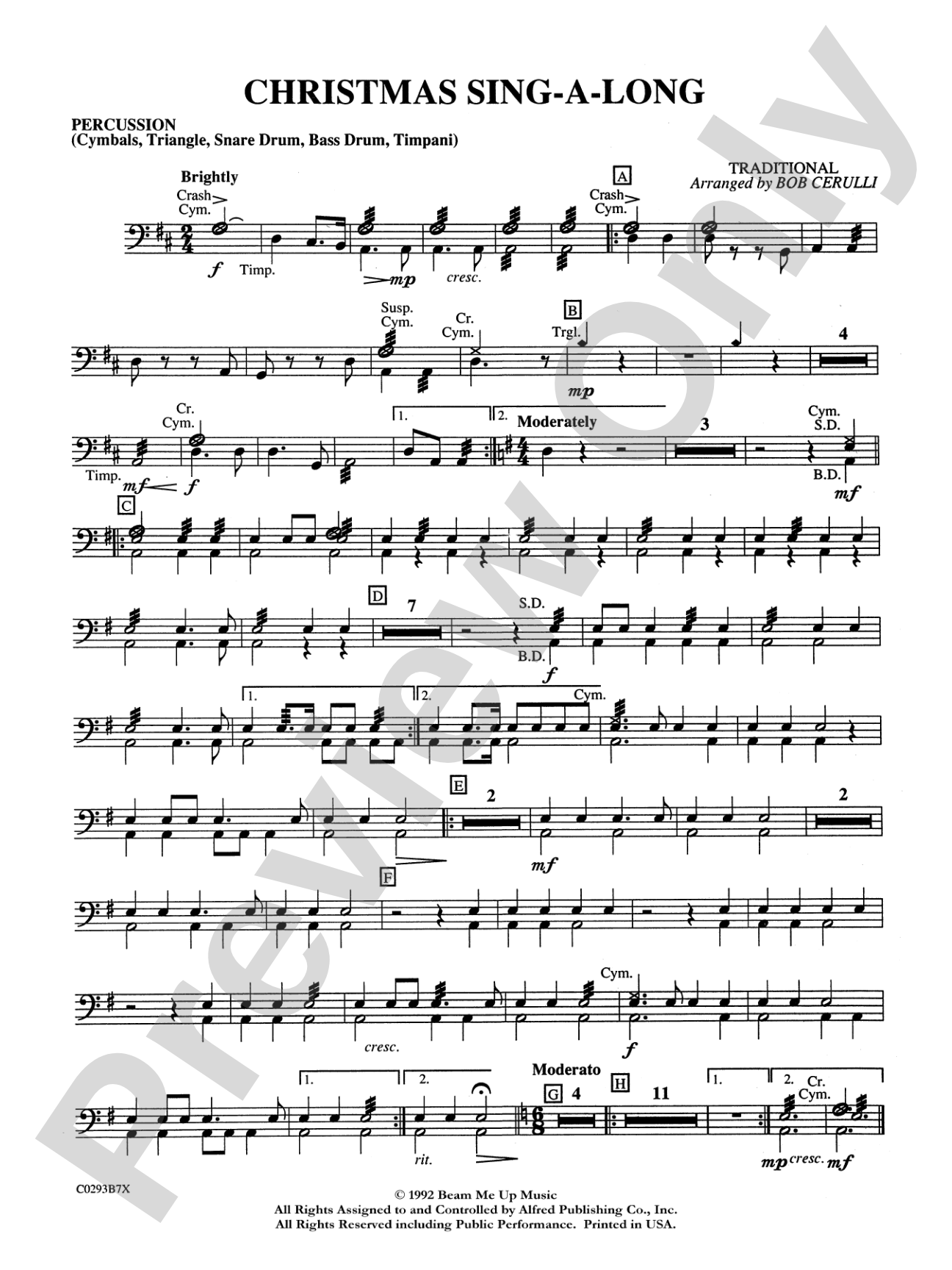

Christmas Sing-a-Long: 1st Percussion
Traditional / arr. Bob Cerulli
Grade: 3.5
Item: 00-PC-0002288_PC1
$3.00
Pickup currently not available
Description
To be performed with the audience singing along, or as a stand-alone arrangement, this medley contains “Joy To the World,” “O Come All Ye Faithful,” “Hark! The Herald Angels Sing,” and “Silent Night.” A magnificent way to have your orchestra sparkle for your holiday performance. Dazzling!


Don't just read it, hear it, play along with it, and watch your students grow with it. In MakeMusic Cloud, Christmas Sing-a-Long: 1st Percussion comes alive with professional accompaniment, adjustable tempo, and built-in practice tools that turn solo practice into real progress.
Open in the Player
Jump straight in and assign it today.
Start Your Free Trial
Open this title and explore the full library in minutes.
Sample Audio
1
Audio File
--:--
0:00
0:00
Sample Video
Additional Details
Series:
Pop Intermediate Full Orchestra
Publisher:
Alfred Music
Page Count:
925
SKU:
00-PC-0002288_PC1
More about this title
About the Arranger: Bob Cerulli

Bob Cerulli's path through music was shaped by rigorous training at Curtis and deep roots in professional orchestral life. He spent years as principal bassist for multiple regional orchestras and performed alongside world-class musicians including Henry Mancini, Luciano Pavarotti, and Andrea Bocelli, work that taught him how orchestras actually breathe and communicate.
After three decades teaching in public schools, Cerulli brings that classroom experience directly into his arrangements. His compositional voice, heard in pieces premiered by the Philadelphia Orchestra and performed by its principal cellist, informs his gift for writing parts that sit comfortably in the hands while maintaining musical integrity. Today he teaches conducting and music education at the college level, continuing to shape how the next generation of musicians thinks about orchestration and ensemble leadership.
Why we love this
Cerulli has written four beloved carols into a single cohesive medley that works equally well as audience participation or pure orchestral performance. The Grade 3.5 setting means your string, woodwind, and brass sections all get moments to shine without the arrangement becoming unwieldy, and the full parts package removes any guesswork about orchestration.
What to expect
Warm, familiar, and celebratory. These four carols are embedded in holiday memory, and Cerulli's orchestration respects that emotional weight while adding orchestral color and momentum. You'll hear the melodies ring out clear and recognizable, anchored by full ensemble sound.
Who it's for
Orchestra directors programming a winter concert who want a piece that engages their audience without sacrificing musicianship. It works for school orchestras with solid fundamentals and the flexibility to perform either with community sing-along or as a polished standalone arrangement.
How to get the most out of it
- Balance the accompaniment carefully during audience singing sections. The orchestra should support, not overshadow, the collective voice in the hall.
- Use the key centers as structural signposts. Transitioning between these four well-known melodies gives your ensemble natural breathing points to reset and refocus.
- Shape each carol with its own character. 'Joy to the World' needs forward momentum, 'Silent Night' requires restraint; these contrasts make the medley feel intentional rather than rushed.
- If performing without audience participation, lean into the "dazzling" quality mentioned in the arrangement notes. The orchestration likely contains flourishes and countermelodies designed to catch ears when the melody stands alone.
How to use it
Close your holiday concert with this medley if you're inviting the audience into the finale. Alternatively, place it early in the program as a bridge between your concert repertoire and a sing-along finale, or perform it straight through as a polished orchestral arrangement that shows off your ensemble's range and ensemble control.
Skills your students will build
- Balancing solo lines against accompaniment texture
- Executing smooth key modulations across a multi-movement form
- Coordinating conductor cues across four distinct musical sections
- Reading a full score with independent string, woodwind, and brass writing