Christmas Hornpipe: 2nd B-flat Trumpet Sheet Music Preview

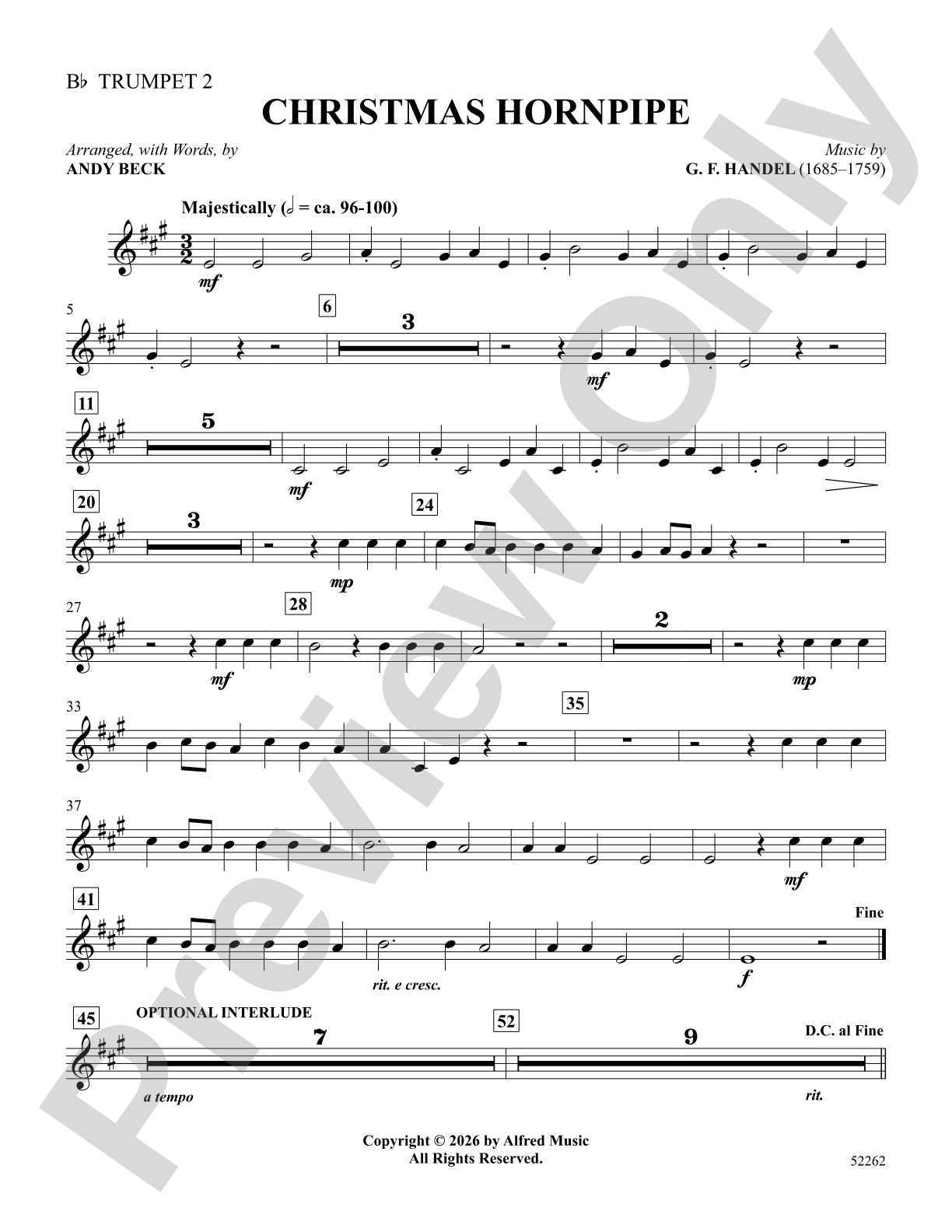
Christmas Hornpipe: 2nd B-flat Trumpet

Music by G. F. Handel / arr., with words, by Andy Beck

Item: 00-PC-0019734_T2

Digital Download
$3.00
Description
Handel's famous "Water Music" becomes a spirited holiday fanfare with the addition of a celebratory Christmas text. Buoyant vocal parts, traditional choral writing, and the jaunty hornpipe feel are a natural fit for the season and bring a touch of class to every performance. The flexible form invites you to sing just once through, or use the optional keyboard interlude as a Baroque-style transition before a joyful recapitulation. Elevate the majestic flair with festive brass and timpani (SoundPax sold separately).

Christmas Hornpipe: 2nd B-flat Trumpet isn't in MakeMusic Cloud just yet...but it could be. Let us know you'd like to see it, and you'll help shape what comes next. In the meantime, start a free trial and dive into thousands of interactive titles your students can play along with today.

Sample Audio
0:00
0:00
Sample Video
Additional Details
Series: Alfred Choral Designs
SKU: 00-PC-0019734_T2

More about this title

About the Composer: Georg Friedrich Handel

Georg Friedrich Handel (1685-1759) was a German-born composer who spent most of his career in England, where he became a dominant figure in Baroque music. His instrumental works, particularly the Water Music suites, remain staples of the concert repertoire and are celebrated for their rhythmic vitality, elegant melodies, and masterful orchestration. Handel's genius lay in his ability to write music that was both sophisticated and immediately accessible, a quality that made his works beloved across social classes during his lifetime and continues to resonate with audiences today.

Why we love this

This arrangement takes one of the Baroque era's most recognizable instrumental themes and gives it fresh life through celebratory Christmas text and choral writing that honors Handel's harmonic language. The optional keyboard interlude creates a natural break point that lets you shape the performance architecture yourself, and the suggestion of brass and timpani parts means you can scale the festive impact to match your resources. It's a piece that sounds polished and substantial without requiring unusual forces, making it an elegant alternative to typical holiday fare.

What to expect

The hornpipe dance rhythm brings infectious joy and courtly elegance, buoyed by Handel's gift for memorable melody and clear harmonic progression. Singing this feels celebratory without being sentimental; it's the musical equivalent of festive pageantry, with enough structural sophistication to keep both singers and listeners engaged.

Who it's for

This piece suits choirs with solid music-reading skills and comfort with four-part harmony. It works equally well for community chorales, church choirs planning a winter concert, school choirs performing for a holiday program, or any ensemble looking to add a Baroque masterwork to their seasonal programming.

How to get the most out of it

  • Shape the hornpipe rhythm with forward motion in the melodic line; resist the temptation to over-articulate in a way that flattens the dance-like character. Think "bouncy" rather than "staccato."
  • Balance the choral texture so that no single voice part dominates. Handel's part-writing is transparent by design, and each line contributes to the harmonic integrity of the piece.
  • If using the keyboard interlude as a transition, rehearse it separately so singers understand it as a moment to reset and prepare for the recapitulation with fresh energy.
  • Pair your choir's vowel sounds across all four parts to strengthen blend; the traditional voicing will only shine if the singers are hearing each other clearly.

How to use it

Pair this with other holiday selections that range in style and period to create a varied concert program. It works beautifully as a finale piece, sending the audience out with high spirits and musical substance. The flexibility of the form also makes it suitable as an opener if you want to establish an elegant, celebratory tone from the start.

Skills your students will build

  • Baroque phrasing and articulation in choral context
  • Maintaining rhythmic precision in dance-based meters
  • Four-part harmonic balance and blend
  • Singing text with the same musicality as instrumental melody
  • Interpreting optional structural choices (keyboard interlude placement)

You May Also Like