
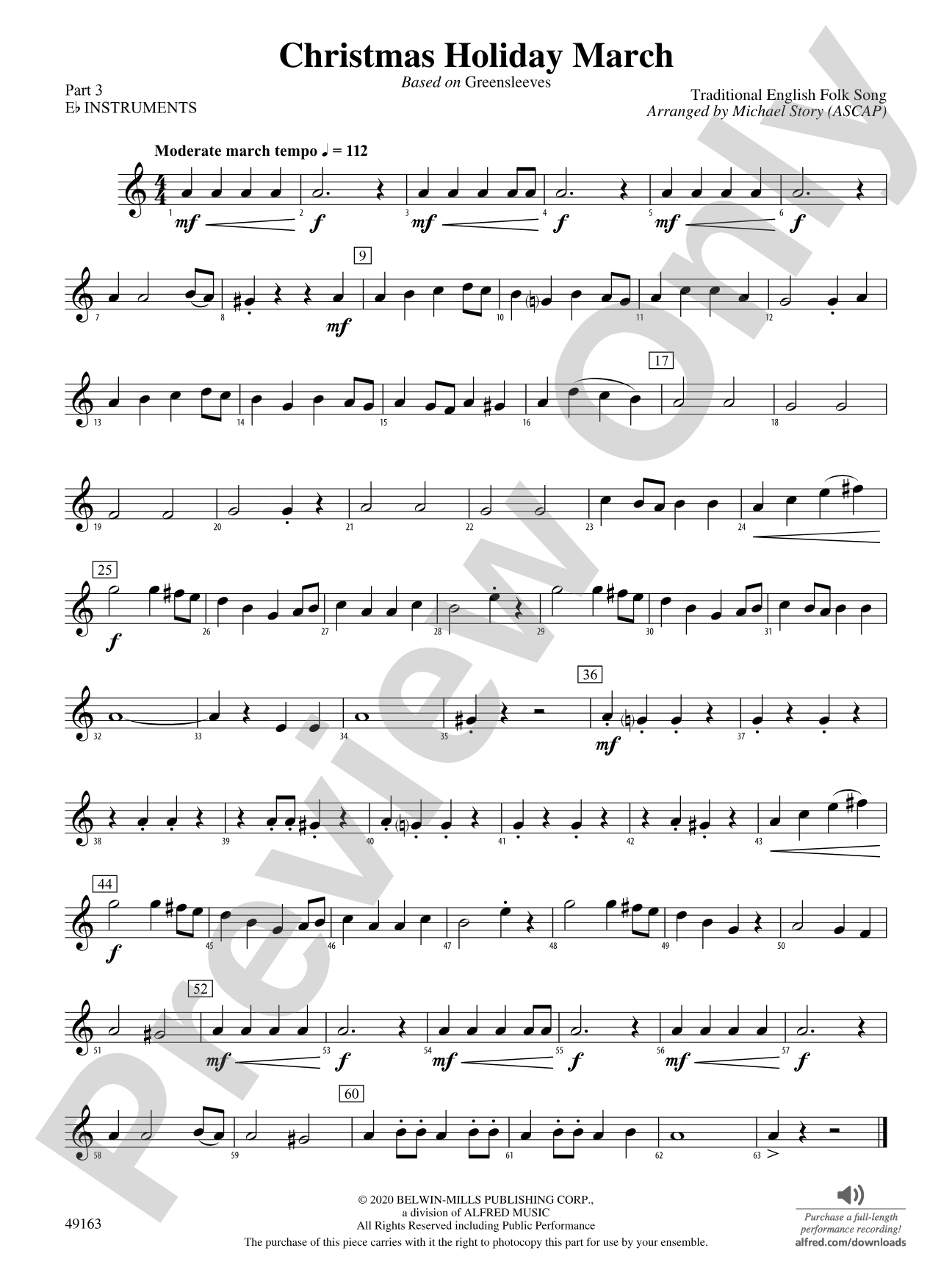

Christmas Holiday March: Part 3 - E-flat Instruments
Based on "Greensleeves"
Traditional English Folk Song / arr. Michael Story
Grade: 1 (Very Easy)
Item: 00-PC-0018497_PART3_EFLAT
$3.00
Pickup currently not available
Description
This version of Christmas Holiday March arranged by Michael Story is part of our Belwin FLEX offerings and is designed with maximum flexibility for use by any mix of instruments---wind, strings, and percussion, including like- or mixed-ensembles with as few as 4 players. The suggested instrumentation and a customizable Teacher Map will help you plan out how to best assign parts to suit your ensemble's needs. The 4-part instrumentation will support balanced instrumentation of the lower voices. It also comes with supplemental parts for maximum flexibility. With the purchase of this piece, permission is granted to photocopy the parts as needed for your ensemble. A percussion accompaniment track is also available as a free download. String parts have been carefully edited with extra fingerings and appropriate bowings to support students in mixed ensembles playing in less familiar keys.
This march setting of the 16th-century traditional English folk song "Greensleeves" is an outstanding fusion piece for beginners. With teaching opportunities for contrasting articulations and phrasing, this is a wonderful selection to march into the holiday season. (2:15)
Percussion Accompaniment Track Downloads:
with click
without click.


This march setting of the 16th-century traditional English folk song "Greensleeves" is an outstanding fusion piece for beginners. With teaching opportunities for contrasting articulations and phrasing, this is a wonderful selection to march into the holiday season. (2:15)
Percussion Accompaniment Track Downloads:
with click
without click.
Don't just read it, hear it, play along with it, and watch your students grow with it. In MakeMusic Cloud, Christmas Holiday March: Part 3 - E-flat Instruments comes alive with professional accompaniment, adjustable tempo, and built-in practice tools that turn solo practice into real progress.
Open in the Player
Jump straight in and assign it today.
Start Your Free Trial
Open this title and explore the full library in minutes.
Sample Audio
1
Audio File
--:--
0:00
0:00
Sample Video
Additional Details
Series:
Belwin Beginning Band
Publisher:
Alfred Music
Page Count:
84
SKU:
00-PC-0018497_PART3_EFLAT
More about this title
About the Arranger: Michael Story
Michael Story has established himself as one of the most prolific and respected arrangers for beginning and intermediate ensembles. His arrangements for Belwin and other publishers are known for their careful attention to pedagogical detail, thoughtful scoring across mixed instrumentation, and genuine musicality at every level.
Story's work reflects a deep understanding of how young musicians learn and what engages them. He writes with particular sensitivity to the needs of flexible ensembles, where instrumentation varies widely, and his arrangements consistently earn adoption in school programs across the country.
Why we love this
Story's arrangement transforms a 16th-century melody into something that feels fresh and celebratory while remaining deeply accessible to Grade 1 ensembles. The real gift here is the scoring: the 4-part instrumentation, customizable teacher map, and carefully edited string parts with extra fingerings and bowings mean you can run this with whatever players you have on any given day, from four musicians to a full class.
What to expect
Bright and festive, yet grounded in the timeless character of "Greensleeves." The march setting gives the 16th-century melody a forward momentum that feels celebratory without losing the melody's inherent dignity. Crisp articulations in the winds and singing bowings in the strings create energy and clarity throughout.
Who it's for
Beginning band and string directors working with mixed ensembles of any size. This arrangement accommodates anything from a quartet of students to a full heterogeneous class, with or without the traditional wind and percussion complement. Conductors leading holiday concerts will find a piece that sounds mature and intentional without asking too much of novice musicians.
How to get the most out of it
- Balance the contrasting articulations: wind players should keep staccato notes crisp and light while strings maintain a corresponding clarity with their bowings. This distinction shapes the march character without requiring aggressive dynamics.
- Use the suggested fingerings and bowings as written, especially in the string parts. They are designed to keep younger players in comfortable positions and support accurate intonation in the keys this arrangement uses.
- Check your tempo against the provided click track download. A steady march feel at a moderate tempo prevents rushing during the dotted rhythms and gives the melody room to breathe.
How to use it
This works beautifully as an opening number for a holiday concert, setting a joyful tone before more substantial choral selections. It also pairs well with other traditional arrangements in a holiday medley or as a standalone offering that fills a 15-minute program slot when other pieces are still in development.
Skills your students will build
- Articulation contrast (staccato versus legato in a march context)
- Phrasing and shaping over two-bar and four-bar units
- Flexible instrumentation reading (transferable parts across mixed ensemble voicings)
- Intonation in less familiar keys with guided fingerings and bowings
- Ensemble rhythmic unity in dotted rhythms and march tempos