
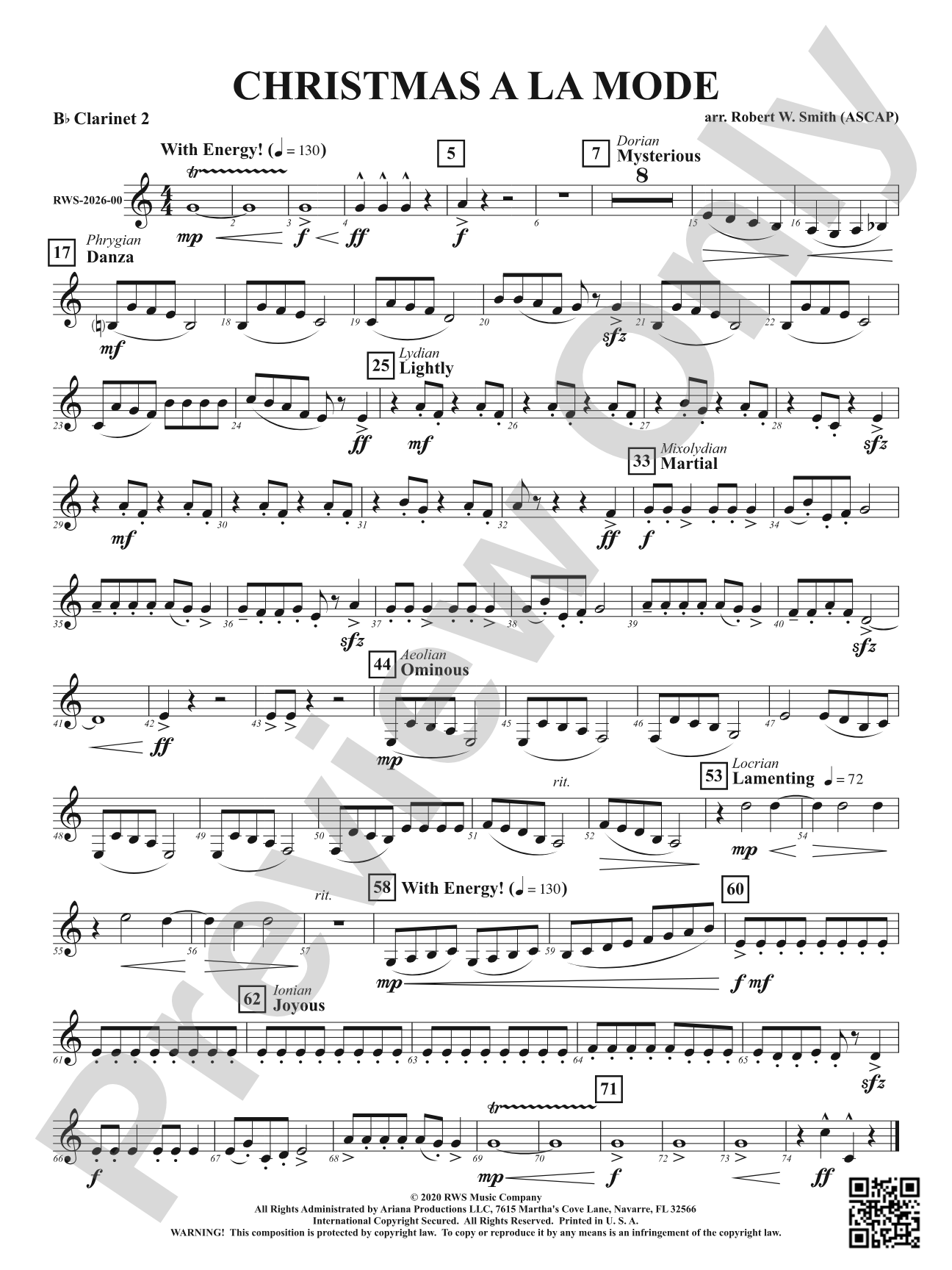

Christmas A La Mode: 2nd B-flat Clarinet
Arranged by Robert W. Smith
Grade: 2.5
Item: 98-PC-RWS2026_C2
$3.99
Pickup currently not available
Description
Use the holiday season to introduce and reinforce the importance of scales with your students. Robert W. Smith's Christmas A La Mode is an arrangement of "Jingle Bells" that takes the band and audience on a journey through the traditional modes. Following a brief introduction, our journey begins in the Dorian mode. We continue our sleigh ride through Phrygian, Lydian, Mixolydian, and Aeolian before an ominous stop in the Locrian mode. We return to Ionian as the arrangement concludes in glorious fashion. A wonderful educational opportunity combining music theory with effective performance!
Original Item#: RWS-2026-00


Original Item#: RWS-2026-00
Christmas A La Mode: 2nd B-flat Clarinet isn't in MakeMusic Cloud just yet...but it could be. Let us know you'd like to see it, and you'll help shape what comes next. In the meantime, start a free trial and dive into thousands of interactive titles your students can play along with today.
Request This Title
Tell us you want it.
Start Your Free Trial
Explore everything that's ready to play right now.
Sample Audio
1
Audio File
--:--
0:00
0:00
Sample Video
No sample videos found.
Additional Details
Series:
RWS - Developing Band
Publisher:
RWS Music Company
SKU:
98-PC-RWS2026_C2
More about this title
About the Arranger: Robert W. Smith

Robert W. Smith stands among the most frequently performed composers of concert band and orchestral music in the United States. With over 400 published works distributed primarily through Alfred Music, he has established himself as a vital voice in the developing band repertoire. His education includes a Bachelor of Music Education from Troy State University in Alabama and a Master of Music from the University of Miami.
Smith's compositions have traveled globally, from concert halls across North America and Europe to stages in Australia, Asia, and beyond. His symphonies The Divine Comedy and The Odyssey have resonated with musicians and audiences worldwide, while works like The Tempest have become foundational pieces for developing ensembles. Beyond the concert hall, his music has appeared on major television broadcasts, from Olympic ceremonies to the opening of the Macy's Thanksgiving Day Parade, and his work as a conductor and clinician has taken him across the United States, Canada, Japan, Australia, and several European nations.
Why we love this
Smith transforms a familiar melody into a deliberate pedagogical tool without sacrificing musical coherence or entertainment value. Directors gain a legitimate reason to drill modal theory into a concert piece your students will actually enjoy playing, and the progression through modes feels logical rather than arbitrary. The arrangement respects the Grade 2.5 level while treating the underlying harmonic concept with real sophistication.
What to expect
The piece opens with holiday brightness before pulling your students on a chromatic adventure through the colors of the modal spectrum. Each mode casts a different emotional light on the familiar "Jingle Bells" theme, from the minor shimmer of Dorian to the unsettling darkness of Locrian, before returning home to the warmth of major tonality.
Who it's for
Band directors working with developing ensembles who want to teach modal theory through actual repertoire rather than isolated exercises. This arrangement suits musicians ready for harmonic thinking beyond major and minor scales but still building foundational musicianship at the Grade 2.5 level.
How to get the most out of it
- Establish the tonal center clearly at the opening of each mode shift. Mark rehearsal numbers where the modal change occurs so students recognize when the harmonic landscape tilts.
- Balance articulation across sections as the arrangement moves through different harmonic colors. The minor character of Phrygian and the dark quality of Locrian ask for slightly different attack and release than the major sections.
- Let the Locrian section breathe with genuine tension. Resist rushing or over-brightening it; that ominous quality creates the emotional payoff when you return to Ionian.
- Use the familiar "Jingle Bells" melody as your anchor when students feel lost in modal harmony. Pointing to where the theme appears in each section helps them hear the melodic continuity beneath the harmonic shifts.
How to use it
Program this during a holiday concert to give your audience an unexpected musical education without sacrificing entertainment. It works equally well as a mid-season showcase of your band's growing harmonic sophistication, or as the centerpiece of a theory unit where students perform what they're learning in class.
Skills your students will build
- Recognizing and hearing the sound of each modal scale (Dorian, Phrygian, Lydian, Mixolydian, Aeolian, Locrian)
- Understanding how mode shapes melodic and harmonic character
- Maintaining tonal awareness across key center shifts within a single piece
- Playing with precision and balance in changing harmonic contexts