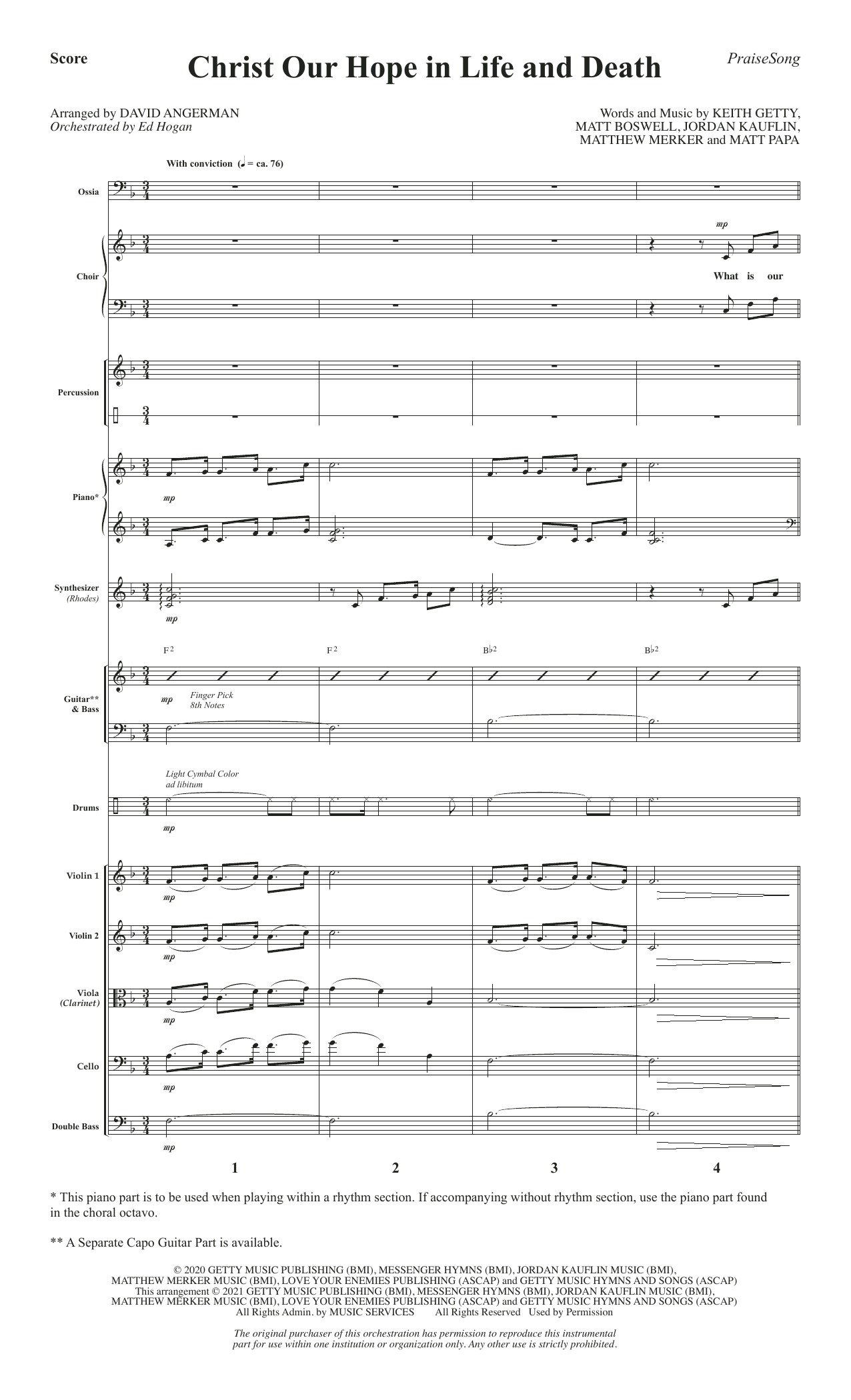
Christ Our Hope In Life And Death (arr. David Angerman) Sheet Music Preview

Christ Our Hope In Life And Death (arr. David Angerman): Choral Instrumental Pak

As performed by Keith and Kristyn Getty / Arranged by David Angerman

Item: 35-PK00511022

Digital Download
$60.00

One moment…

Description
This theologically rich song springs from New Testament hope and delivers an encouraging reminder of the promises of faith. Inspired by the Heidelberg Confession, this foundational truth is wrapped up in a sturdy modern hymn that sings naturally and authentically. Powerful! Score and Parts (perc 1-2, pno, syn, gtr, b, dm, vn 1-2, va, vc, db) available as a digital download.

Christ Our Hope In Life And Death (arr. David Angerman): Choral Instrumental Pak isn't in MakeMusic Cloud just yet...but it could be. Let us know you'd like to see it, and you'll help shape what comes next. In the meantime, start a free trial and dive into thousands of interactive titles your students can play along with today.

Sample Audio
No sample audio found.
Sample Video
Additional Details
Publisher: Hal Leonard
SKU: 35-PK00511022

More about this title

About the Artist: Keith and Kristyn Getty

Keith and Kristyn Getty are Northern Irish songwriters and performers who have become influential voices in modern congregational music. Their compositions blend theological depth with accessible melodies, drawing from classical hymn traditions while speaking to contemporary worship sensibilities. Their work appears regularly in churches worldwide and has shaped how many communities sing about faith.

The Gettys approach songwriting with careful attention to both textual substance and musical craft. Their collaborations with arrangers like David Angerman extend their hymns into fuller instrumental settings, creating resources that serve everything from intimate services to large festival performances.

Why we love this

This arrangement transforms a confession of faith into music that sounds inevitable rather than imposed. The orchestration balances clarity with richness, giving you genuine flexibility: you can lead it with just a few instruments or deploy the full ensemble depending on your context. What makes it particularly rewarding is how naturally the modern hymn sits in singers' voices while the accompaniment pattern gives your musicians something architecturally interesting to support.

What to expect

Direct and anchored, with an underlying warmth. The modern harmonic language keeps the piece from feeling antiquated, yet the hymn structure gives it a stability that feels earned rather than trendy. There's genuine encouragement in the melodic arc without resorting to sentimentality.

Who it's for

Directors programming sacred music in churches, school chapels, or concert settings where theological content matters alongside musical sophistication. This works for choirs with access to even a modest ensemble (strings plus rhythm section) all the way up to full orchestrations. It serves congregations seeking modern hymns that don't sacrifice doctrinal substance for singability.

How to get the most out of it

  • Let the rhythm section establish the harmonic foundation first. Lock the percussion, bass, and keyboard together before layering strings and horns, which allows the choir to trust where the pulse sits.
  • Emphasize the text's declarative moments. This isn't a hymn that needs apologetic phrasing; the theological assertions deserve forward motion and confidence from your singers.
  • Balance the dynamic range across the full arrangement. The contemporary instrumentation can easily overwhelm voices if you're not intentional about creating space for the lyrics to land.
  • Consider how the guitar and synthesizer interact. Either can carry harmonic color, but one should recede slightly so the other defines the sonority during key structural moments.

How to use it

Use this as a centerpiece for a service or concert exploring faith and assurance themes. It pairs well with older hymn arrangements on the same program, creating a conversation between generations of confessional music. Consider it especially for Reformation commemorations, memorial services, or any context where you want singers and players to engage something both singable and substantial.

Skills your students will build

  • Balancing choral blend with active instrumental accompaniment
  • Sustaining forward momentum in modern harmonic language
  • Ensemble coordination across mixed instrumental families (strings, keyboards, percussion)
  • Extracting textual meaning and theological nuance through phrasing
  • Managing dynamic control in fuller orchestrations

You May Also Like