Joseph M. Martin studied piano performance at Furman University and later earned a master's degree from the University of Texas, Austin, where he also taught in the Piano Pedagogy Department for five years. His performing career has taken him across North America and Mexico, including a competition win that led to a featured performance with the Guadalajara Symphony Orchestra, and his recital work has been broadcast nationally. In recent years, Martin has redirected his considerable talents toward church music and composition, becoming a familiar voice at worship services and musicians' conferences throughout the United States and Canada.
Martin's output as a composer and arranger spans an impressive range, from concert hall performances at venues like Carnegie Hall to regional theaters and countless congregations. His arrangements have become staples in church music libraries, valued for their accessibility and their ability to engage singers at multiple skill levels while maintaining musical integrity.
Why we love this
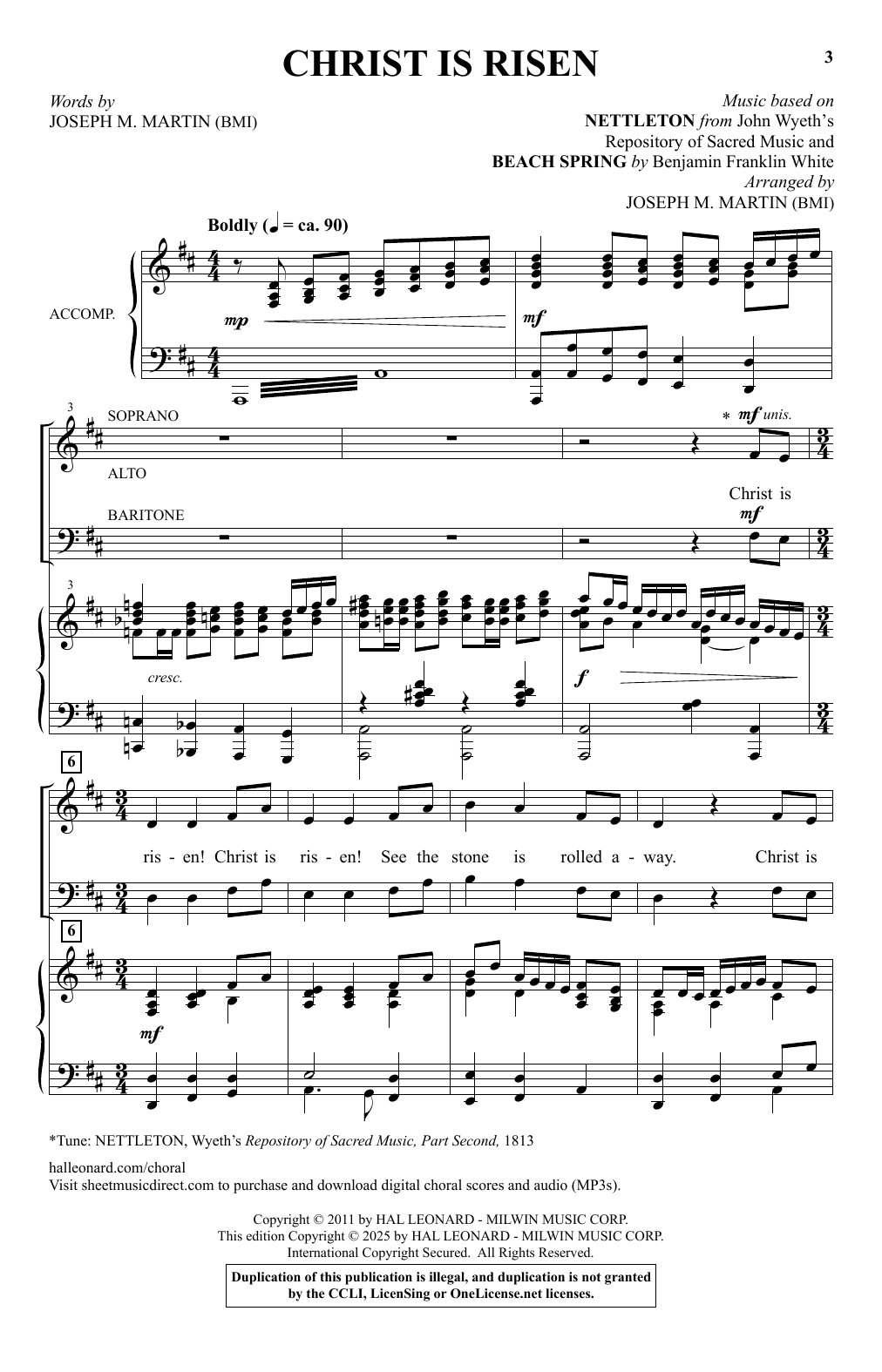
Martin's arrangement captures the jubilant spirit of Easter resurrection theology without demanding impossible technical feats from your singers. The SAB voicing remains singable across a typical mixed choir while the accompaniment provides harmonic richness and structural clarity that keeps everything moving forward naturally.
What to expect
Bright and affirmative. The arrangement radiates confidence in its harmonic language and melodic contour, expressing triumph without veering into sentimentality. There's both dignity and directness in how it unfolds.
Who it's for
Any choir preparing an Easter service or spring concert, from church choirs with limited rehearsal time to community and school ensembles looking for repertoire that's singable yet musically satisfying. SAB voicing makes this accessible to groups with limited tenor resources or mixed age ranges.
How to get the most out of it
Balance the three parts independently during early rehearsals; many singers default to humming the melody, so isolate the alto and bass lines first to build ownership of the harmony.
Determine your approach to any repeated sections before learning day one. Decide whether you'll add dynamic or textural variation, or keep them consistent.
Shape the piece with attention to text phrasing rather than bar lines. Where does the message shift? Let that guide your musical breath and intensity.
How to use it
Position this as a cornerstone for an Easter service liturgy, or pair it with instrumental or a cappella work to create a varied Lenten program. Its length and scope make it substantial enough to anchor a concert set while short enough to leave room for contrasting pieces.
Skills your students will build
Singing in three independent parts with clear harmonic function
Maintaining text clarity while managing ensemble blend
Phrasing and breathing in accordance with textual meaning rather than notation alone
You May Also Like
Scan to Complete Your Purchase
Use your phone's camera to scan the code below
You'll log in on your phone and the order will be added to your account