
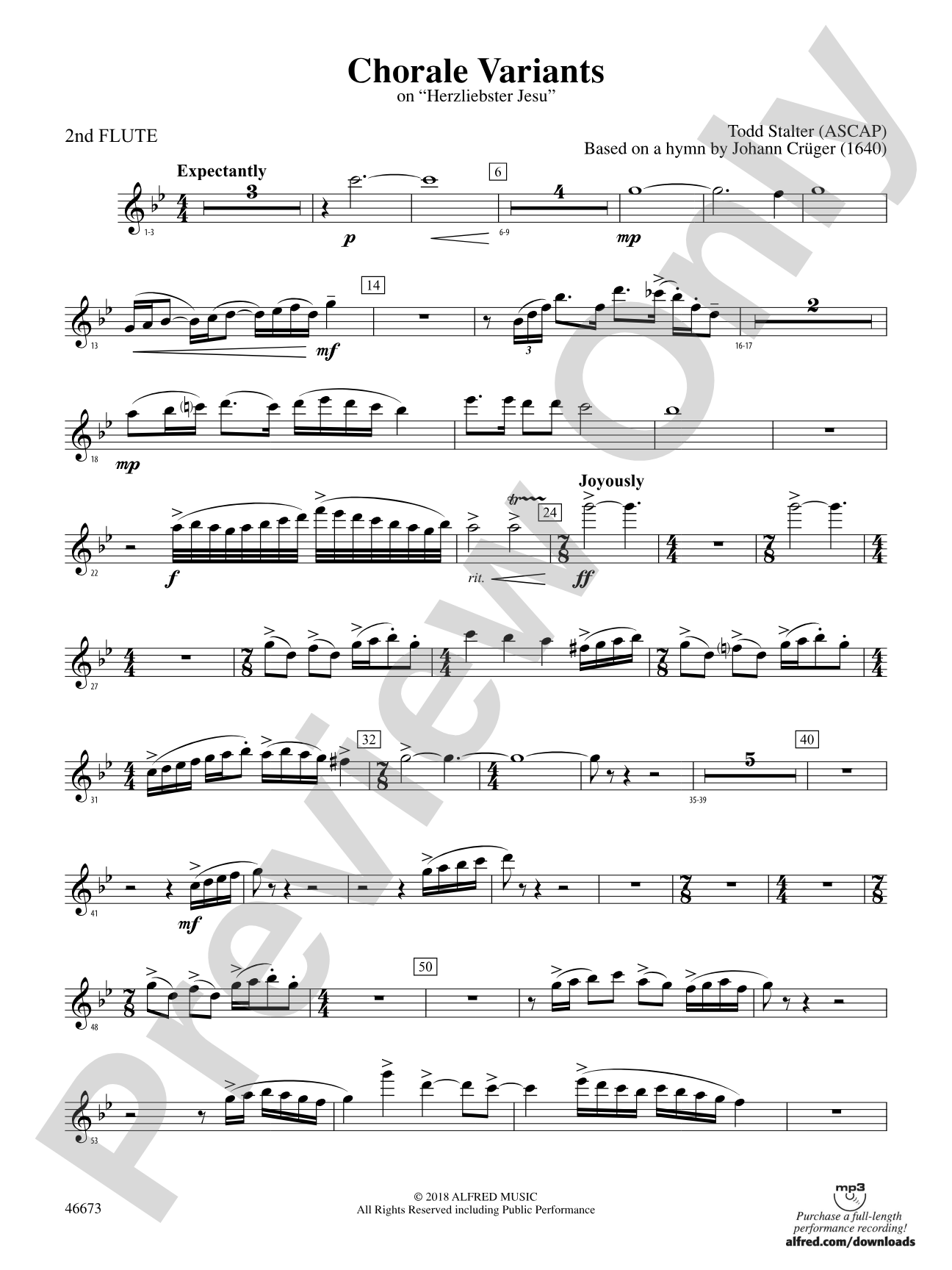

Chorale Variants: 2nd Flute
On "Herzliebster Jesu"
By Todd Stalter, based on a hymn by Johann Cruger
Grade: 4 (Medium Difficult)
Item: 00-PC-0017812_F2
$3.00
Pickup currently not available
Description
"Chorale Variants" is cast more as a fantasia than a set of variations. The woodwind flourishes purposely infer what an organist might play while improvising on a chorale theme, and the full dynamic power of the wind band brings the piece to a passionate and vibrant close.


Don't just read it, hear it, play along with it, and watch your students grow with it. In MakeMusic Cloud, Chorale Variants: 2nd Flute comes alive with professional accompaniment, adjustable tempo, and built-in practice tools that turn solo practice into real progress.
Open in the Player
Jump straight in and assign it today.
Start Your Free Trial
Open this title and explore the full library in minutes.
Sample Audio
1
Audio File
--:--
0:00
0:00
Sample Video
Additional Details
Series:
Alfred Concert Band
Publisher:
Alfred Music
Page Count:
280
SKU:
00-PC-0017812_F2
More about this title
About the Composer: Todd Stalter

Todd Stalter built a legendary 34-year tenure as Director of Bands at Eureka High School in Illinois, where his ensembles earned 16 Class 1A State Marching Band Championships and consistent Superior ratings in concert competition. His bands performed at Orchestra Hall in Chicago and Walt Disney World, and he earned induction into the Illinois State Marching Band Championships Hall of Fame. Beyond the high school podium, Stalter has conducted All-State Bands in Georgia and Delaware, adjudicated extensively for the Illinois High School Association, and presented clinics on conducting and composition at state and regional music education conferences.
Stalter holds a Bachelor of Music Education and a Master of Music in Trumpet Performance from Illinois State University, where he studied conducting with Dr. Stephen K. Steele. His compositions for band and string orchestra have gained national reach, with numerous works appearing on state contest and festival lists and featured in the GIA publication "Teaching Music Through Performance in Band."
Why we love this
This score respects the sacred source material while giving the full concert band a genuine reason to shine. Rather than treating the chorale as a set of mechanical variations, Stalter frames it as an improvisatory exploration that lets woodwind players inhabit an organist's voice, then builds to a finale that demands the full ensemble's dynamic commitment. It's the kind of piece that reminds students why large ensemble music matters.
What to expect
A meditation that transforms into celebration. The piece opens with quiet, searching woodwind textures that evoke the spacious sound of organ improvisation, then gradually gathers the full band into something luminous and affirming. By the final statement, the chorale feels not ancient but vital and present.
Who it's for
Concert bands at the Grade 4 level looking for sacred repertoire that serves both contest and concert programs. This works equally well for groups seeking a centerpiece that showcases musical maturity and technical facility in a meaningful context.
How to get the most out of it
- Balance the woodwind flourishes in the opening sections so they feel like genuine improvisation rather than competing for prominence. These moments set up the entire arc of the work.
- Shape the chorale statements themselves with long lines and warm tone. The harmonic foundation is your anchor; everything else orbits around it.
- Commission careful attention to the full ensemble crescendos leading into the final statement. This is where the piece finds its passion, and clarity in the brass and woodwind voices determines whether it lands with power.
- Use the score study to identify where individual sections need to yield and where they need to assert themselves. The fantasia approach requires ensemble cohesion that transcends section responsibility.
How to use it
Program this as a centerpiece on a concert or festival appearance where you want to demonstrate both the lyrical and dynamic range of your band. The Grade 4 difficulty and sacred context make it an excellent pairing with other hymn-based works or as a bridge between lighter contest selections and larger concert works.
Skills your students will build
- Balancing multiple textures and dynamic layers within a single ensemble
- Sustaining long melodic lines with consistent tone and intonation
- Responding to subtle conducting gestures that guide improvisatory phrasing
- Building ensemble sound from simple harmonic foundations to full dynamic climaxes
- Interpreting sacred repertoire with musical weight and reverence