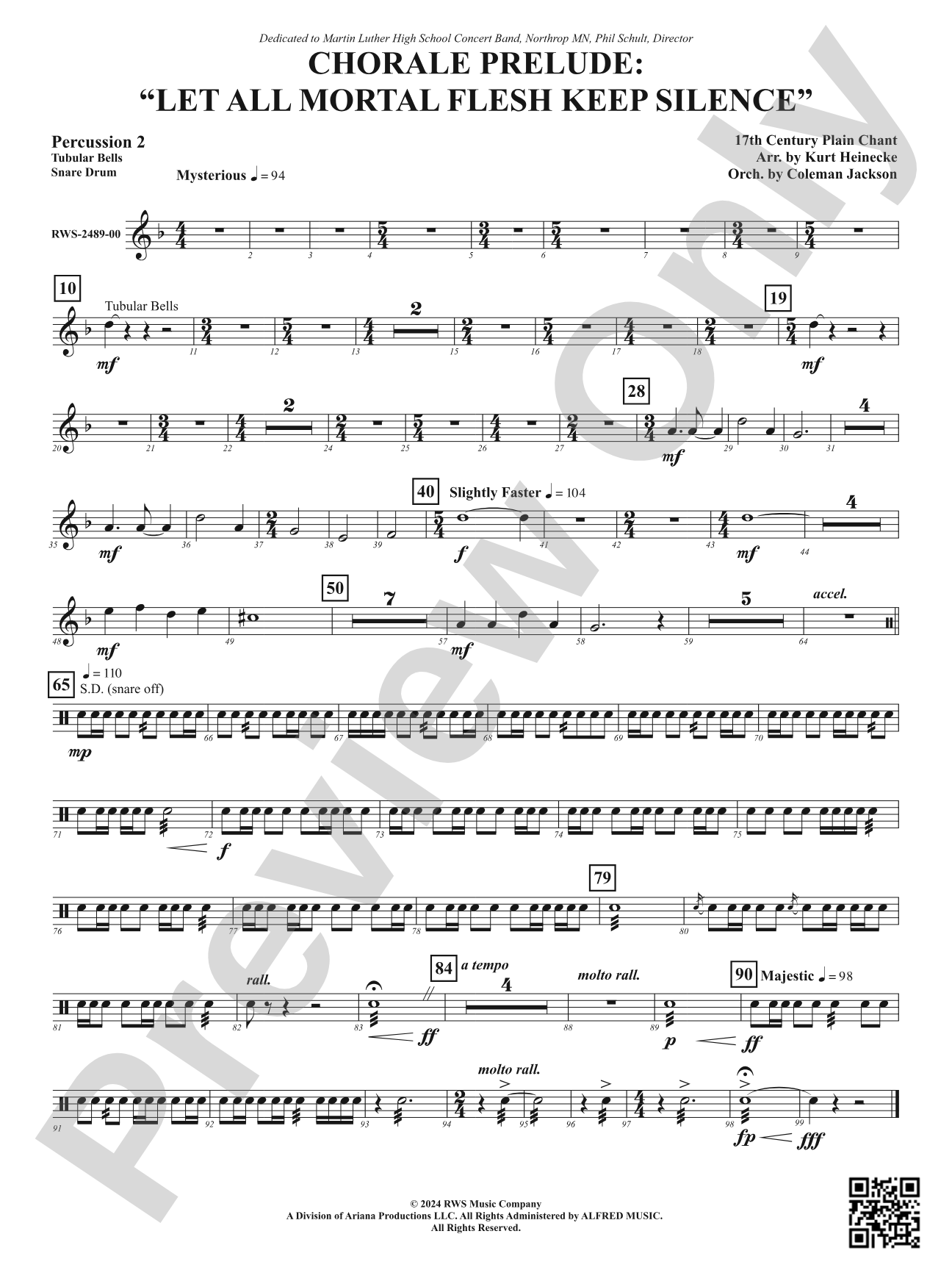
Chorale Prelude: Let All Mortal Flesh Keep Silence: 2nd Percussion Sheet Music Preview

Chorale Prelude: Let All Mortal Flesh Keep Silence: 2nd Percussion

Arr. Kurt Heinecke / orch. Coleman Jackson

Grade: 4

Item: 98-PC-RWS2489_PC2

Digital Download
$3.99
Description
Chorale Prelude: Let All Mortal Flesh Keep Silence reinterprets a centuries-old French carol that captures the awe and mystery of the Christmas story: a child sent to redeem the world. Starting with the literal sound of breath going silent, the beginning motif soars between optional soloists and a variety of time signatures. Growing with a pulse throughout, Kurt Heinecke's work ends in a stirring climax as the Christmas angels exult "Alleluia!" (3:41)

Chorale Prelude: Let All Mortal Flesh Keep Silence: 2nd Percussion isn't in MakeMusic Cloud just yet...but it could be. Let us know you'd like to see it, and you'll help shape what comes next. In the meantime, start a free trial and dive into thousands of interactive titles your students can play along with today.

Sample Audio
0:00
0:00
Sample Video
Additional Details
Series: RWS - Concert Orchestra
Publisher: RWS Music Company
SKU: 98-PC-RWS2489_PC2

More about this title

About the Arranger: Kurt Heinecke

Kurt Heinecke is an arranger and composer whose work for school orchestras balances musical integrity with accessibility. His arrangements honor classical and traditional material while reshaping them for young ensembles, creating scores that challenge musicians without overwhelming them.

Coleman Jackson collaborated on this arrangement, bringing additional expertise to the orchestration. Together, they have created a work that respects the carol's centuries-old heritage while speaking directly to modern concert orchestras.

Why we love this

This arrangement transforms a familiar carol into something genuinely theatrical and emotionally complex. The opening gesture of silence followed by soaring solos creates an immediate sense of occasion, while the shifting meters and orchestral colors keep the familiar melody feeling fresh and purposeful. It's the kind of piece that lands powerfully in a holiday program without ever feeling sentimental.

What to expect

There's genuine mystery in the opening: the sense of breath stilling before something profound begins. As the piece unfolds, the carol emerges with growing confidence, supported by an orchestra that sounds both reverent and alive. The climax captures real joy without losing the sacred quality that makes the original carol so enduring.

Who it's for

Grade 4 orchestras with solid rhythmic foundation and comfort with shifting meters. The optional soloists add flexibility, allowing you to feature strong players or simplify if needed. This work suits programs seeking holiday music with depth and craftsmanship rather than surface charm.

How to get the most out of it

  • Shape the opening breath motif as a literal moment of silence and anticipation; the contrast between stillness and the soaring entrance of optional soloists defines the entire emotional arc.
  • Balance the optional solo passages so they're clearly heard over the accompaniment without requiring soloists to push hard; Heinecke's orchestration is designed to support them.
  • Pay attention to the metric shifts throughout; these aren't distracting but purposeful, reflecting the text's meaning. Rehearse transitions between time signatures deliberately so ensemble members feel secure.
  • Build the final climax with real momentum. The piece earns its "Alleluia!" moment by growing steadily throughout; resist the temptation to rush the ending even as excitement builds.

How to use it

This is a natural centerpiece for a holiday concert, equally at home with classical repertoire or alongside other seasonal pops selections. At under four minutes, it pairs well with longer works or serves as a powerful standalone moment. The piece also works effectively at festivals and competitions where holiday programming is welcome.

Skills your students will build

  • Reading and executing mixed meters (3/4, 4/4, and asymmetrical time signatures)
  • Balancing soloists with orchestral accompaniment
  • Sustaining long melodic lines over rhythmic accompaniment
  • Responding to expressive architectural shifts within a single work
  • Precision entrances following moments of silence or sparse texture

You May Also Like