
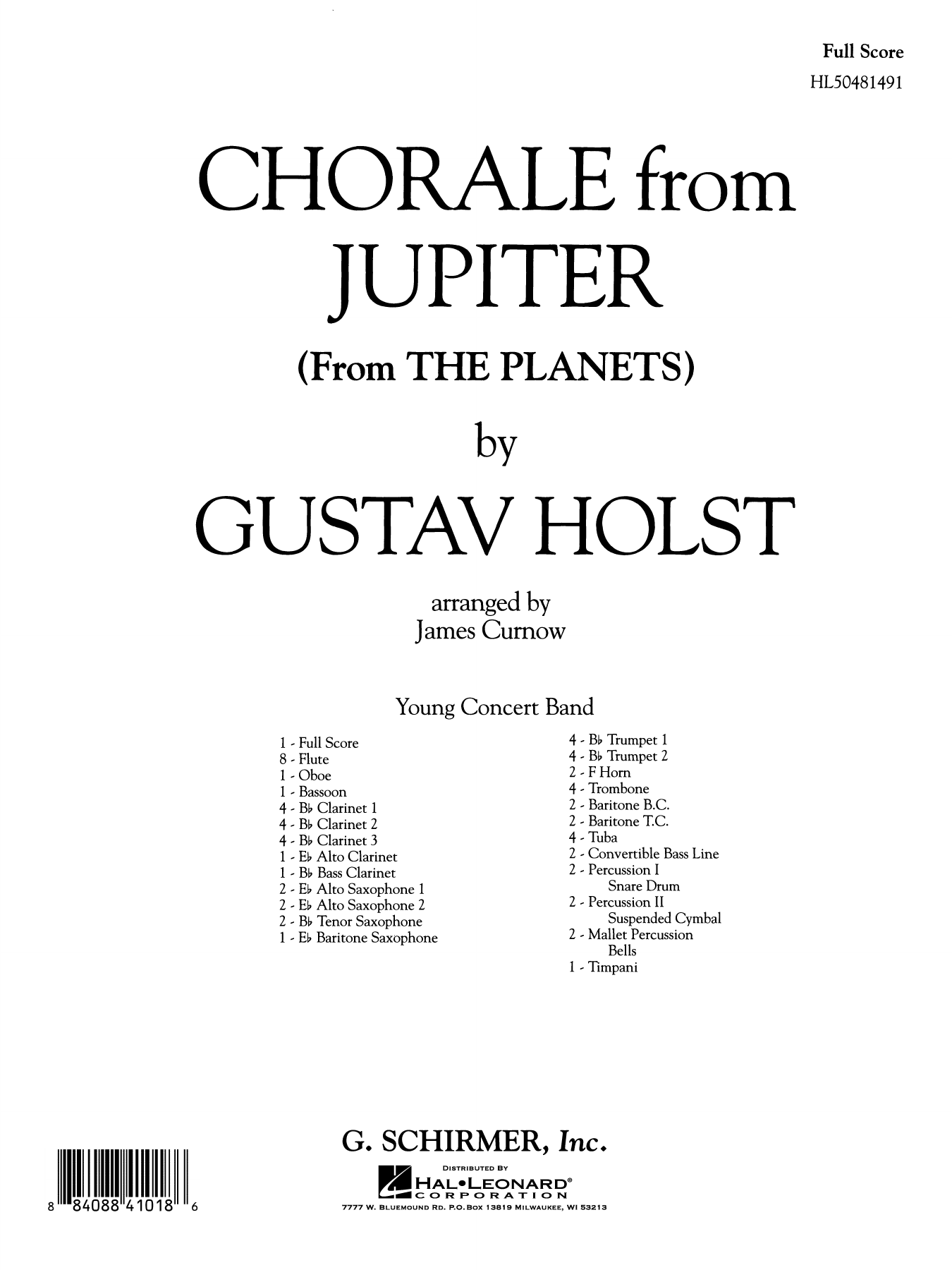

Chorale from Jupiter (from The Planets) (arr. James Curnow): Concert Band Conductor Score & Parts
By Gustav Holst / Arranged by James Curnow
Grade: 2
Item: 35-PK01913827
$70.00
Pickup currently not available
Buy Extra Parts (Digital PDF Download)
Parts Added to Cart!
Description
Introduce your students to Gustav Holst's monumental work, 'The Planets' with this beautiful majestic chorale from the movement 'Jupiter.' James Curnow's solid scoring of this work makes it a choice selection for young bands.


Chorale from Jupiter (from The Planets) (arr. James Curnow): Concert Band Conductor Score & Parts isn't in MakeMusic Cloud just yet...but it could be. Let us know you'd like to see it, and you'll help shape what comes next. In the meantime, start a free trial and dive into thousands of interactive titles your students can play along with today.
Request This Title
Tell us you want it.
Start Your Free Trial
Explore everything that's ready to play right now.
Sample Audio
No sample audio found.
Sample Video
No sample videos found.
Additional Details
Publisher:
Hal Leonard
SKU:
35-PK01913827
More about this title
About the Composer: Gustav Holst
Gustav Holst (1874-1934) was a British composer whose orchestral suite The Planets stands as one of the most performed and recognizable classical works of the 20th century. Beyond this masterpiece, Holst was a devoted music educator who taught at St. Paul's Girls' School in London for over three decades, shaping generations of young musicians and composing extensively for school ensembles. His belief that music education should engage students with substantive repertoire, not watered-down versions, profoundly influenced how concert bands approach serious literature.
Holst's compositional voice balanced modernist harmonic language with melodic accessibility, a combination that made his work both artistically significant and teachable. The Planets, composed between 1914 and 1916, captures distinct emotional and atmospheric qualities in each movement; Jupiter, in particular, radiates majesty and optimism, offering young musicians their first gateway into orchestral masterworks.
Why we love this
This chorale distills the most memorable and emotionally resonant moment from one of classical music's most iconic works, giving younger bands access to genuine artistry without overwhelming them. Curnow's scoring respects Holst's original harmonic language while distributing the musical weight evenly across the ensemble, so no section feels left out. Your students will immediately recognize the gravitas of what they're playing, and audiences will feel it just as acutely.
What to expect
Stately and grand, with a hymn-like dignity that invites reverent playing. The chorale unfolds with warm, rich harmonies that feel both noble and deeply human, creating moments of quiet grandeur alongside passages of swelling proclamation.
Who it's for
Grade 2 concert bands ready to explore classical literature beyond light entertainment fare. This arrangement works equally well for developing ensembles seeking repertoire with substance and younger advanced groups building their classical foundation.
How to get the most out of it
- Shape the melodic arc as a single unified phrase rather than marking time at each bar line; the chorale's power lies in its forward momentum and arrival at the climax.
- Balance the inner voices carefully so the harmonic progressions remain clear; ask the second clarinets and altos to listen for how their parts support the top line.
- Breathe as an ensemble at marked phrase endings, treating silence as part of the musical statement rather than a gap to fill.
- Bring the dynamic arch to life by gradually building from mezzo forte to the fortissimo moment, then tapering with intention rather than letting energy collapse.
How to use it
Program this as an opening statement on a concert centered around classical masterworks or as a dignified counterpoint to lighter fare. It also serves beautifully in spring concerts, formal ceremonies, or as a stepping stone before performing the full Planets suite with an advanced ensemble.
Skills your students will build
- Shaping long melodic phrases across multiple measures
- Balancing transparent four-part harmonic writing
- Responding to conductor gesture for unified ensemble breathing
- Connecting classical repertoire to modern band arrangements
- Sustaining tone quality and intonation across dynamic range