
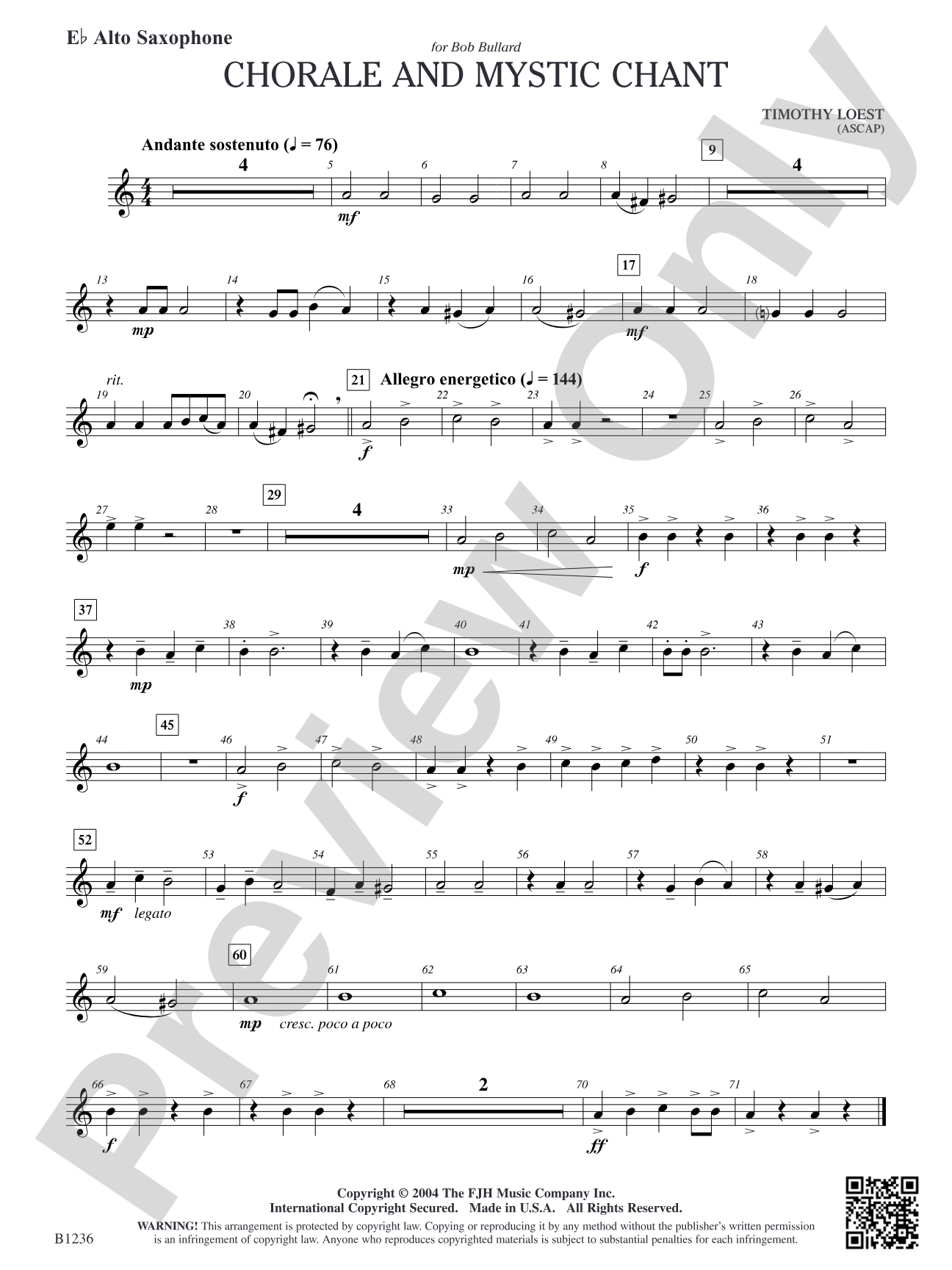

Chorale and Mystic Chant: E-flat Alto Saxophone
By Timothy Loest
Grade: 1
Item: 98-PC-DB1236_AX1
$7.00
Pickup currently not available
Description
A beautiful hymn with rich harmonies and suspensions opens this fine work for beginning bands. As the lyrical melody reaches a final cadence, the piece then moves into a bombastic chant with a wealth of percussion. The theme is presented in different textures and students will explore the basic components of a fugue in an easy setting. Listeners and performers alike will be excited by the rhythmic drive of the percussion. In addition, consider using the opening as a daily chorale to work on intonation with your ensemble.


Chorale and Mystic Chant: E-flat Alto Saxophone isn't in MakeMusic Cloud just yet...but it could be. Let us know you'd like to see it, and you'll help shape what comes next. In the meantime, start a free trial and dive into thousands of interactive titles your students can play along with today.
Request This Title
Tell us you want it.
Start Your Free Trial
Explore everything that's ready to play right now.
Sample Audio
1
Audio File
--:--
0:00
0:00
Sample Video
No sample videos found.
Additional Details
Series:
FJH Beginning Band
Publisher:
The FJH Music Company, Inc.
SKU:
98-PC-DB1236_AX1
More about this title
About the Composer: Timothy Loest

Timothy Loest has spent over three decades in the classroom at F.E. Peacock Middle School in Itasca, Illinois, where he developed a deep understanding of what young musicians need to grow. His compositions for beginning and intermediate bands are performed by ensembles worldwide, and his work has earned him the Illinois Grade School Music Association's Cloyd Myers Memorial Award for Excellence in Music Education in 2017. That same year, his composition Cloud Gate (Reflections of a City) reached over 5,000 listeners at Chicago's Millennium Park.
Loest's prolific output spans multiple publishers including FJH Music Company, C.L. Barnhouse, and his own Fanfare Music Press, founded in 2022 to champion quality compositions for band. His pedagogical influence extends through collaborations on widely adopted methods like Measures of Success: A Comprehensive Musicianship Band Method and Chorales and Beyond. His music has also appeared on network television programs ranging from The Tonight Show to Good Morning America. Loest holds degrees from Illinois State University and Northwestern University and maintains membership in ASCAP.
Why we love this
Loest understands the developmental arc of beginning bands and uses it brilliantly here. The opening chorale works double duty as both a stunning concert opener and a daily intonation tool, while the shift to the mystic chant with full percussion keeps students engaged and gives your percussion section real responsibility from day one. The fugal exploration in an accessible setting exposes young musicians to form and counterpoint without overwhelming them, making this ideal for contests, festivals, or general programming.
What to expect
The opening hymn unfolds with warmth and depth, its suspensions creating moments of gentle tension that resolve into rich harmony. When the percussion enters the mystic chant, the energy shifts dramatically, propelling the piece with rhythmic vitality and textural color that keeps both performers and audience engaged.
Who it's for
This score and parts set serves beginning concert bands (Grade 1) looking for repertoire that is musically substantial without overextending young musicians. Directors appreciate both the contest and festival appeal and the pedagogical value woven into the composition itself.
How to get the most out of it
- Start rehearsals by isolating the opening chorale without accompaniment; lock in the suspensions and voice leading before adding harmonic movement. This foundation pays dividends when the full texture returns later.
- Give your percussion section early ownership of the mystic chant. Their rhythmic drive propels the entire section, so let them rehearse independently and bring that energy into full ensemble run-throughs.
- When students encounter the fugal writing, sing through the subject and answer first to clarify the melodic idea before layering parts. This demystifies the form and strengthens individual line security.
- Use the opening chorale as a consistent warm-up routine. Intonation work embedded in performance repertoire builds musicianship far more effectively than isolated exercises.
How to use it
Program this as a festival or contest entry where the opening chorale showcases your band's musicality and the second section demonstrates rhythmic precision and ensemble control. The piece also works beautifully on a concert that pairs it with a contrasting selection, as its length and structural clarity make it a confident program anchor for beginning ensembles.
Skills your students will build
- Balancing melody and harmonic support in sustained chorale textures
- Playing suspensions with accurate voice leading and proper resolution
- Reading and performing simple fugal writing with independent melodic lines
- Maintaining rhythmic accuracy and ensemble cohesion in percussion-driven sections
- Tuning unisons and intervals within a four-part harmonic context