
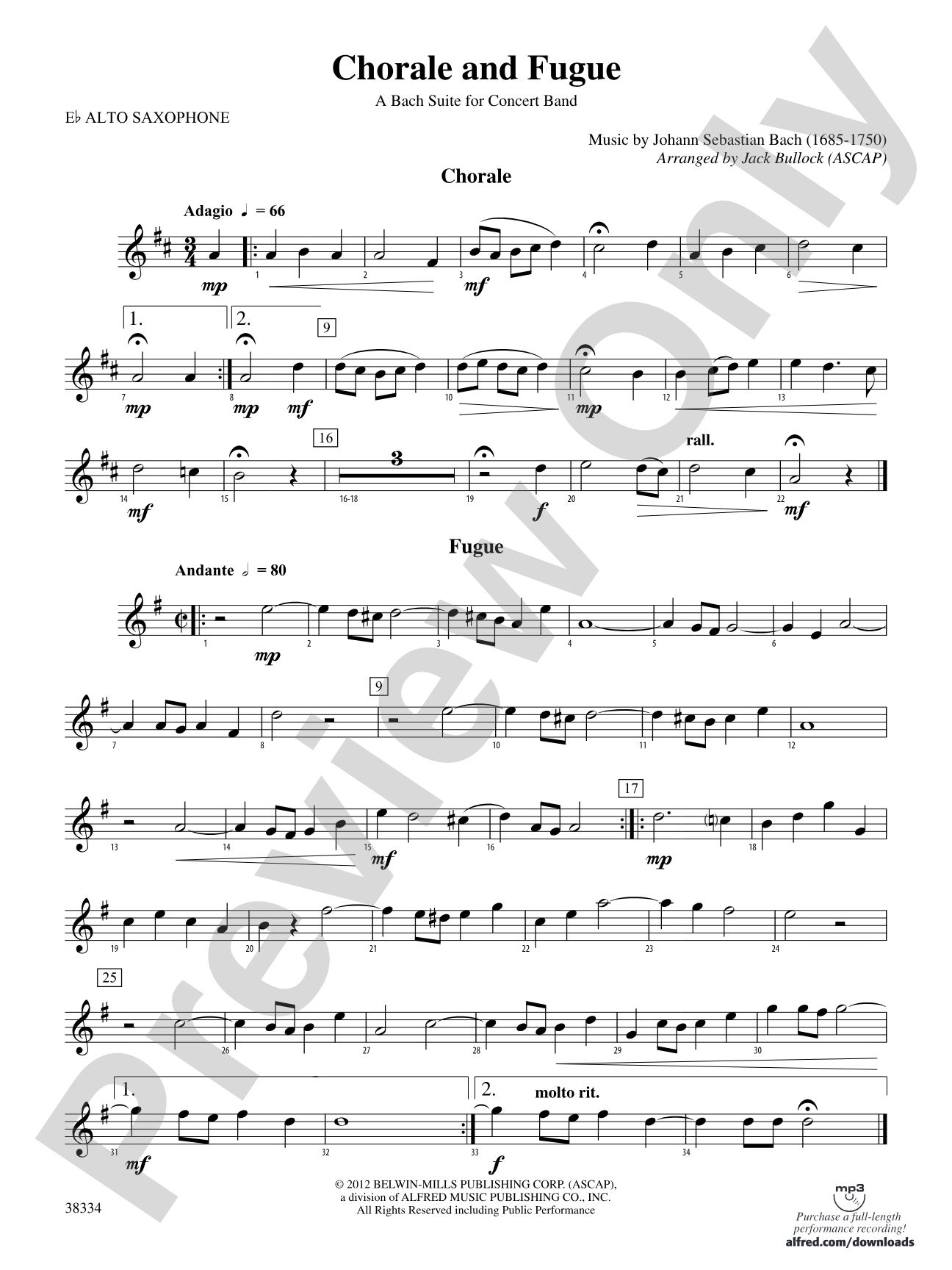

Chorale and Fugue: E-flat Alto Saxophone
By Johann Sebastian Bach / arr. Jack Bullock
Grade: 2 (Easy)
Item: 00-PC-0015428_AX1
$3.00
Pickup currently not available
Description
This wonderful music arranged for young instrumentalists is a testament to the everlasting works of this great composer of music. Composed during the 17th and 18th centuries, Bach's music rates high in appeal and gives pleasure to present day audiences. These two small pieces are part of the extensive output of this talented musician, organist, and composer. This title is available in MakeMusic Cloud.


Don't just read it, hear it, play along with it, and watch your students grow with it. In MakeMusic Cloud, Chorale and Fugue: E-flat Alto Saxophone comes alive with professional accompaniment, adjustable tempo, and built-in practice tools that turn solo practice into real progress.
Open in the Player
Jump straight in and assign it today.
Start Your Free Trial
Open this title and explore the full library in minutes.
Sample Audio
1
Audio File
--:--
0:00
0:00
Sample Video
No sample videos found.
Additional Details
Series:
Belwin Young Band
Publisher:
Alfred Music
Page Count:
114
SKU:
00-PC-0015428_AX1
More about this title
About the Composer: Johann Sebastion Bach
Johann Sebastian Bach (1685-1750) stands as one of the most influential composers in Western music history. His mastery of counterpoint, harmonic innovation, and structural clarity established foundations that shaped centuries of musical thought. Bach's prolific output spans sacred and secular works across nearly every genre of his era, from intricate fugues to chorales that remain central to music education today.
As both a virtuoso organist and dedicated teacher, Bach understood how to write idiomatically for instruments while maintaining compositional rigor. His chorales and fugues have become cornerstones of music pedagogy because they balance accessibility with intellectual depth. For student musicians, Bach's music offers a direct pathway into understanding voice leading, harmonic progression, and the architecture of musical form.
Why we love this
Jack Bullock's arrangement brings two Bach masterworks within reach of young musicians without sacrificing the integrity of Bach's voice leading and harmonic language. At Grade 2, the piece opens the door to Bach's formal genius—students experience real fugal process and chorale texture rather than simplified approximations. Programming Bach at this level signals to audiences that your band can handle substantive repertoire.
What to expect
The chorale opens with warm, hymn-like simplicity that grounds the ensemble in Bach's harmonic language. When the fugue begins, the mood shifts to intellectual energy as melodic fragments interweave and build, creating the characteristic Baroque texture of Bach's instrumental writing.
Who it's for
This arrangement serves Grade 2 concert bands ready to tackle substantive repertoire beyond pop arrangements and simplified marches. Directors seeking to build students' understanding of Baroque form and voice leading will find this pairing of chorale and fugue both pedagogically sound and musically rewarding. The Grade 2 level makes it accessible to intermediate musicians while preserving enough compositional complexity to challenge growing ensembles.
How to get the most out of it
- Shape each phrase to its harmonic destination rather than playing mechanically through the measures. Young musicians often miss how Bach's melodic lines follow the underlying harmonic motion.
- Balance transparency between parts in the chorale section. Encourage winds to listen across the ensemble so no single line dominates; Bach's beauty emerges from equal partnership.
- Mark the structural divisions (where the fugue enters, where subjects return) clearly in rehearsal. Students who understand the form play with greater confidence and musicality.
- Establish a steady, unwavering tempo in the fugal section. Bach's contrapuntal writing reveals itself only when the conductor provides rock-solid time.
How to use it
This works powerfully as a concert opener, establishing musical sophistication early and setting high expectations for the rest of your program. Pairing it alongside other Baroque or early Classical works creates a coherent stylistic arc, or position it as the centerpiece of a program exploring musical form across eras. Many bands also find Bach excellent for festival and contest programming where adjudicators recognize student engagement with canonical repertoire.
Skills your students will build
- Recognizing and executing fugal entries and subject statements
- Balancing multiple independent melodic lines in four-part chorale texture
- Following harmonic progression by ear and sight
- Sustaining steady tempo through contrapuntal passages
- Interpreting Baroque articulation and phrasing conventions