
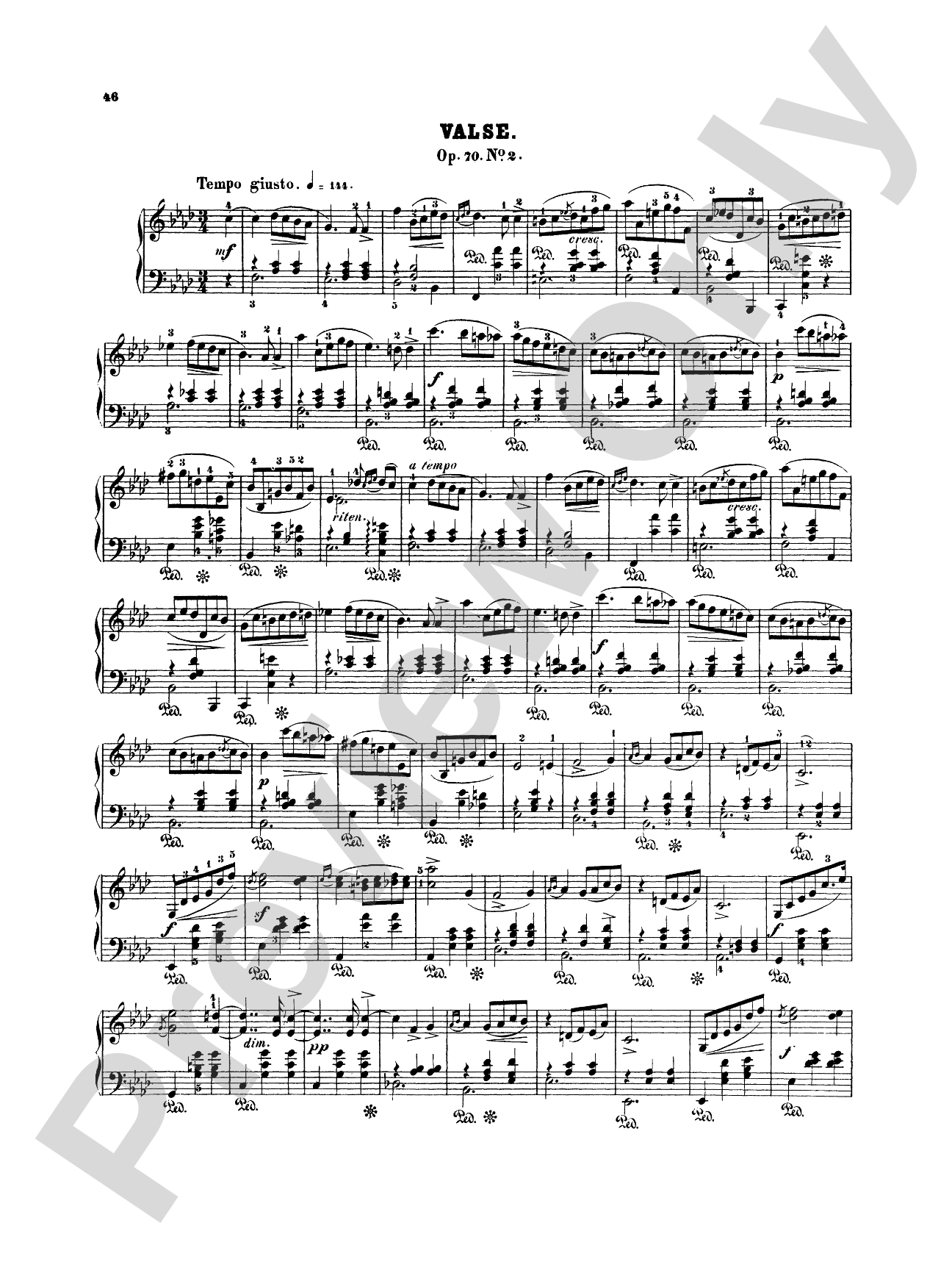

Chopin: Waltzes (Ed. Eduard Mertke)
By Frédéric Chopin / ed. Eduard Mertke
Item: 00-PC-0006539
$0.99
Pickup currently not available
Description
Frédéric Chopin's Waltzes are much different than the earlier Viennese waltzes in that they were not designed for dancing but for concert performance. Chopin started writing waltzes in 1824, when he was fourteen, and continued until the year of his death, 1849. This volume was edited by Ed Mertke and includes performance and historical notes. Contains: Grand Valse Brillante, Op. 18 * Valse Brillante, Op. 34, No. 1 * Valse Brillante, Op. 34, No. 2 * Valse Brillante, Op. 34, No. 3 * Valse, Op. 42 * Valse, Op. 61, No. 1 * Valse, Op. 64, No. 2 * Valse, Op. 64, No. 3 * Valse, Op. 69, No. 1 * Valse, Op. 69, No. 2 * Valse, Op. 70, No. 1 * Valse, Op. 70, No. 2 * Valse, Op. 70, No. 3 * Valse in E Minor (Post.) * Valse in E Major (Post.).


Don't just read it, hear it, play along with it, and watch your students grow with it. In MakeMusic Cloud, Chopin: Waltzes (Ed. Eduard Mertke) comes alive with professional accompaniment, adjustable tempo, and built-in practice tools that turn solo practice into real progress.
Open in the Player
Jump straight in and assign it today.
Start Your Free Trial
Open this title and explore the full library in minutes.
Sample Audio
No sample audio found.
Sample Video
No sample videos found.
Additional Details
Series:
Kalmus Edition
Publisher:
Alfred Music
Page Count:
56
SKU:
00-PC-0006539
More about this title
About the Composer: Frédéric Chopin
Frédéric Chopin (1810-1849) was a Polish composer and pianist whose output, though relatively small in volume, fundamentally shaped Romantic piano literature. He pioneered an entirely new approach to the instrument, exploiting its lyrical and coloristic possibilities in ways that influenced every composer who followed. His music balances technical brilliance with profound intimacy, demanding both virtuosic command and emotional depth from performers.
Chopin spent much of his career in Paris, where he composed prolifically despite chronic illness and a life marked by personal turbulence. He wrote almost exclusively for piano, and his mastery of the instrument's capabilities remains unmatched. His waltzes occupy a unique position in his catalog: they are concert pieces first, requiring far more sophistication than their predecessors while retaining the essential three-beat character that defined the form.
Why we love this
Chopin's waltzes represent some of the most rewarding concert repertoire available to pianists at the intermediate-advanced level. This collection spans his entire compositional life, offering the chance to trace how his harmonic language and structural ambition evolved across twenty-five years. The waltzes sit at that rare intersection where technical display serves emotional expression rather than overshadowing it.
What to expect
These waltzes shimmer with Parisian elegance and introspection. They pulse with the three-beat grace of the ballroom transformed into something more intimate and psychologically complex, offering moments of crystalline beauty alongside passages of surprising harmonic daring. There is joy here, but it is the sophisticated, sometimes melancholic joy of music written for listening rather than movement.
Who it's for
This collection serves pianists preparing recital programs, students exploring Romantic literature beyond the familiar nocturnes and études, and performers seeking concert pieces that balance accessibility with genuine artistic challenge. Advanced amateur pianists and conservatory students will find material suited to their advancing technical and musical maturity.
How to get the most out of it
- Shape each waltz's phrasing as if singing rather than dancing. Chopin's rubato is essential here; allow the melody to breathe independently of the accompaniment, especially in the opening statements of themes.
- Balance the left hand with intention. The accompanying figurations must support rather than overwhelm; many pianists make the mistake of driving the bass line forward when it should provide a gentle foundation.
- Approach the key changes and harmonic shifts with clarity. Chopin often modulates unexpectedly; highlight these moments without exaggerating the tempo or dynamics, letting the harmonic color speak for itself.
- Differentiate the character between sections. The Brillante waltzes demand more virtuosic display, while the later opus numbers achieve sophistication through restraint. Adjust your interpretive approach accordingly within each piece.
How to use it
Feature a single waltz as a contrasting lighter moment within a larger recital, or program several consecutively to showcase Chopin's evolving harmonic language across decades. The shorter, simpler pieces (Op. 69 and 70) work well as encores, while the Grand Valse Brillante and the Op. 34 waltzes anchor substantial concert programs.
Skills your students will build
- Rubato and temporal flexibility within a steady pulse
- Voicing chords with clarity in the right hand while maintaining accompaniment patterns in the left
- Pedal control to enhance harmonic color without blurring rapid passagework
- Structural awareness across varied formal designs
- Execution of ornaments and decorative figuration with elegance rather than mere technical display
- Interpretation of Romantic-era harmonic language and unexpected key relationships