
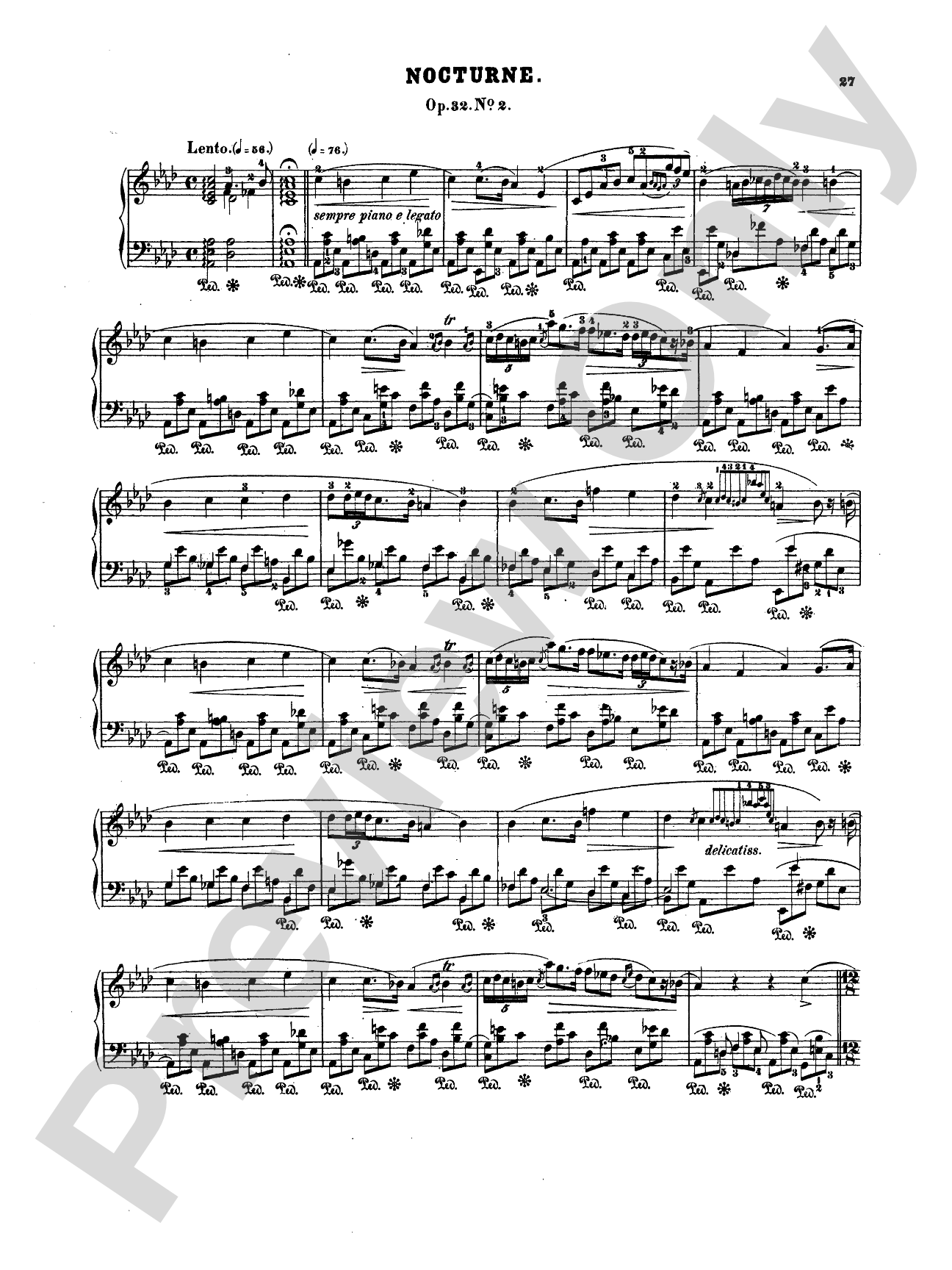

Chopin: Nineteen Nocturnes (Ed. Eduard Mertke)
By Frédéric Chopin / ed. Eduard Mertke
Level: Advanced
Item: 00-PC-0006577
$0.99
Pickup currently not available
Description
Chopin wrote the nocturnes, short pieces for solo piano, between 1827 and 1846. They are considered among the finest short solo works for piano. Although Chopin did not invent the nocturne, he popularized and expanded on it, building on the form developed by Irish composer John Field. This volume is edited and fingered by Ed Mertke, with historical and performance notes.


Don't just read it, hear it, play along with it, and watch your students grow with it. In MakeMusic Cloud, Chopin: Nineteen Nocturnes (Ed. Eduard Mertke) comes alive with professional accompaniment, adjustable tempo, and built-in practice tools that turn solo practice into real progress.
Open in the Player
Jump straight in and assign it today.
Start Your Free Trial
Open this title and explore the full library in minutes.
Sample Audio
No sample audio found.
Sample Video
No sample videos found.
Additional Details
Series:
Kalmus Edition
Publisher:
Alfred Music
Page Count:
64
SKU:
00-PC-0006577
More about this title
About the Composer: Frédéric Chopin
Frédéric Chopin (1810-1849) was a Polish composer and pianist who fundamentally reshaped the possibilities of solo piano writing during the Romantic era. His innovations in harmony, texture, and keyboard technique established him as one of the most influential figures in piano literature, with an output concentrated entirely on works for solo piano or piano with voice or small ensemble.
Chopin's nocturnes represent a pinnacle of his artistic achievement. Building on the lyrical form pioneered by John Field, he transformed the nocturne into a vehicle for intimate, ornament-rich melody supported by sophisticated accompaniment. These twenty works span his creative life and showcase his evolution from early virtuosic display to later harmonic boldness and emotional depth.
Why we love this
Chopin's nocturnes demand serious pianistic and interpretive engagement without requiring the virtuosic fireworks that can overshadow musical substance. This collection, edited and fingered by Mertke with performance and historical context, gives advanced students the roadmap they need to navigate the harmonic subtlety, ornamental decoration, and long-line singing voice that define this repertoire. Programming even a single nocturne signals artistic maturity and opens conversations about Romantic-era aesthetics in a way few other genres can.
What to expect
These nocturnes evoke intimate reverie and melancholic beauty, each shaped by Chopin's gift for spinning out a singing melody over gently rocking accompaniment. The emotional landscape ranges from nocturnal solitude and yearning to moments of passionate intensity, creating miniature emotional arcs that feel simultaneously simple and profoundly complex.
Who it's for
Advanced pianists preparing for conservatory study, upper-level university music majors, and serious adult learners ready to engage with repertoire that rewards sustained interpretive work. Students should have secure technique, comfort with ornaments and rapid figuration, and the musical maturity to sustain long melodic lines without structural support from harmonic rhythm.
How to get the most out of it
- Treat the right-hand ornamentation as vocal phrasing rather than mere decoration; each grace note and turn should serve the melodic line and breath of the phrase.
- Balance the left hand to support without overwhelming the primary melody. The accompaniment figures, while intricate, exist to frame the nocturne's song.
- Study Chopin's own recordings and period performances to hear how tempo flexibility (rubato) functioned in his artistic vision, then develop your own informed approach rather than assuming strict metronomic steadiness.
- Approach the pedal with precision tied to harmonic changes, not merely atmospheric effect; each pedal marking in the score serves structural clarity.
How to use it
A single nocturne works beautifully as a recital opener or closer, setting an introspective tone that distinguishes student programs from more athletic repertoire. Pairing two nocturnes in contrasting moods (early versus late-period, for instance) can anchor a recital's middle section and give audiences a focused experience of Chopin's stylistic range.
Skills your students will build
- Long-line phrasing and sustaining melody over broken accompaniment figures
- Ornamental realization including grace notes, turns, and trills appropriate to Romantic style
- Pedal technique coordinated to harmonic change rather than count
- Rhythmic flexibility and rubato within structural integrity
- Voicing and balancing between treble melody and inner-voice accompaniment layers
- Harmonic analysis of Chopin's chromaticism and unconventional chord progressions