
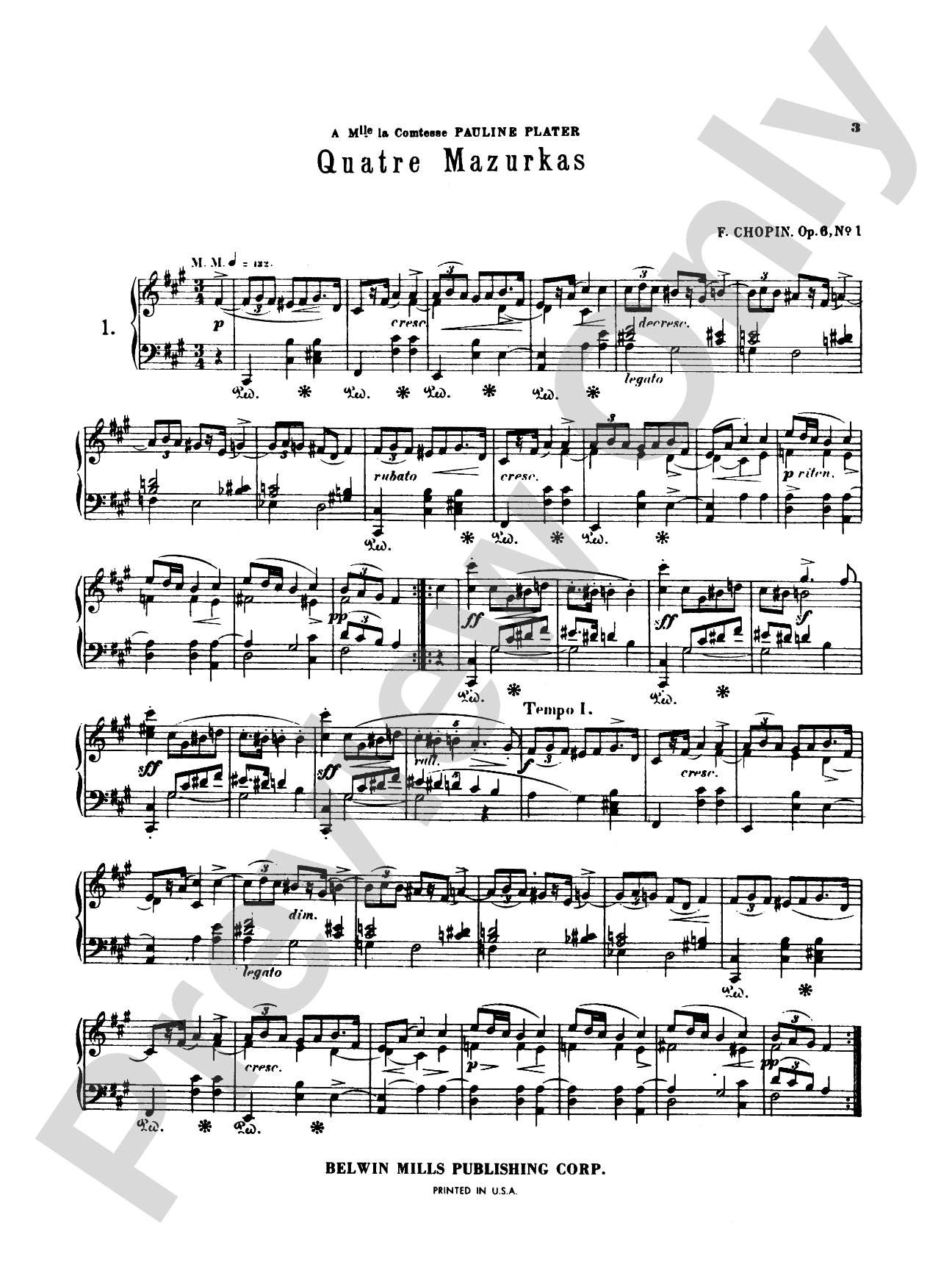

Chopin: Fifty-Six Mazurkas (Ed. Franz Liszt)
By Frédéric Chopin / ed. Franz Liszt
Level: Advanced
Item: 00-PC-0006441
$0.99
Pickup currently not available
Description
Chopin based his mazurkas on the traditional Polish folk dance, and was writing them on a regular basis between 1825 and 1849. Contains: Op. 6, No. 1 * Op. 6, No. 2 * Op. 6, No. 3 * Op. 6, No. 4 * Op. 7, No. 1 * Op. 7, No. 2 * Op. 7, No. 3 * Op. 7, No. 4 * Op. 7, No. 5 * Op. 17, No. 1 * Op. 17, No. 2 * Op. 17, No. 3 * Op. 17, No. 4 * Op. 24, No. 1 * Op. 24, No. 2 * Op. 24, No. 3 * Op. 24, No. 4 * Op. 30, No. 1 * Op. 30, No. 2 * Op. 30, No. 3 * Op. 30, No. 4 * Op. 33, No. 1 * Op. 33, No. 2 * Op. 33, No. 3 * Op. 33, No. 4 * Op. 41, No. 1 * Op. 41, No. 2 * Op. 41, No. 3 * Op. 41, No. 4 * Op. 50, No. 1 * Op. 50, No. 2 * Op. 50, No. 3 * Op. 56, No. 1 * Op. 56, No. 2 * Op. 56, No. 3 * Op. 59, No. 1 * Op. 59, No. 2 * Op. 59, No. 3 * Op. 63, No. 1 * Op. 63, No. 2 * Op. 63, No. 3 * Op. 67, No. 1 * Op. 67, No. 2 * Op. 67, No. 3 * Op. 67, No. 4 * Op. 68, No. 1 * Op. 68, No. 2 * Op. 68, No. 3 * Op. 68, No. 4 * Posthumous Mazurkas in G major, A minor, B-flat major, D major, C major, A minor, D major.


Don't just read it, hear it, play along with it, and watch your students grow with it. In MakeMusic Cloud, Chopin: Fifty-Six Mazurkas (Ed. Franz Liszt) comes alive with professional accompaniment, adjustable tempo, and built-in practice tools that turn solo practice into real progress.
Open in the Player
Jump straight in and assign it today.
Start Your Free Trial
Open this title and explore the full library in minutes.
Sample Audio
No sample audio found.
Sample Video
No sample videos found.
Additional Details
Series:
Kalmus Edition
Publisher:
Alfred Music
Page Count:
136
SKU:
00-PC-0006441
More about this title
About the Composer: Frédéric Chopin
Frédéric Chopin (1810-1849) was a Polish composer and pianist who fundamentally reshaped what the piano could express. Working primarily in Paris after leaving Poland in his early twenties, he created an intimate, virtuosic voice that emphasized lyrical melody, harmonic innovation, and technical brilliance. His influence on Romantic-era music and piano pedagogy remains unmatched.
Chopin's mazurkas occupy a unique place in his catalog. Drawing from the rhythmic and melodic character of Polish folk dances, he elevated the form across nearly three decades of composition, creating works that range from salon pieces to complex, deeply personal statements. The mazurka became his vehicle for exploring national identity, structural experimentation, and emotional subtlety.
Why we love this
This comprehensive collection gives serious pianists access to Chopin's entire mazurka output in a single, practical volume. The progression from Op. 6 through the posthumous works reveals how Chopin's compositional voice evolved over twenty-five years, from virtuosic salon brilliance to introspective, structurally adventurous writing. Programming these works across a season or year of study provides both immediate performance opportunities and deep insight into Romantic piano music.
What to expect
These mazurkas move between elegant salon grace and profound introspection, carrying the pulse and spirit of Polish folk tradition into concert music of sophistication and depth. You'll encounter moments of lyrical tenderness, sudden harmonic surprises, brilliant fingerwork, and the peculiar rhythmic swing that makes the mazurka instantly recognizable even as Chopin transforms it across fifty-six variations.
Who it's for
Advanced pianists preparing for recital programming, auditions, competitions, or advanced study should explore this collection systematically. Teachers seeking repertoire for upper-level students will find an unmatched resource for building interpretive maturity, harmonic understanding, and national music awareness.
How to get the most out of it
- Approach the rhythmic character of the mazurka as dance-derived but not strictly metered; Chopin's rubato in these pieces is structural, not ornamental, so shape phrases around the natural accent patterns of the Polish folk source rather than forcing even time.
- Listen carefully to the left hand as an independent voice, especially in the later mazurkas where Chopin uses inner voices and harmonic movement to create textural depth that equals the melodic line.
- Examine the specific ornamentation in each piece; Chopin's grace notes, turns, and embellishments are integral to phrasing and harmony, not decorative additions, so allow them to breathe organically within the tempo.
- Balance the technical passages and finger-work with vocal simplicity in the songlike sections; the contrast between virtuosity and intimacy defines much of this repertoire.
How to use it
Select individual mazurkas or small groupings for recital opening movements, concert interludes, or encores; their relatively compact scale and emotional directness make them ideal for varied programming. Advanced students can develop personal recital programs entirely from this collection, creating thematic connections across different opuses to showcase interpretive growth.
Skills your students will build
- Understanding rhythmic flexibility and rubato in Romantic repertoire
- Harmonic analysis of chromaticism and voice leading in the nineteenth century
- Interpretive choices within national musical forms and folk idiom
- Textural independence between right and left hands
- Expressive ornamentation and its relationship to melodic shape
- Pedal techniques for color and resonance in lyrical passages