
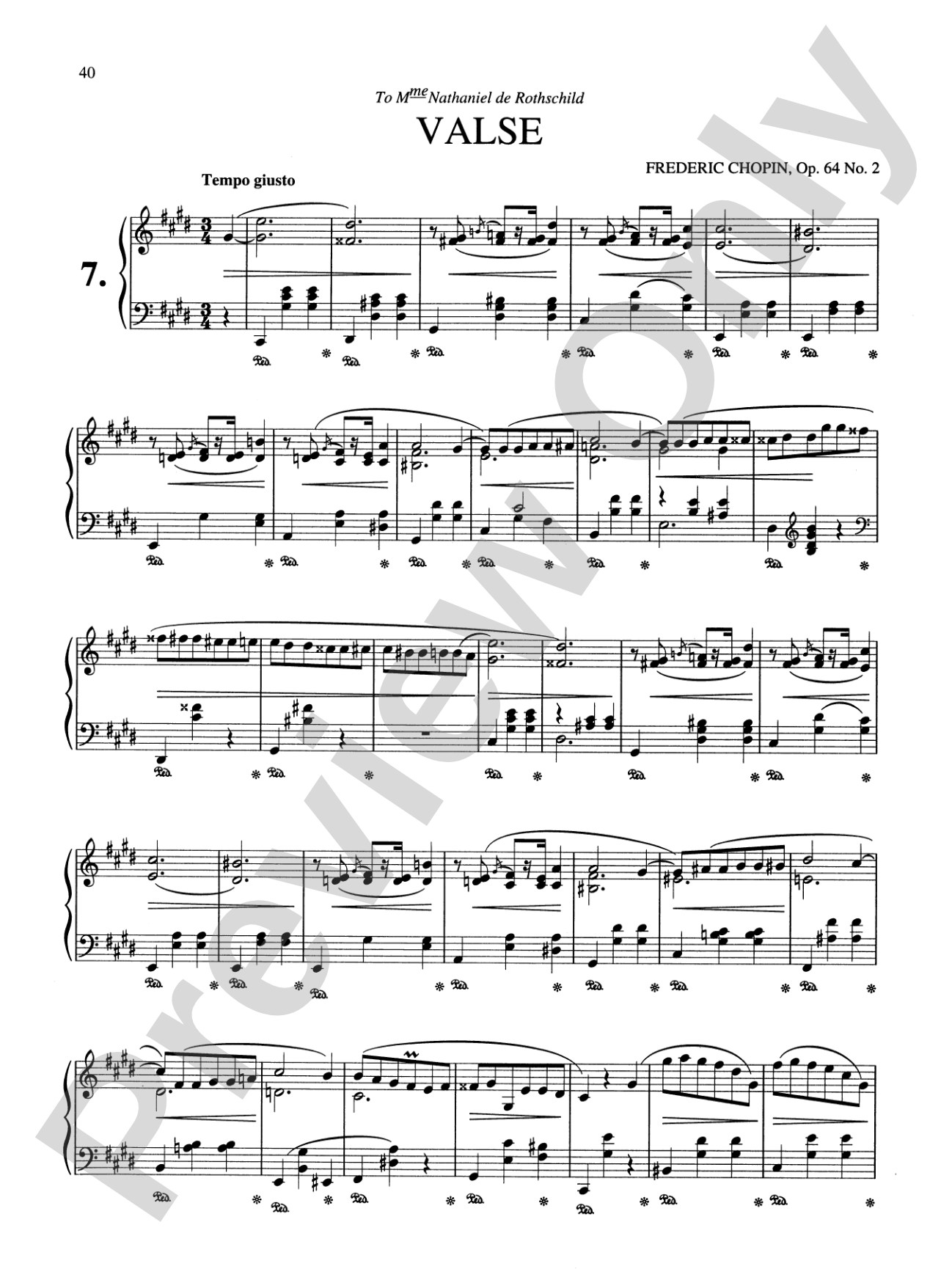

Chopin: Fifteen Waltzes
By Frédéric Chopin
Item: 00-PC-0003560
$0.99
Pickup currently not available
Description
Frédéric Chopin's Waltzes are much different than the earlier Viennese waltzes in that they were not designed for dancing but for concert performance. Chopin started writing waltzes in 1824, when he was fourteen, and continued until the year of his death, 1849. Contains: Grand Valse Brillante, Op. 18 * Valse Brillante, Op. 34, No. 1 * Valse Brillante, Op. 34, No. 2 * Valse Brillante, Op. 34, No. 3 * Valse, Op. 42 * Valse, Op. 61, No. 1 * Valse, Op. 64, No. 2 * Valse, Op. 64, No. 3 * Valse, Op. 69, No. 1 * Valse, Op. 69, No. 2 * Valse, Op. 70, No. 1 * Valse, Op. 70, No. 2 * Valse, Op. 70, No. 3 * Valse in E Minor (Post.) * Valse in E Major (Post.).


Don't just read it, hear it, play along with it, and watch your students grow with it. In MakeMusic Cloud, Chopin: Fifteen Waltzes comes alive with professional accompaniment, adjustable tempo, and built-in practice tools that turn solo practice into real progress.
Open in the Player
Jump straight in and assign it today.
Start Your Free Trial
Open this title and explore the full library in minutes.
Sample Audio
No sample audio found.
Sample Video
No sample videos found.
Additional Details
Series:
Kalmus Edition
Publisher:
Alfred Music
Page Count:
76
SKU:
00-PC-0003560
More about this title
About the Composer: Frédéric Chopin
Frédéric Chopin (1810-1849) reshaped the piano's role in concert music, moving away from the virtuosic display pieces that dominated his era toward works of intimate harmonic innovation and lyrical depth. A Polish composer who spent much of his adult life in Paris, Chopin developed a compositional language that transformed the Romantic piano into an instrument capable of singing with unprecedented expressiveness, influencing generations of composers and pianists who followed.
His approach to the waltz form stands as one of his most significant contributions to music history. Rather than composing dances for ballrooms, Chopin elevated the waltz to the recital hall, infusing the three-beat framework with harmonic subtlety, emotional complexity, and technical demands that made these pieces vehicles for artistic expression rather than mere social entertainment.
Why we love this
These waltzes reveal how Chopin transformed a popular dance form into concert art without abandoning the grace and lyricism that made the genre beloved. Your advanced students will encounter works that demand genuine musicianship alongside technical facility: rubato must serve the phrase, not undermine it; ornamentation must emerge from harmonic logic; and the left hand must support the melody with elegance rather than mere accompaniment. The collection spans nearly three decades of his output, so you can program individual pieces across multiple recitals or pair them thematically to illustrate his stylistic evolution.
What to expect
Chopin's waltzes shimmer with elegance and underlying melancholy. The early Brillante waltzes sparkle with virtuosic passagework and lyrical grace, while the later pieces grow more introspective, layering unexpected harmonies beneath familiar waltz rhythms. Even in moments of brilliance, there is always an undercurrent of yearning, a reminder that these are salon pieces heard in concert halls, not ballroom music meant for dancing.
Who it's for
Advanced pianists preparing for recital or competition will find a substantial body of concert repertoire that balances technical display with genuine emotional content. Teachers seeking to expand their students' experience of the Romantic era beyond concertos and sonatas will appreciate how these pieces illuminate Chopin's compositional voice while remaining more accessible than his nocturnes or études in terms of scope.
How to get the most out of it
- Approach the left-hand accompaniment as a partner to the melody, not a backdrop. Chopin's waltz left hands often contain their own rhythmic and harmonic interest; listen to how figures support or counterpoint the right-hand line rather than simply marking time.
- Establish the dance frame early in each piece, but let rubato emerge gradually. The 3/4 pulse should feel inevitable rather than rigid; flexibility in tempo works only when listeners sense the underlying metric foundation.
- Shape phrases across the natural breath points rather than stopping at the barline. Many of these waltzes contain long melodic arcs; finding where they rise and fall will guide your use of pedal and dynamics more naturally than harmonic analysis alone.
- Attend to the transitions between sections, especially in the longer Brillante waltzes. Chopin often modulates through unexpected harmonic moves; these moments are best served by clear voicing and a slight ease in tempo that lets listeners absorb the new tonal center.
How to use it
Feature the Grand Valse Brillante, Op. 18 as a showpiece recital opener or midpoint lift, then follow with quieter, later waltzes to demonstrate the genre's range across Chopin's lifetime. Individual waltzes work beautifully in mixed recitals or student solo competitions, and the collection's variety allows you to select pieces that suit different technical strengths and musical temperaments.
Skills your students will build
- Romantic-era rubato and its relationship to metric stability
- Voice leading in the left hand to support rather than accompany
- Harmonic analysis and modulation in extended tonal structures
- Pedal technique to sustain harmonic wash without muddying texture
- Phrasing across sectional boundaries and structural divisions
- Left-hand independence and rhythmic flexibility separate from the right hand