
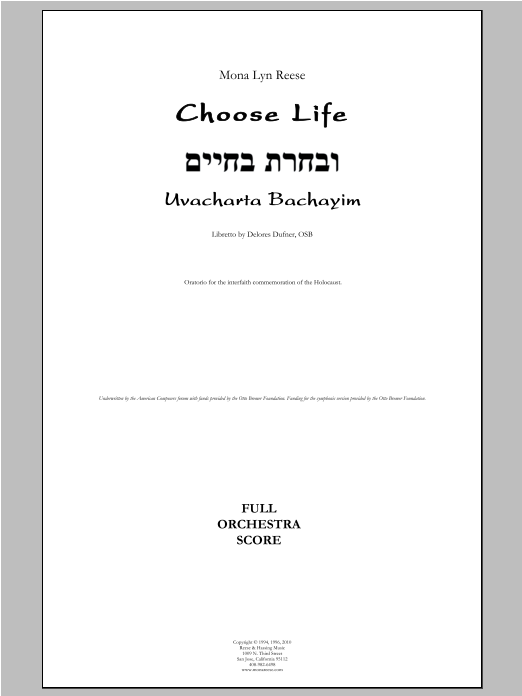

Choose Life, Uvacharta Bachayim-Full Orchestra: String Orchestra Conductor Score & Parts
Arranged by Mona Lyn Reese
Item: 35-PK00285649
$108.05
Pickup currently not available
Buy Extra Parts (Digital PDF Download)
Parts Added to Cart!
Description
Choose Life combines solos, choruses, and a narrator. Gregorian chant, polyphonic motets, Anglican verse and choral anthems, Jewish modes and hymnody, recitative, and Klezmer music blend to create the score. The music and text express bitterness, anguish, anger, our sorrow and need for comfort, our will to overcome evil, and our determination to choose life over death. The readings were selected from Holocaust survivors' writings. Choose Life is staged with singers in costumes, minimal sets, lighting, and choreography. Many musical styles and sounds occur in the score. The music of Adonai and Lazar includes traditional Jewish modes and hymnody, recitative, and klezmer music. Music in the Christian tradition such as Gregorian chant, polyphonic motets, Anglican Verse and Choral anthems also appear in the work. see www.chooselife-music.com Duration: 50:00


Choose Life, Uvacharta Bachayim-Full Orchestra: String Orchestra Conductor Score & Parts isn't in MakeMusic Cloud just yet...but it could be. Let us know you'd like to see it, and you'll help shape what comes next. In the meantime, start a free trial and dive into thousands of interactive titles your students can play along with today.
Request This Title
Tell us you want it.
Start Your Free Trial
Explore everything that's ready to play right now.
Sample Audio
No sample audio found.
Sample Video
No sample videos found.
Additional Details
Publisher:
Hal Leonard
SKU:
35-PK00285649
More about this title
Why we love this
Choose Life demands something rare from conductors and ensembles: the ability to navigate radically different musical languages within a single, cohesive statement. The string writing holds everything together while the score moves between Gregorian chant, klezmer idioms, Anglican anthems, and Jewish modal music. This is ambitious repertoire that forces your musicians to expand their stylistic range and deepens their understanding of how music carries meaning across traditions.
What to expect
Solemn and searching, moving from lamentation through anger toward a hard-won resolve. The interweaving of sacred musical languages creates moments of profound beauty alongside raw, unpolished anguish. By the end, you sense witness and testimony rather than catharsis.
Who it's for
String orchestras preparing ambitious, socially conscious concert works that engage with difficult history and multiple cultural traditions. This score fits programs at the advanced high school or college level where musicians have the stylistic flexibility and emotional maturity to do the material justice.
How to get the most out of it
- Study the Holocaust survivor testimonies that underpin the text. Your musicians don't need to perform this work as historical recreation; they need to understand the emotional weight they're supporting.
- Work closely with your staging director and lighting designer from the start. The choreography, costumes, and lighting are integral to how audiences receive the music, not ornamental additions.
- Balance the soloists and chorus carefully during rehearsals. The narrator and singers share storytelling duties, and clarity requires intentional attention to blend and balance across the ensemble.
- Let the different musical idioms speak in their own voice. Resist the urge to homogenize the score; the Klezmer passages should sound Klezmer, the Gregorian chant should breathe liturgically, the polyphonic sections should layer transparently.
How to use it
Reserve this for a full concert or a substantial portion of a program where it can breathe without competition. The 50-minute duration and staging requirements make it a centerpiece work. Consider pairing it with a post-performance conversation or study guide for your audience.
Skills your students will build
- Conducting and performing across multiple sacred and secular musical traditions
- Sight-reading modal and Klezmer idioms outside Western common practice tonality
- Collaborating with soloists, narrators, and staging teams in a fully staged work
- Sustaining ensemble focus and emotional commitment over an extended narrative arc
- Balancing transparency in dense polyphonic textures with directional phrasing in recitative passages