
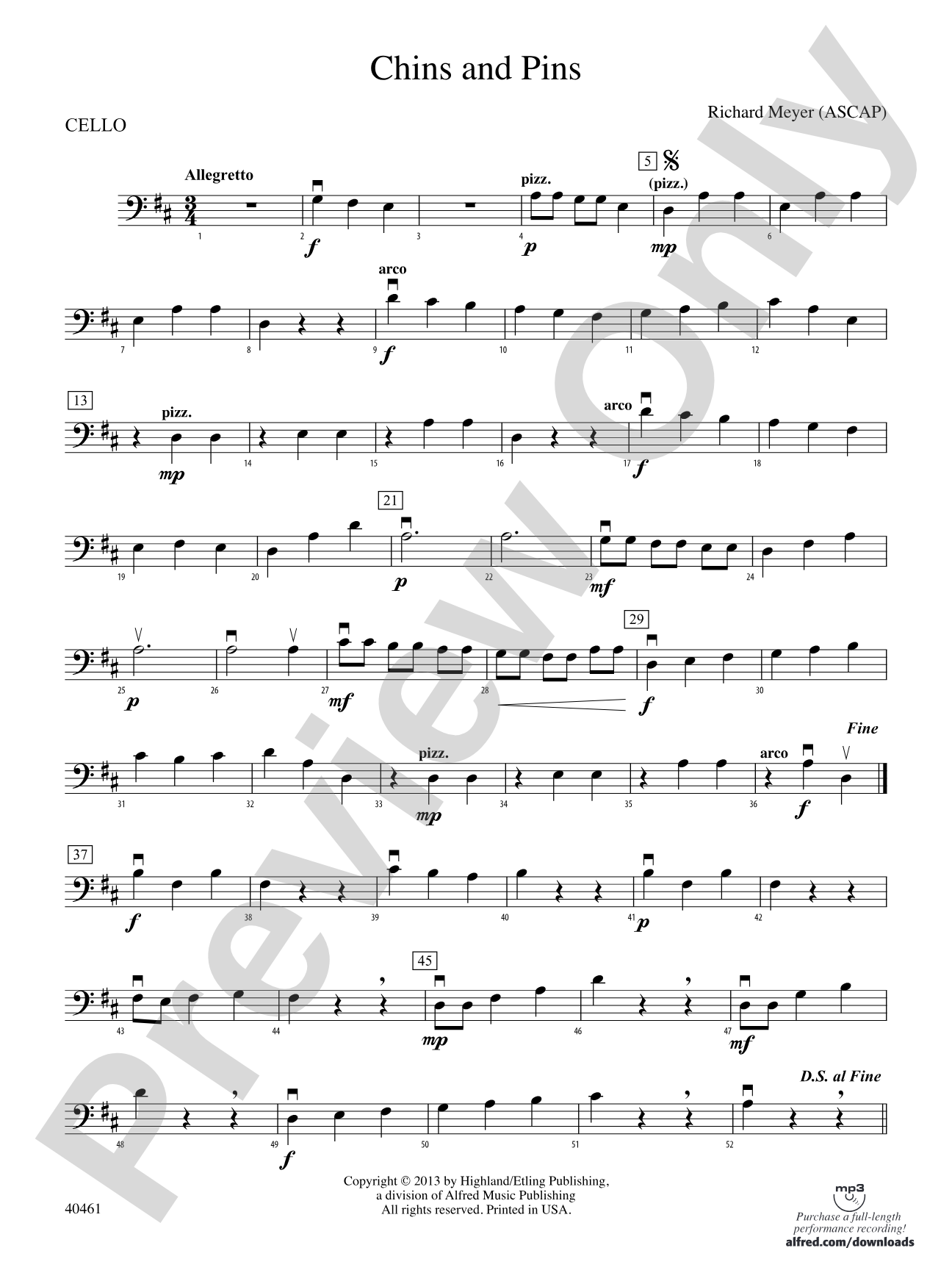

Chins and Pins: Cello
By Richard Meyer
Grade: 0.5
Item: 00-PC-0015994_VC1
$5.99
Pickup currently not available
Description
It's a musical conversation between the Chins (violins and violas) and the Pins (cellos and basses)! Your beginning orchestra will love this simple yet fun piece that is perfect for their first "note-reading" concert. Students will learn the role of melody and accompaniment as one group's phrase is answered, always in contrary motion, by the second group. Frequent changes from arco to pizzicato will keep everyone on their toes! Uses only the notes of the D Major scale, and includes piano accompaniment and violin III parts. Correlates to String Explorer, Book 1, Unit 9.


Don't just read it, hear it, play along with it, and watch your students grow with it. In MakeMusic Cloud, Chins and Pins: Cello comes alive with professional accompaniment, adjustable tempo, and built-in practice tools that turn solo practice into real progress.
Open in the Player
Jump straight in and assign it today.
Start Your Free Trial
Open this title and explore the full library in minutes.
Sample Audio
1
Audio File
--:--
0:00
0:00
Sample Video
No sample videos found.
Additional Details
Series:
Highland/Etling String Explorer
Publisher:
Alfred Music
Page Count:
72
SKU:
00-PC-0015994_VC1
More about this title
About the Composer: Richard Meyer

Richard Meyer spent 35 years teaching strings across elementary, middle, and high school levels in Southern California public schools. At Oak Avenue Intermediate School in Temple City, he directed orchestras for 22 years, expanding the program from 29 to 200 students while also overseeing the city's elementary string curriculum. He led the Pasadena Youth Symphony Orchestra for 16 years, taking them on performance tours to New York, Washington D.C., Vienna, Australia, and Canada.
Beyond the classroom and rehearsal hall, Meyer has become a nationally recognized composer with nearly 200 published works and arrangements. He served as string editor for Alfred Publishing Company for 16 years and co-authored the String Explorer series and Sight-read It for Strings. His "Giving Bach" program, launched in 2009, uses interactive concerts to reach special needs and underserved students throughout Southern California and has earned national recognition for its innovative approach. Meyer has been a featured clinician at the A.S.T.A. National Conference, the Texas Orchestra Directors' Association Conference, and university workshops nationwide, and regularly guest-conducts All-State and Honor Orchestras.
Why we love this
This piece solves a genuine teaching need: it gives beginners a musically engaging experience of call-and-response without overwhelming them technically. The contrary motion between Chins and Pins creates an immediate aural sense of balance and conversation that students can hear and feel, making abstract concepts like melody and accompaniment concrete. The frequent arco-to-pizzicato switches add playfulness and keep young players invested while staying within their technical reach.
What to expect
Playful and conversational, like two groups of musicians trading musical phrases back and forth. The contrary motion gives it a sense of balance and symmetry, while the pizzicato breaks keep the mood light and engaging. It feels achievable and fun, the kind of piece that makes young musicians want to come back to rehearsal.
Who it's for
Beginning orchestra students ready for their first concert experience, especially those working through String Explorer Book 1. This piece rewards accurate note-reading and introduces basic orchestration concepts without demanding advanced shifting or complex rhythms.
How to get the most out of it
- Prepare the pizzicato passages separately in sectionals. Mark the exact moments of transition in all parts so the shift happens cleanly and simultaneously across both groups.
- Shape each phrase as a complete musical thought, even though it's short. Train students to listen for where the Chins' line ends and the Pins' answer begins, creating a responsive dialogue rather than static back-and-forth.
- Use the piano accompaniment to anchor intonation and help students hear the harmonic context. This grounds them in D Major and provides security for inexperienced players.
- Balance dynamics between the two groups carefully. The answering figure should neither disappear nor overshadow the opening phrase; equal presence makes the conversation work musically.
How to use it
Place this as the centerpiece of a beginner concert where the focus is celebrating solid fundamentals and musical communication. Its novelty character and clear structure make it an ideal opener or closer, setting a confident, approachable tone for an audience that includes families new to string music.
Skills your students will build
- Reading and sustaining notes within the D Major scale
- Executing clean arco-to-pizzicato transitions
- Understanding melodic and accompanimental roles within an ensemble texture
- Responding to phrase structure and musical dialogue
- Maintaining ensemble balance and blend across sections