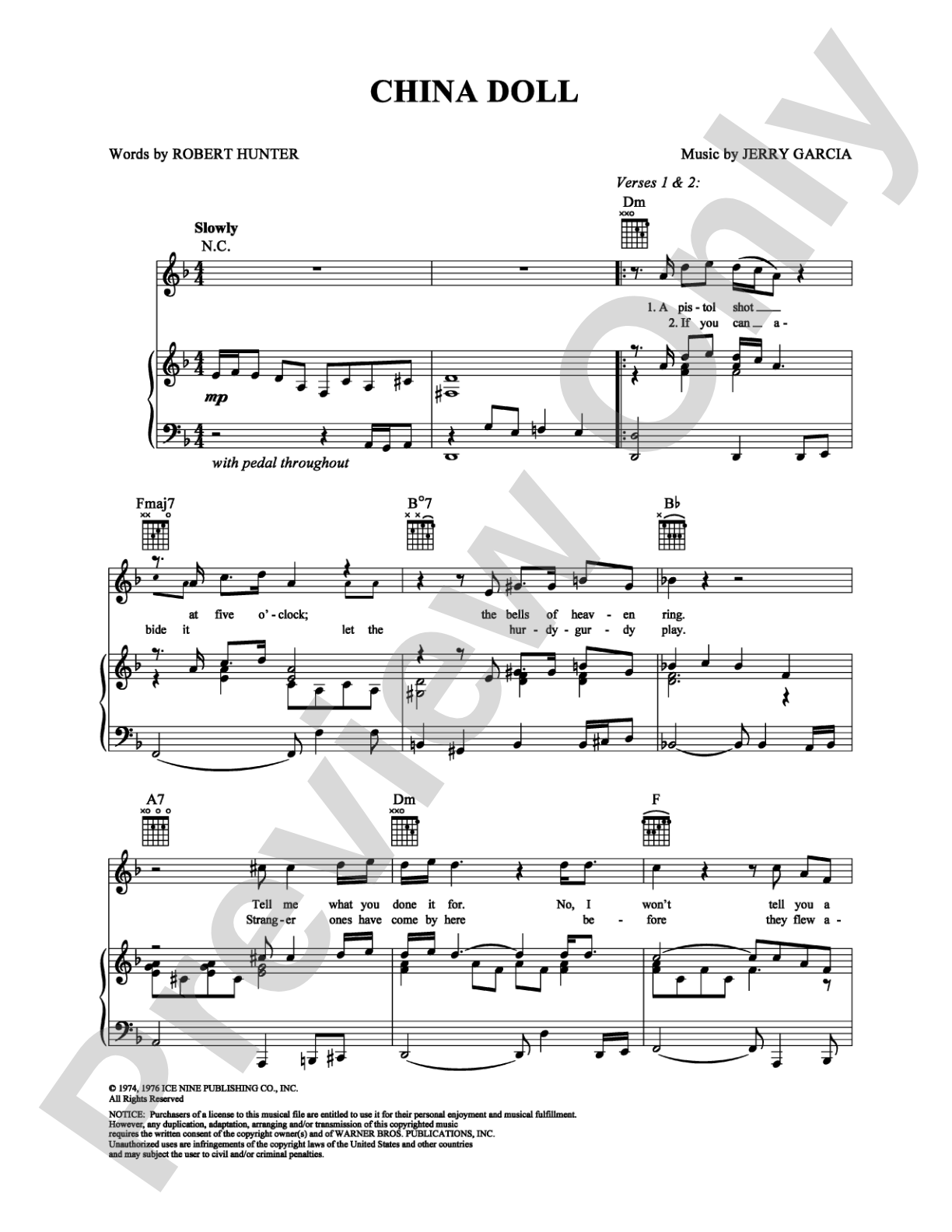
China Doll: Piano/Vocal/Chords Digital Sheet Music

China Doll: Piano/Vocal/Chords Digital Sheet Music

Jerry Garcia, Grateful Dead

Item: 00-PS-0009199

Digital Download
$2.95
Description

China Doll: Piano/Vocal/Chords Digital Sheet Music isn't in MakeMusic Cloud just yet...but it could be. Let us know you'd like to see it, and you'll help shape what comes next. In the meantime, start a free trial and dive into thousands of interactive titles your students can play along with today.

Sample Audio
No sample audio found.
Sample Video
Additional Details
SKU: 00-PS-0009199

More about this title

About the Artist: Grateful Dead

The Grateful Dead emerged from the San Francisco Bay Area in the mid-1960s as pioneers of jam-band rock, blending folk, blues, country, and psychedelic influences into a sound that prioritized exploration and improvisation. Their decades-long career produced hundreds of original compositions alongside interpretations of standards, establishing them as influential figures in American popular music and live performance.

Why we love this

"China Doll" captures the band's gift for marrying melodic simplicity with emotional depth, making it accessible for pianists and singers while preserving the harmonic richness that draws listeners back. The piano/vocal/chords format invites arrangers and accompanists to find their own interpretive voice within the song's framework, much as the Dead themselves approached their material.

What to expect

Introspective and grounded, with the kind of quiet intensity that comes from plainspoken lyrics paired with thoughtfully constructed chords. The music feels both intimate and spacious, inviting the performer to inhabit the emotional landscape rather than race through the form.

Who it's for

Pianists and singer-pianists with intermediate harmonic literacy who want to explore 1970s rock songwriting and performers building repertoire beyond classical or contemporary pop standards. This arrangement also serves accompanists preparing to support vocalists in recital or rehearsal contexts.

How to get the most out of it

  • Explore the chord voicings with attention to color rather than literal notation; the piano part should breathe and support the vocal line without overwhelming it.
  • Let the rhythm settle into a natural pocket that allows the lyrics to land clearly; Grateful Dead material often improves when phrasing is prioritized over metronomic precision.
  • Balance the dynamic arc of the melody against the harmonic movement; this piece rewards singers who listen to where the chords pull the voice.

How to use it

Program alongside other introspective American songwriting to show students the compositional lineage between folk and rock traditions. It works well in a showcase of 1970s material or as a recital piece that demonstrates how a simple melody becomes memorable through harmonic support.

Skills your students will build

  • Reading piano/vocal/chord chart notation
  • Balancing vocal melody against piano accompaniment
  • Interpreting rock harmony in a classical or art song context
  • Phrasing and rubato in rock-influenced repertoire

You May Also Like