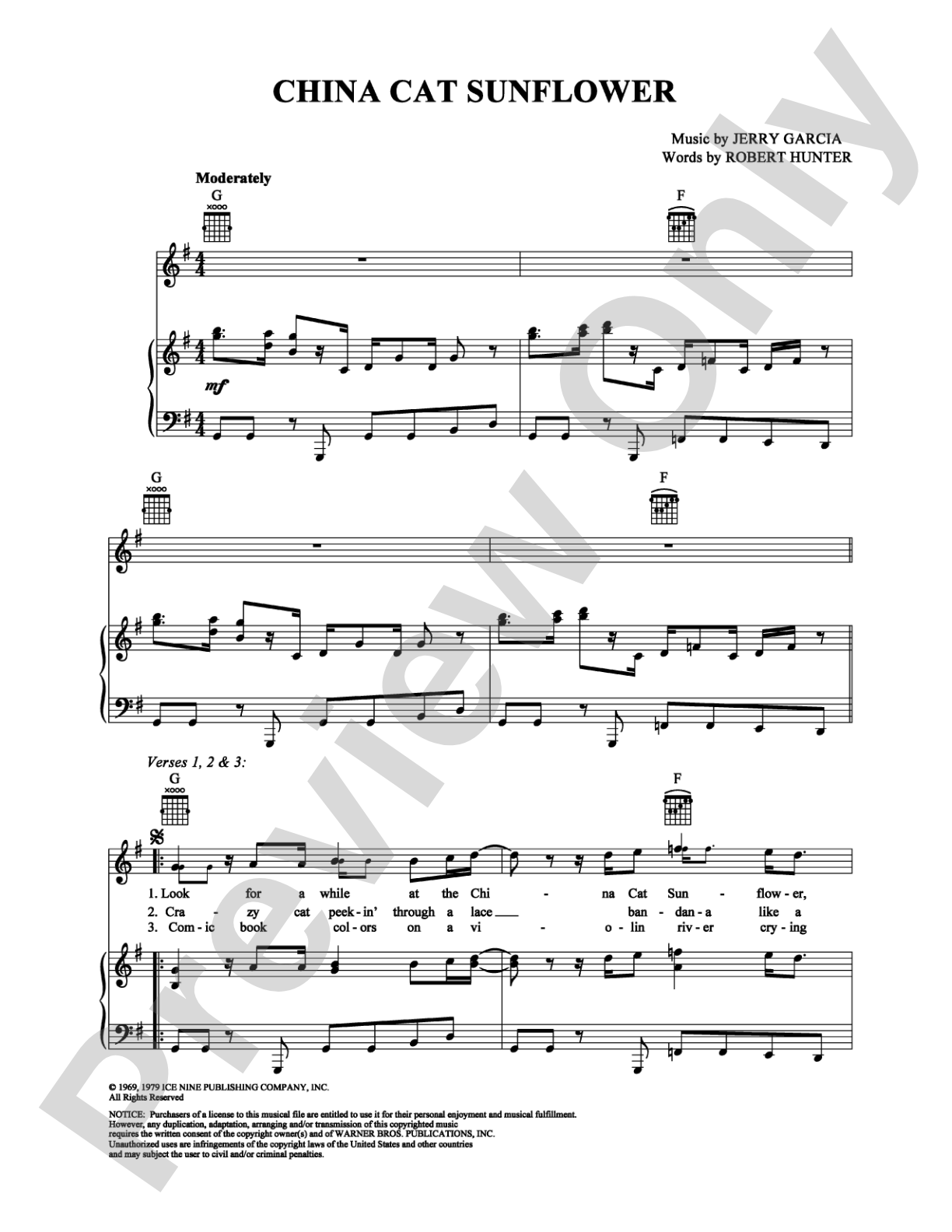
China Cat Sunflower: Piano/Vocal/Chords Digital Sheet Music

China Cat Sunflower: Piano/Vocal/Chords Digital Sheet Music

Jerry Garcia, Grateful Dead

Item: 00-PS-0006670

Digital Download
$2.95
Description

China Cat Sunflower: Piano/Vocal/Chords Digital Sheet Music isn't in MakeMusic Cloud just yet...but it could be. Let us know you'd like to see it, and you'll help shape what comes next. In the meantime, start a free trial and dive into thousands of interactive titles your students can play along with today.

Sample Audio
No sample audio found.
Sample Video
Additional Details
SKU: 00-PS-0006670

More about this title

About the Artist: Grateful Dead

The Grateful Dead emerged from the San Francisco Bay Area in the mid-1960s as pioneers of psychedelic rock and improvisational ensemble playing. Led by Jerry Garcia, the band built a devoted following through their extended jam sessions, intricate musical conversations, and willingness to reimagine songs night after night. Their influence extends far beyond rock music into jazz, bluegrass, and experimental music education, making them foundational figures in understanding how improvisation and collective listening drive musical conversation.

The Dead's approach to composition and arrangement prioritized emotional expression over rigid structure, inviting musicians to find their own voice within a composition. This philosophy has made their catalog invaluable for educators teaching students how to balance written material with interpretive freedom, and how to listen actively to ensemble partners.

Why we love this

China Cat Sunflower captures the essence of the Dead's compositional voice: a song that invites personal interpretation while maintaining strong melodic and harmonic structure. The piano/vocal/chords arrangement opens this material to singers and pianists outside the original rock ensemble context, making it accessible for recital, educational performance, or studio exploration. Vocalists and pianists working with this piece engage directly with how a song can shift meaning through arrangement while staying true to its lyrical and emotional core.

What to expect

Introspective and expansive simultaneously, with imagery-rich lyrics that unfold over a harmonic landscape encouraging both reflection and motion. The song has a hypnotic, flowing quality that invites the performer and listener into a dreamlike space, balancing intimacy with subtle complexity.

Who it's for

Singers and pianists seeking repertoire that bridges rock songwriting with accessible chamber or recital performance. This arrangement works for advanced high school vocalists, college-level students exploring American popular song, or experienced amateur performers interested in classic songwriting outside the classical tradition.

How to get the most out of it

  • Let the chord changes breathe; this song rewards harmonic awareness rather than rushing through phrases. Notice where the progression expands or contracts, and use rubato to highlight those moments.
  • Balance the vocal line with piano accompaniment so the melody remains clear without drowning the harmonic interest underneath. The piano arrangement likely contains countermelody or comping patterns worth bringing into the foreground strategically.
  • Experiment with dynamics and touch to find the song's narrative arc; China Cat Sunflower benefits from dynamic contrast that reflects lyrical shifts and emotional weight.
  • Work from the chord symbols to understand voice leading and substitution possibilities. This encourages pianists to develop their own comping voice rather than strictly following a single arrangement.

How to use it

Include this in a recital exploring American songwriting across genres, or pair it with folk or singer-songwriter material to show how rock compositions can translate into acoustic, intimate settings. It also works well as a bridge between classical and contemporary repertoire when building a diverse mixed recital, particularly for students discovering their voice in non-classical contexts.

Skills your students will build

  • Reading and interpreting chord symbols in a lead-sheet format
  • Balancing melodic clarity with harmonic accompaniment in piano/vocal textures
  • Understanding lyrical phrasing and how narrative shapes musical interpretation
  • Applying rubato and dynamic shaping to extend meaning in popular song arrangements
  • Developing comping skills and personal voice through chord-based improvisation

You May Also Like