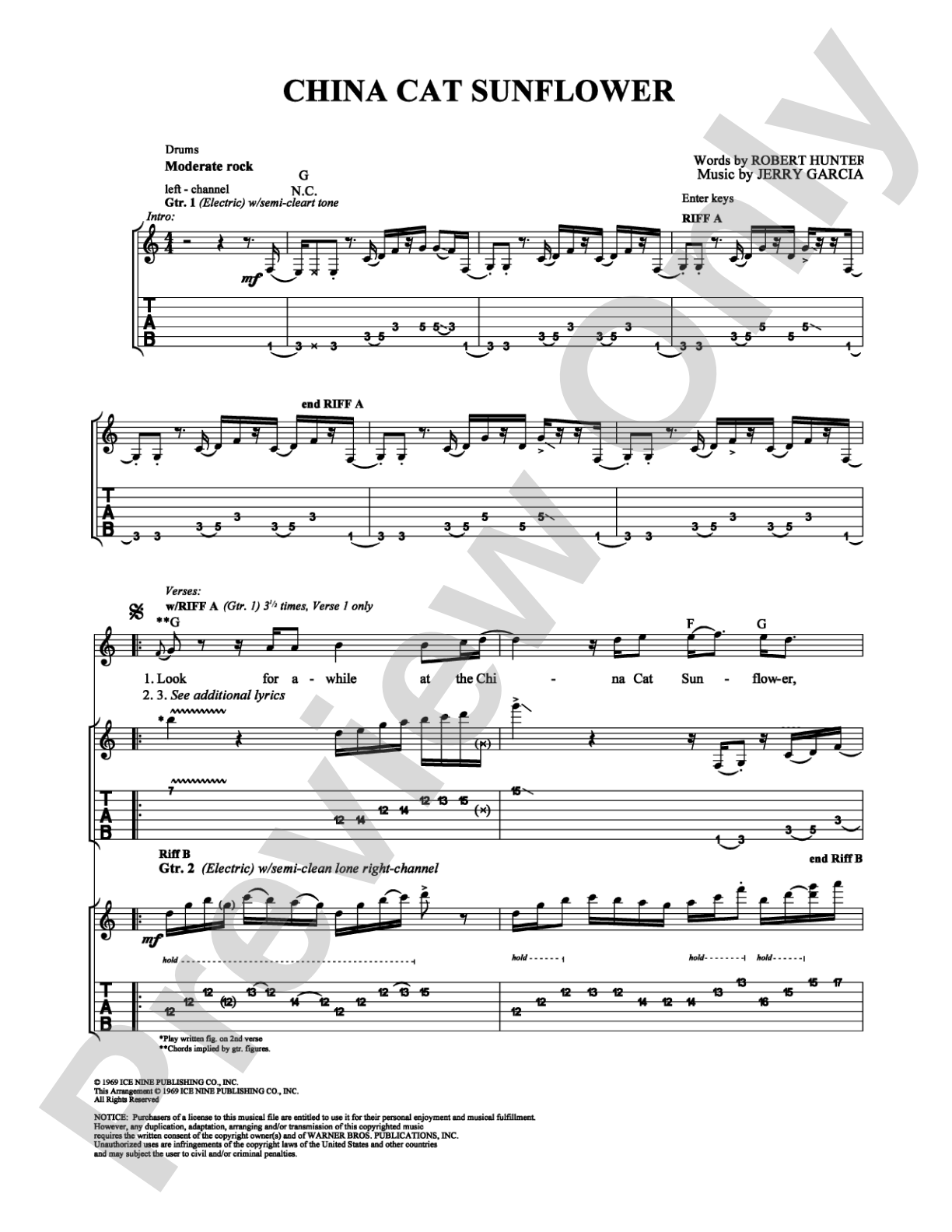
China Cat Sunflower: Guitar TAB Digital Sheet Music

China Cat Sunflower: Guitar TAB Digital Sheet Music

Jerry Garcia, Grateful Dead

Item: 00-PS-0000271

Digital Download
$2.95
Description

China Cat Sunflower: Guitar TAB Digital Sheet Music isn't in MakeMusic Cloud just yet...but it could be. Let us know you'd like to see it, and you'll help shape what comes next. In the meantime, start a free trial and dive into thousands of interactive titles your students can play along with today.

Sample Audio
No sample audio found.
Sample Video
Additional Details
SKU: 00-PS-0000271

More about this title

About the Artist: Grateful Dead

The Grateful Dead emerged from the San Francisco Bay Area in the mid-1960s as architects of a distinctive improvisational rock sound that blended folk, blues, country, and psychedelia. Led by guitarist Jerry Garcia and lyricist Robert Hunter, the band became known for extended jam sessions, intricate instrumental arrangements, and a devoted following that documented and shared live performances across decades. Their influence on rock guitar playing, ensemble dynamics, and the culture of live music remains profound in music education and popular music study.

Garcia's guitar work in particular set a standard for fluid, conversational playing across multiple tunings and styles. The band's songwriting explored complex compositional ideas within a rock framework, making their catalog valuable for students learning how popular music can accommodate sophistication and experimentation alongside accessibility.

Why we love this

This song showcases the kind of melodic clarity and rhythmic sophistication that makes the Grateful Dead's catalog work so well for guitar students moving into jam-based and improvisational contexts. The TAB format gives players a direct path into the band's signature guitar textures without requiring transcription skills, making the piece immediately playable while still demanding attention to phrasing and timing.

What to expect

Luminous and floating, with a gentle rhythmic propulsion underneath intricate, lyrical guitar work. The song captures a sense of ease and natural momentum, inviting the listener into a spacious sound world where individual notes have room to resonate and shimmer.

Who it's for

Guitar students who are ready to engage with jam-based rock styles and want to build fluency in improvisation within a band context. This piece works well for intermediate to advanced players exploring how melodic lines function in ensemble settings and how open tunings shape the acoustic character of rock guitar.

How to get the most out of it

  • Pay close attention to the recorded version's articulation and note spacing; the Grateful Dead's strength lies in how notes breathe rather than how fast they move.
  • Experiment with the tuning indicated in the TAB. Open and alternate tunings change the resonance and fingering comfort of the part, so confirm your tuning against the original before locking into muscle memory.
  • Balance precision with feel. These parts are notated precisely, but the band's performances often stretch time slightly for expressive effect; use the TAB as your harmonic and melodic anchor while letting your phrasing respond to the rhythm section.
  • Listen across multiple live versions. The Grateful Dead performed this song hundreds of times with subtle variations; studying different recordings helps you understand which elements are core to the song and which invite interpretation.

How to use it

Feature this in a rock or popular music unit where students study improvisation and ensemble interplay beyond traditional jazz contexts. It pairs naturally with other Grateful Dead songs or classic rock pieces that emphasize guitarists working within and around a groove rather than over it.

Skills your students will build

  • Reading and executing guitar TAB notation
  • Adapting fingering to alternate tunings
  • Phrasing and articulation for melodic clarity in a group setting
  • Listening and responding to rhythmic and harmonic anchors during improvisation
  • Understanding the relationship between guitar texture and overall band sound

You May Also Like