China Boy: Piano Digital Sheet Music

China Boy: Piano Digital Sheet Music

Dick Winfree, Phil Boutelje, Freddie Slack

Item: 00-PS-0007236

Digital Download
$3.99
Description

China Boy: Piano Digital Sheet Music isn't in MakeMusic Cloud just yet...but it could be. Let us know you'd like to see it, and you'll help shape what comes next. In the meantime, start a free trial and dive into thousands of interactive titles your students can play along with today.

Sample Audio
No sample audio found.
Sample Video
Additional Details
SKU: 00-PS-0007236

More about this title

About the Artist: Freddie Slack

Freddie Slack was a pianist, bandleader, and composer who became a key figure in West Coast jazz during the 1940s and 1950s. He led his own orchestras and appeared frequently on radio broadcasts, where his smooth piano style and accessible arrangements helped bring jazz to mainstream audiences. His compositions and recordings bridged the gap between swing and early bebop, making him an important voice in jazz history during a pivotal era.

Slack's work as a pianist emphasized clarity and groove over virtuosic display, an approach that made his music both engaging for listeners and playable for musicians of varying skill levels. He collaborated with many notable jazz artists and remained active in music throughout his career, leaving behind a catalog of standards and original compositions that continue to showcase the elegance of mid-century jazz piano.

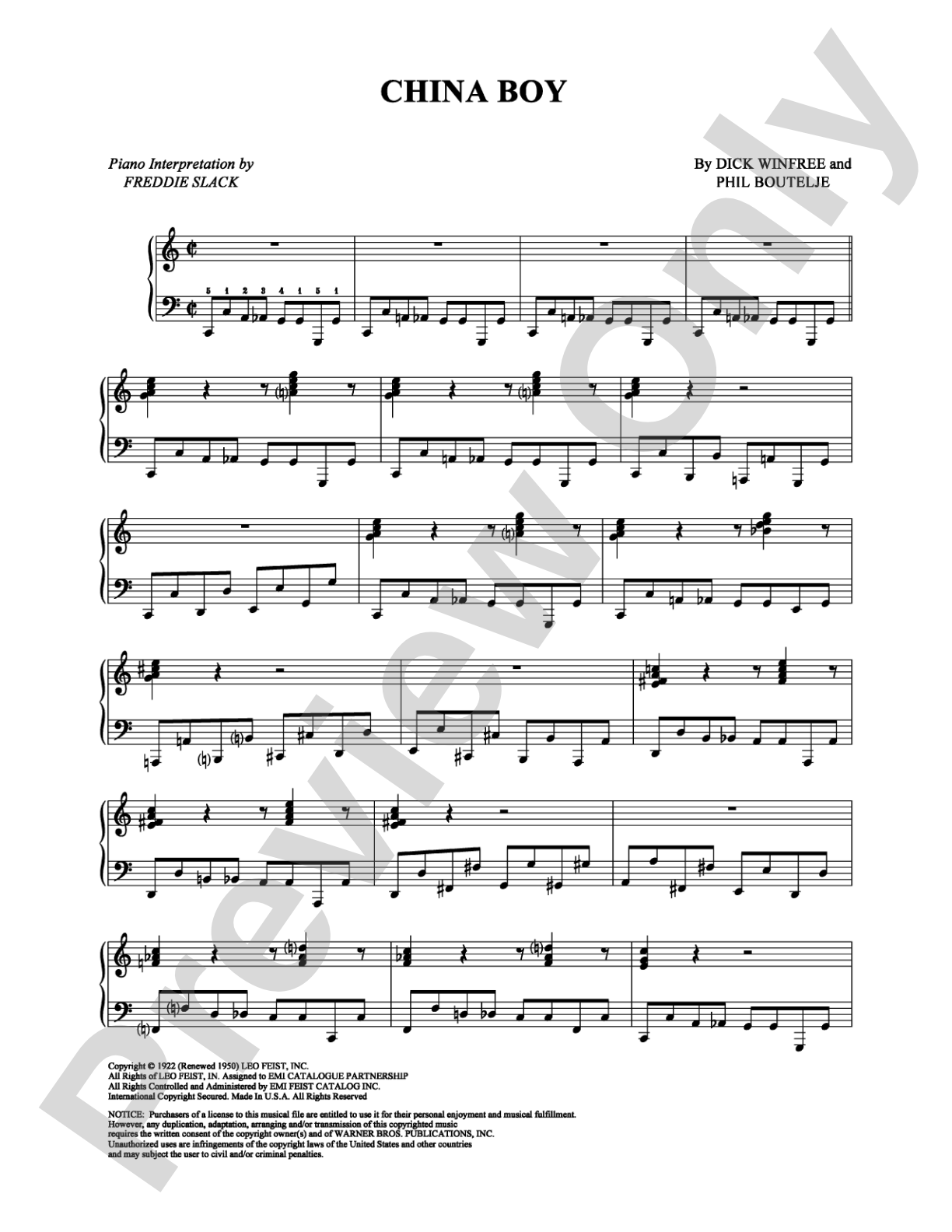
Why we love this

China Boy is a jazz standard with irresistible melodic charm, and Slack's treatment respects both the tune's singability and its swinging potential. The piece sits perfectly for pianists exploring jazz repertoire at the intermediate level, offering enough harmonic interest to keep things musical without requiring advanced comping or improvisation skills. It's the kind of piece that sounds great in a recital, builds repertoire for jazz combos, and reminds students why these classic tunes have lasted for decades.

What to expect

Cheerful and sophisticated, China Boy swings with a light touch and an almost conversational melody that feels both playful and refined. The piece has an urban elegance to it, evoking the glamour of 1940s dance halls and radio broadcasts without ever losing its warmth and approachability.

Who it's for

This piece works well for pianists studying jazz standards and intermediate players looking to expand their jazz repertoire beyond pop or classical contexts. It suits students preparing for jazz combos, recitals, or exams that include a jazz component. Pianists interested in the history of mid-century American jazz will find this a rewarding and accessible entry point.

How to get the most out of it

  • Establish the swing feel early by settling into a relaxed, slightly behind-the-beat phrasing rather than playing mechanically. Let the melody breathe.
  • Balance melody with accompaniment so the tune remains the focal point. The left hand should support, not compete, with what the right hand is playing.
  • Listen to classic jazz recordings of this standard to hear how different pianists voice and phrase it. Slack's own recordings offer an excellent model for touch and timing.
  • Practice the chord transitions smoothly, particularly in any turnarounds or section breaks. Voice leading matters in jazz more than in classical music.

How to use it

Include this in a jazz-focused recital segment or use it to anchor a program that mixes standards with classical pieces, showing students' range across genres. It works especially well in a combo setting with drums and bass, or as a solo feature in a jazz ensemble concert. This is also an ideal tune for a student who wants to explore improvisation within a familiar melodic framework.

Skills your students will build

  • Reading and interpreting jazz lead sheets and chord symbols
  • Swing phrasing and jazz articulation
  • Chord voicing and left-hand accompaniment patterns in jazz style
  • Listening and responding to harmonic changes in real time
  • Navigating the melodic and harmonic vocabulary of mid-century jazz standards

You May Also Like