China Boy: Piano Digital Sheet Music

China Boy: Piano Digital Sheet Music

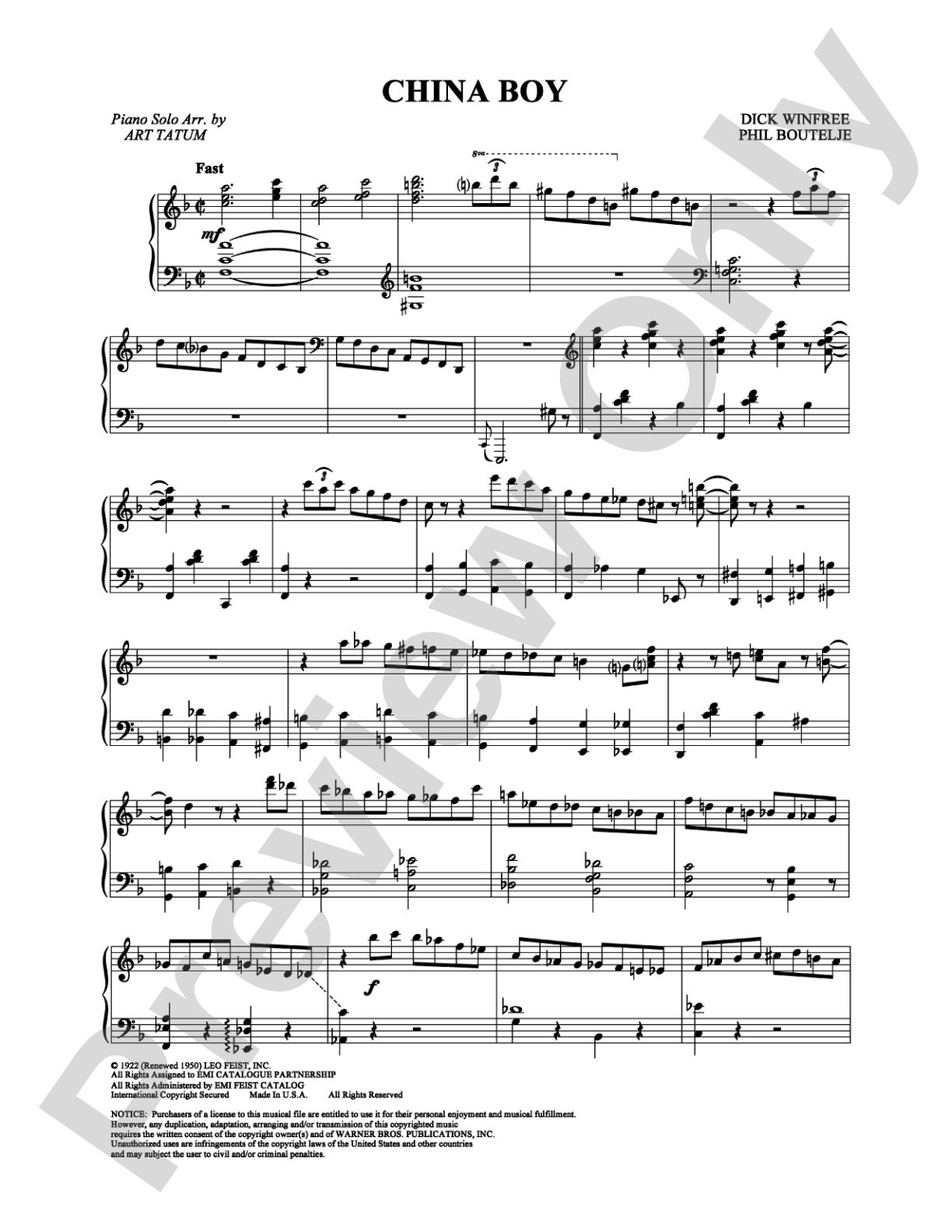
Art Tatum, Dick Winfree, Phil Boutelje

Item: 00-PS-0007235

Digital Download
$3.99
Description

China Boy: Piano Digital Sheet Music isn't in MakeMusic Cloud just yet...but it could be. Let us know you'd like to see it, and you'll help shape what comes next. In the meantime, start a free trial and dive into thousands of interactive titles your students can play along with today.

Sample Audio
No sample audio found.
Sample Video
Additional Details
SKU: 00-PS-0007235

More about this title

About the Artist: Art Tatum

Art Tatum (1909-1956) was a pianist whose technical mastery and harmonic imagination fundamentally changed what was possible at the keyboard. Blind from infancy, he developed an extraordinary ear and an ability to reharmonize melodies with sophistication that influenced generations of jazz musicians. His recordings remain essential listening for anyone studying jazz piano, improvisation, and the intersection of classical technique with jazz sensibility.

Why we love this

Tatum's "China Boy" is a masterclass in stride piano and jazz sophistication. His approach to this standard showcases how a pianist can honor a melody while completely reimagining its harmonic landscape, making it an invaluable study for students learning how jazz musicians interact with songbook material.

What to expect

Tatum's "China Boy" flows with urbane elegance and rhythmic buoyancy. The piece swings with effortless command while the harmony shifts beneath the melody like a well-dressed dancer, never settling for the obvious chord when something richer is possible.

Who it's for

This is for jazz pianists ready to engage with advanced stride technique, reharmonization, and sophisticated melodic interpretation. It suits intermediate-to-advanced students and working musicians who want to deepen their understanding of how Tatum approached a standard.

How to get the most out of it

  • Study Tatum's left hand patterns in isolation before trying to coordinate with the right hand. His stride work is intricate and requires the kind of independence that builds slowly.
  • Mark the harmonic substitutions and tension points in your score. Understanding why Tatum chose each reharmonization will clarify the shape and intent of his interpretation.
  • Don't chase his tempo. Work through the piece at a comfortable speed where you can hear the voice leading in both hands, then gradually increase as your comfort grows.
  • Listen to the recorded performance multiple times before sitting down to learn from the sheet music. Tatum's phrasing and timing choices are essential context for understanding what the notes alone cannot convey.

How to use it

Feature this as a jazz recital centerpiece or as part of a concert celebrating piano artistry and jazz standards. It works equally well in a master class setting where the focus is on studying how professional musicians approach melody, harmony, and rhythm.

Skills your students will build

  • Stride piano technique and left-hand independence
  • Harmonic reharmonization and substitution
  • Jazz interpretation of popular song melodies
  • Listening and transcription skills through score study
  • Swing rhythm and jazz phrasing at the keyboard

You May Also Like