China Boy: Piano Digital Sheet Music

China Boy: Piano Digital Sheet Music

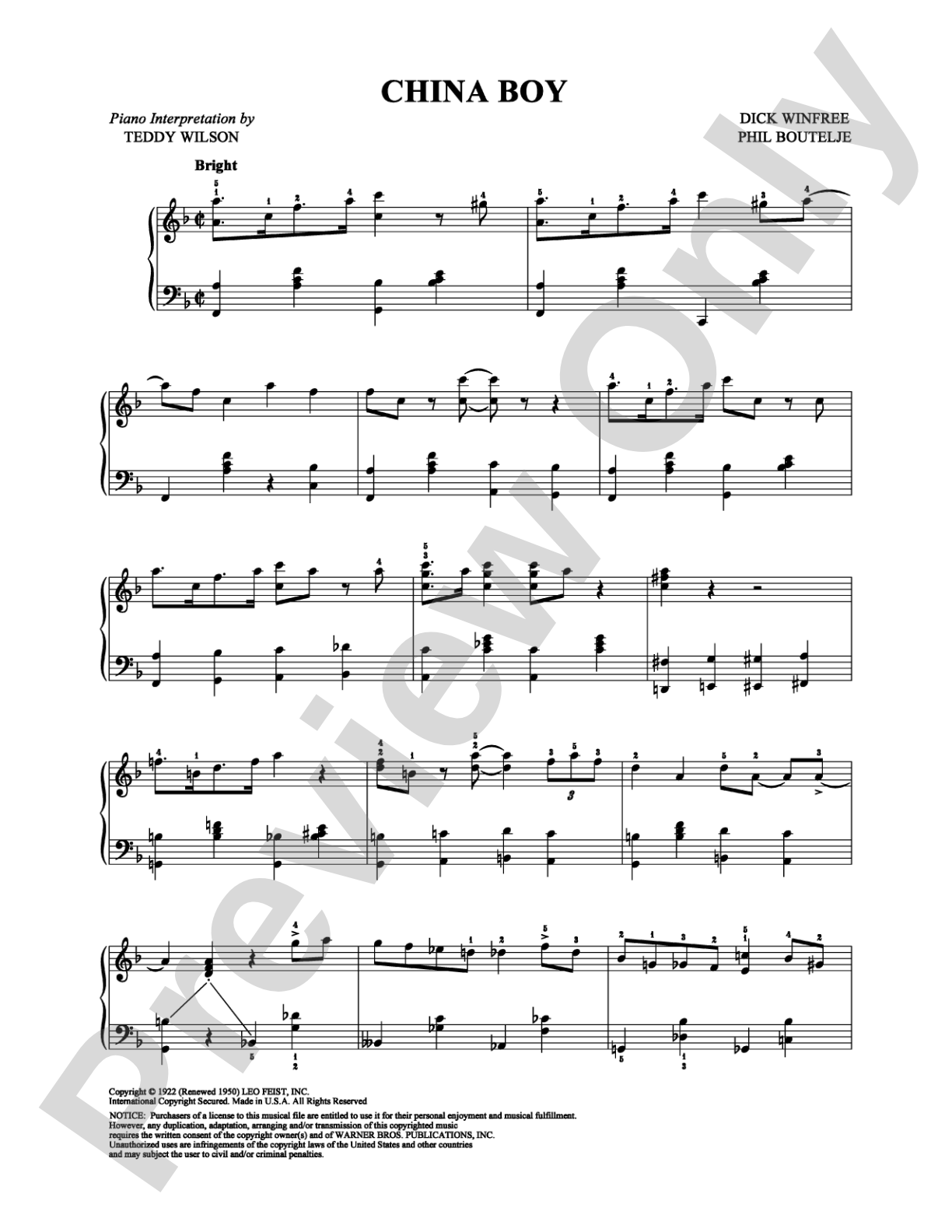
Teddy Wilson, Dick Winfree, Phil Boutelje

Item: 00-PS-0000639

Digital Download
$3.99
Description

China Boy: Piano Digital Sheet Music isn't in MakeMusic Cloud just yet...but it could be. Let us know you'd like to see it, and you'll help shape what comes next. In the meantime, start a free trial and dive into thousands of interactive titles your students can play along with today.

Sample Audio
No sample audio found.
Sample Video
Additional Details
SKU: 00-PS-0000639

More about this title

About the Artist: Teddy Wilson

Teddy Wilson was a pioneering jazz pianist whose elegant touch and harmonic sophistication shaped swing era piano playing from the 1930s onward. As a bandleader, accompanist, and composer, Wilson worked with Duke Ellington, Benny Goodman, and Billie Holiday, becoming known for his refined approach to stride piano and his ability to accompany singers with both sensitivity and rhythmic drive.

Why we love this

This is a chance to work with one of jazz piano's foundational voices on a classic swing standard. Wilson's interpretation captures the style's sophistication without excess, making it an ideal model for students learning how to voice chords idiomatically and maintain rhythmic clarity across stride patterns.

What to expect

The piece moves with a buoyant, unhurried confidence. There's a gleaming quality to the voicings and a natural ease in the way the melody sits atop the stride, evoking a speakeasy late in the evening when the best players have taken the stage.

Who it's for

Jazz pianists working to deepen their understanding of swing era comping and solo voice leading. Advanced students and teachers seeking an authentic exemplar of early jazz piano practice can use this arrangement to study Wilson's harmonic language and accompanying technique.

How to get the most out of it

  • Study the left hand stride pattern carefully; maintain evenness and pulse even when the right hand swings freely over the changes.
  • Listen to the harmonic movement beneath the melody line. Wilson voices these changes with deliberation, and each chord choice will inform your touch.
  • Balance volume between the two hands so the stride provides felt support rather than overwhelming the right-hand voice.
  • Let the rhythm sit slightly behind the beat in the swing passages; this is swing phrasing, not strict metronomic time.

How to use it

Include this in a jazz piano recital that traces the evolution of swing accompaniment, or use it in a master class on stride technique and voicing. It pairs naturally with other Wilson recordings or compositions in a unit on piano's role in early big band arrangement.

Skills your students will build

  • Left-hand stride patterns and evenness under tempo
  • Jazz chord voicing and harmonic reharmonization
  • Swinging rhythmic phrasing and behind-the-beat placement
  • Independence between hands in comping and melody playing
  • Jazz articulation and touch

You May Also Like