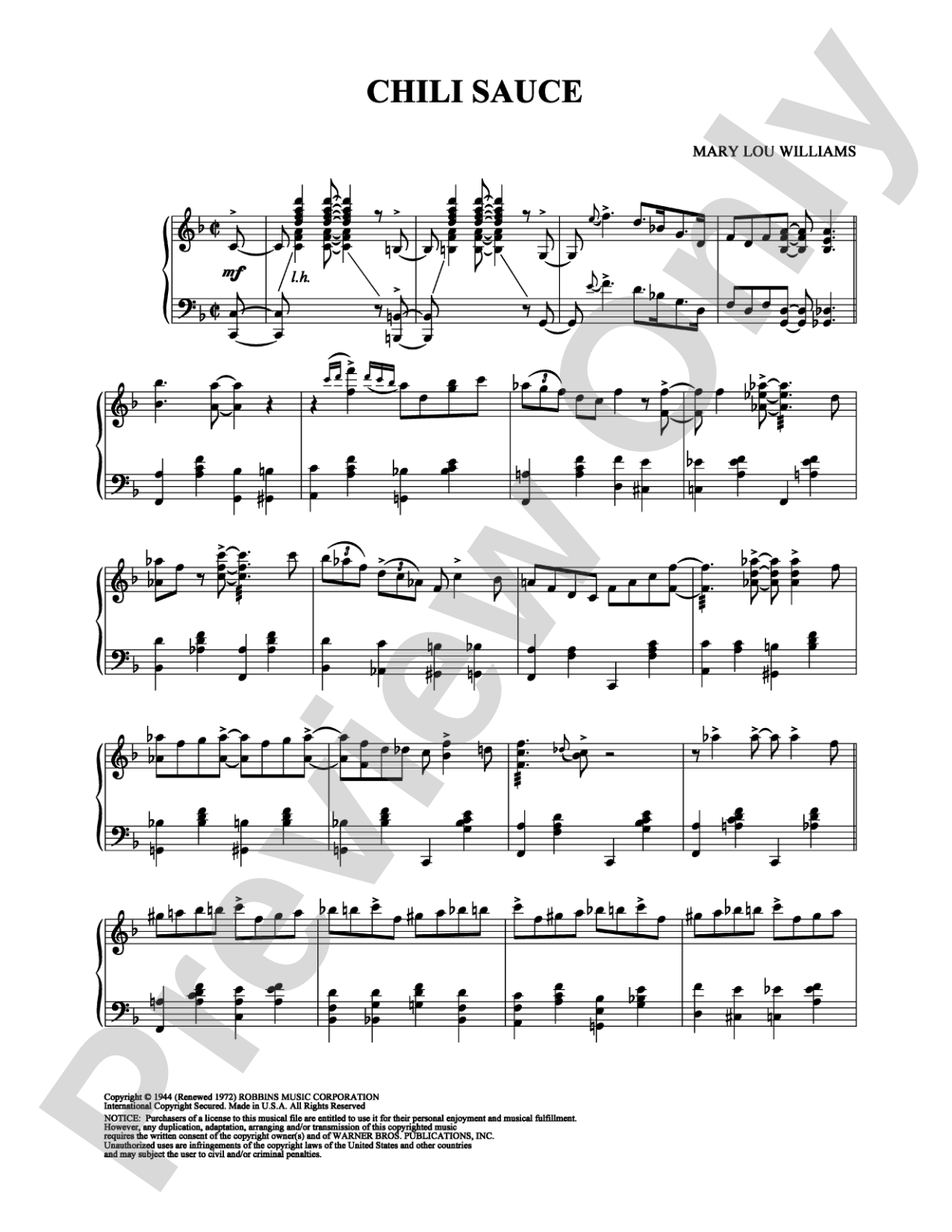
Chili Sauce: Piano Digital Sheet Music

Chili Sauce: Piano Digital Sheet Music

Mary Lou Williams

Item: 00-PS-0004314

Digital Download
$3.99
Description

Chili Sauce: Piano Digital Sheet Music isn't in MakeMusic Cloud just yet...but it could be. Let us know you'd like to see it, and you'll help shape what comes next. In the meantime, start a free trial and dive into thousands of interactive titles your students can play along with today.

Sample Audio
No sample audio found.
Sample Video
Additional Details
SKU: 00-PS-0004314

More about this title

About the Artist: Mary Lou Williams

Mary Lou Williams (1910-1981) was a pianist, composer, and arranger who shaped jazz history across five decades. She worked with every major jazz ensemble of her era, from the Andy Kirk orchestra to Duke Ellington's circle, and composed over 350 works that spanned swing, bebop, and modern jazz. Williams was also a fierce advocate for younger musicians and a dedicated educator who mentored countless players in her later years.

Why we love this

Williams's command of the keyboard and her ability to write idiomatically for jazz piano make this a piece that rewards careful listening. The harmonic sophistication and rhythmic vocabulary reflect a composer working at the height of her powers, giving students and pianists genuine artistry to study and emulate rather than simplified approximations of the jazz tradition.

What to expect

Warm, swinging, and urbane. The piece moves with the casual confidence of a seasoned improviser who knows exactly where the groove sits and how to play against it just enough to keep things fresh. There's joy in the harmony and a natural, conversational quality to the phrasing.

Who it's for

Jazz pianists and improvisers working to deepen their understanding of swing-era vocabulary and harmonic sophistication. Teachers seeking authentic jazz repertoire that rewards serious study and demonstrates the compositional voice of a major figure in jazz history.

How to get the most out of it

  • Pay close attention to the rhythmic placement of the left hand; Williams's stride patterns and comping require precision and relaxed control to sit behind the beat without dragging.
  • Approach the harmonic language with intention. These chords are not mistakes or blues clichés; they are deliberate color choices that define the piece's character.
  • Balance your touch between melody and accompaniment. The right hand melody should sing clearly without overwhelming the rhythmic foundation beneath it.
  • Use the tempo as a guide, not a prison. Jazz piano at this level benefits from subtle pushes and relaxations that follow the phrase and the harmonic rhythm.

How to use it

Include this in a recital or concert exploring jazz history and composition, pairing it with other Williams pieces or works by her contemporaries to show the depth of the tradition. It also works well as a teaching demonstration of how jazz pianists approached form, harmony, and rhythm differently than their classical counterparts.

Skills your students will build

  • Swing rhythm and behind-the-beat placement
  • Left-hand stride patterns and comping coordination
  • Reading jazz harmony and understanding chord extensions
  • Interpreting jazz articulation and phrasing without notation
  • Understanding the relationship between melody and harmonic rhythm

You May Also Like