
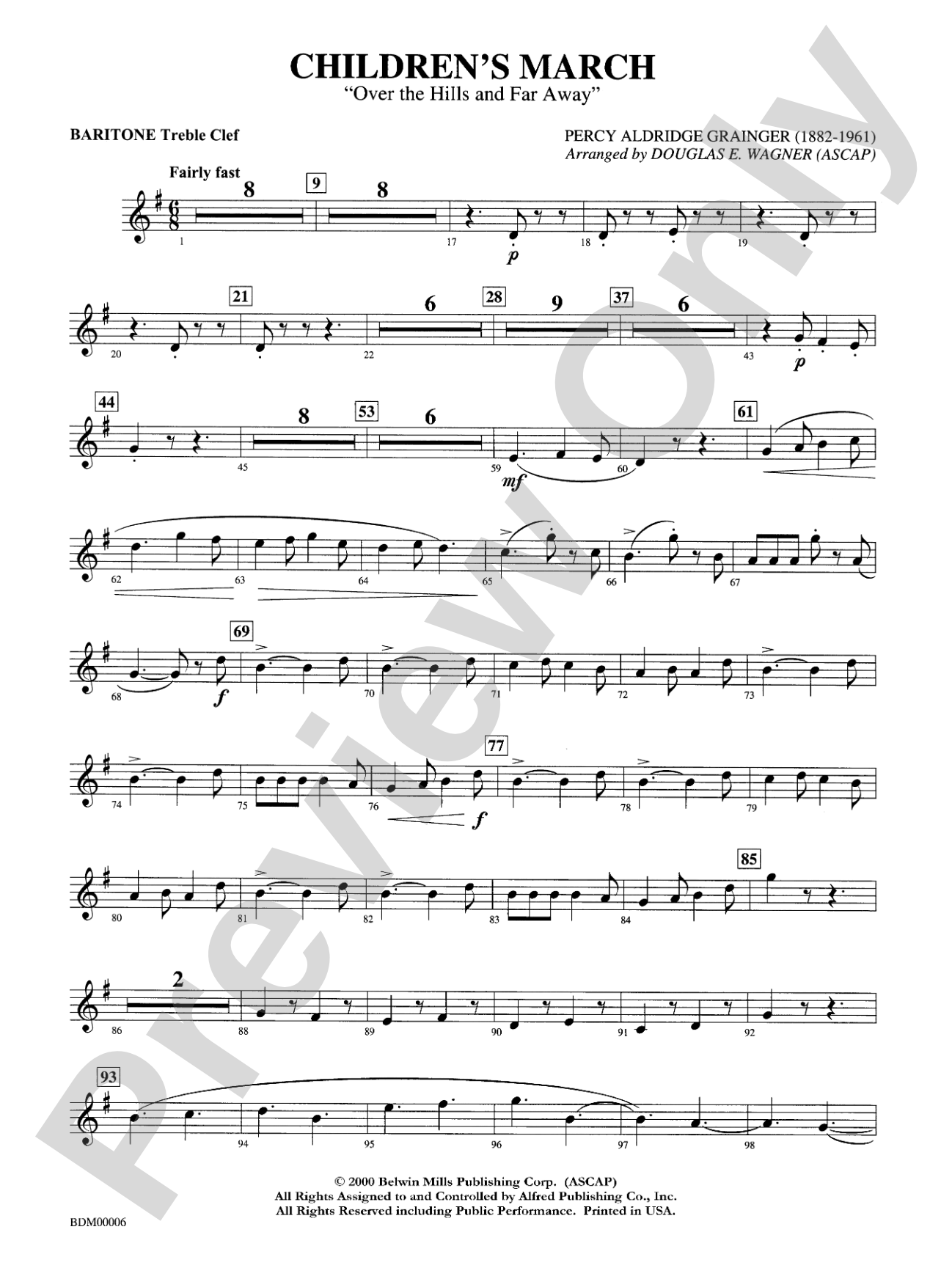

Children's March: Baritone T.C.
By Percy Aldridge Grainger / arr. Douglas E. Wagner
Grade: 3 (Medium Easy)
Item: 00-PC-0002117_BTC1
$3.00
Pickup currently not available
Description
A true classic in every sense of the word, this delightful Percy Grainger work continues to be an audience favorite. Douglas Wagner has scored this brilliant abridged version of Children's March while retaining Grainger's original compositional integrity. The wonderful vitality of Grainger's unique tonal colors and whimsical rhythms guarantee a superior experience for your concert and contest performances. (4:00)


Don't just read it, hear it, play along with it, and watch your students grow with it. In MakeMusic Cloud, Children's March: Baritone T.C. comes alive with professional accompaniment, adjustable tempo, and built-in practice tools that turn solo practice into real progress.
Open in the Player
Jump straight in and assign it today.
Start Your Free Trial
Open this title and explore the full library in minutes.
Sample Audio
1
Audio File
--:--
0:00
0:00
Sample Video
Additional Details
Series:
Belwin Concert Band
Publisher:
Alfred Music
Page Count:
414
SKU:
00-PC-0002117_BTC1
More about this title
About the Composer: Percy Aldridge Grainger
Percy Aldridge Grainger (1882-1961) was an Australian-born composer and pianist whose harmonic innovations and fascination with folk music shaped early 20th-century composition. He brought unprecedented orchestral color and rhythmic freedom to his works, often drawing inspiration from Scandinavian and British traditional music. His willingness to experiment with unconventional tonal combinations and his gift for melody made him a champion of fresh, distinctive sound worlds.
Grainger's influence on wind music remains profound. His concert band and orchestra works showcase orchestration that challenges and educates conductors and students alike, offering technical sophistication wrapped in music that genuinely engages audiences. Children's March exemplifies his ability to write music that is both artistically substantial and immediately appealing.
Why we love this
This Wagner arrangement gives you access to one of the most joyful works in the concert band repertoire at a Grade 3 level without sacrificing Grainger's distinctive voice. The abridged scoring retains the harmonic color and rhythmic personality that make the original irresistible to audiences while remaining playable by mid-level bands. Conductors appreciate how thoroughly this arrangement teaches ensemble balance and sectional independence within a framework that never feels like an exercise.
What to expect
Whimsical and buoyant, with a character that dances across the ensemble like children at play. Grainger's original conjures brightness and humor without condescension, moving through moments of lyricism and outright joy. The orchestration sparkles; every instrumental family gets its moment to shine.
Who it's for
Concert bands at the middle school through early high school level seeking a standard that serves both concert and festival contexts. Directors want repertoire that develops musicianship without overwhelming young musicians, and this arrangement delivers exactly that. Audiences connect immediately with the work's character and energy.
How to get the most out of it
- Balance the woodwind color carefully during the opening themes; Grainger's orchestration depends on clarity between flutes, clarinets, and oboes to project the whimsy he intended.
- Shape the rhythmic momentum without rushing. The piece's vitality comes from confident phrasing and crisp articulation, not tempo inflation.
- Engage your ensemble with the narrative quality of the work. This is music meant to smile at the audience; that intention should shape how you conduct it.
- Pay close attention to the dynamic flow between sections. Grainger uses orchestral transitions to create forward motion, so transitions between tutti and lighter scoring need deliberate control.
How to use it
This works beautifully as a contrast piece between weightier repertoire, or as an accessible opener that establishes rapport with your audience immediately. It fits naturally into a program alongside folk-inspired works or other Grainger compositions, and its four-minute duration makes it ideal for festival performance where time is limited. Program it when you want to celebrate your band's technical growth without abandoning genuine musical substance.
Skills your students will build
- Balancing independent melodic lines across the woodwind and brass sections
- Executing rhythmic precision in syncopated passages
- Responding to subtle dynamic and articulation changes that shape orchestral color
- Understanding harmonic color through unconventional chord voicings
- Maintaining ensemble unity across contrasting sections and tempos