
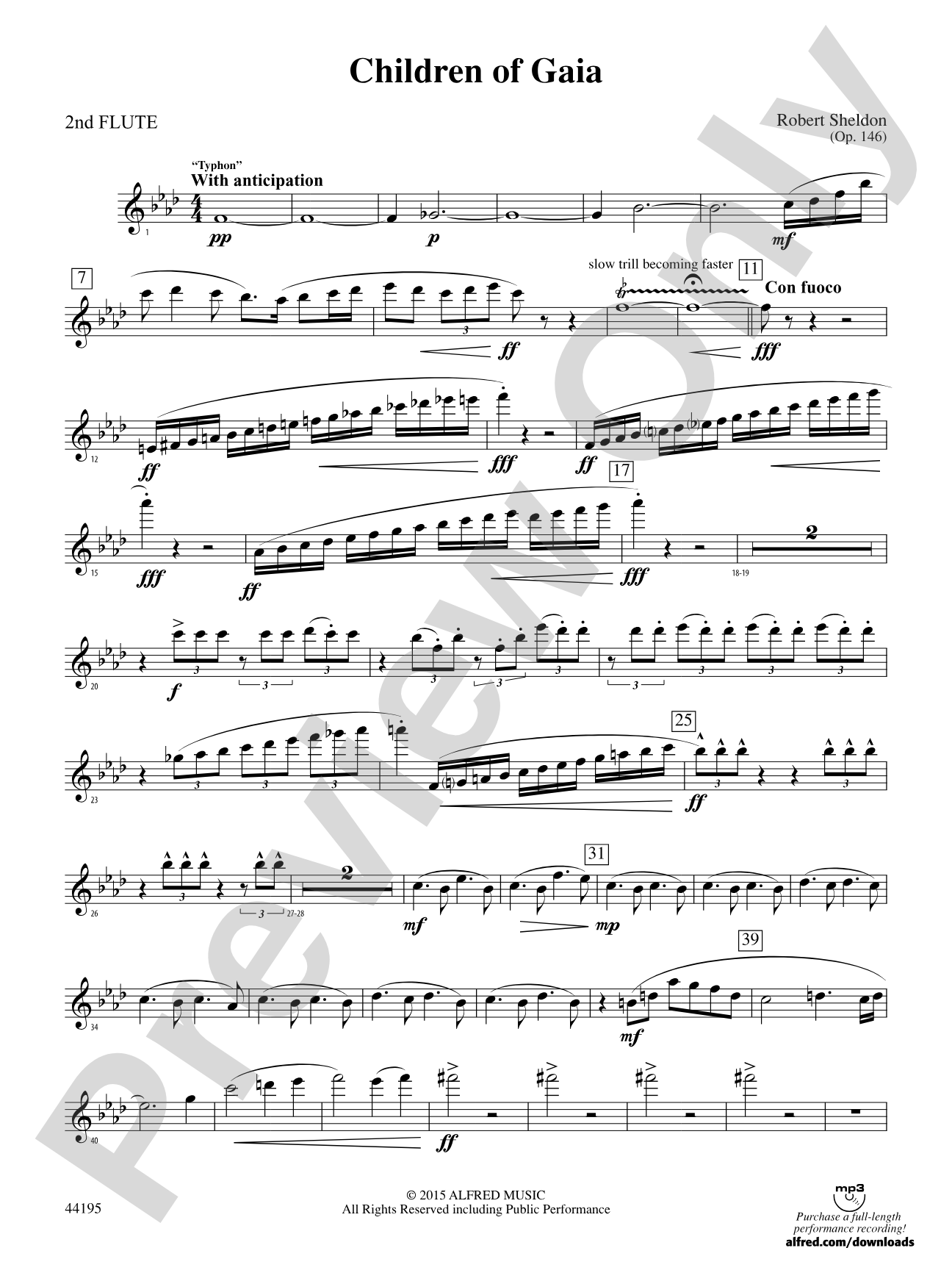

Children of Gaia: 2nd Flute
By Robert Sheldon
Grade: 4.5 (Medium Difficult)
Item: 00-PC-0017045_F2
$3.00
Pickup currently not available
Description
Gaia is a primordial deity in the Ancient Greek pantheon and is sometimes referred to as Mother Nature. In mythology she had numerous children, many of whom are of great significance to the ancient Greeks. Three of these children are represented in this dramatic work for concert band---the fearsome Typhon, the water goddess Tethys, and the menacing Enceladus. (6:00)


Don't just read it, hear it, play along with it, and watch your students grow with it. In MakeMusic Cloud, Children of Gaia: 2nd Flute comes alive with professional accompaniment, adjustable tempo, and built-in practice tools that turn solo practice into real progress.
Open in the Player
Jump straight in and assign it today.
Start Your Free Trial
Open this title and explore the full library in minutes.
Sample Audio
1
Audio File
--:--
0:00
0:00
Sample Video
No sample videos found.
Additional Details
Series:
Alfred Concert Band
Publisher:
Alfred Music
Page Count:
296
SKU:
00-PC-0017045_F2
More about this title
About the Composer: Robert Sheldon

Robert Sheldon stands among the most frequently performed wind band composers of our time. His works appear regularly on state festival lists and concert programs across North America and internationally. He has received major awards from the American School Band Directors Association, Phi Beta Mu, and ASCAP, and his music has been performed in venues ranging from Carnegie Hall to the Sydney Opera House.
Beyond composition, Sheldon leads the pedagogical effort as principal author of Sound Innovations for Concert Band. He maintains an active schedule as a guest conductor for all-state and regional honor bands, clinician at universities and state music education conferences, and commission composer. His conducting and teaching work has taken him to Japan, Canada, Italy, Germany, Australia, and China. In 2020, VanderCook College of Music awarded him an honorary doctorate.
Why we love this
Sheldon crafts mythological narratives into visceral concert band writing that rewards both focused rehearsal and dramatic performance. The piece demands serious musicianship from your ensemble while remaining accessible at the 4.5 grade level, and its six-minute arc gives you a substantial showpiece without programming constraints. Conductors consistently report that students engage deeply with the character work here: Typhon's menace, Tethys's fluidity, and Enceladus's power each require distinct interpretive choices that elevate sectional awareness and ensemble maturity.
What to expect
The music moves between menacing and otherworldly textures, capturing the raw power and alien nature of primordial deities. Typhon's sections crackle with danger and dissonance; Tethys flows with sinuous grace; Enceladus bears down with relentless force. The six-minute arc feels epic without becoming exhausting, leaving audiences in a state of rapt attention.
Who it's for
This conductor score and parts set is built for concert bands at the 4.5 grade level ready for substantial repertoire with real dramatic weight. It works equally well for festival programs, contest entries, or concert showcases where you want to demonstrate your ensemble's musicality and range. Conductors seeking a piece that combines accessible technical demands with sophisticated musical storytelling will find this a natural fit.
How to get the most out of it
- Build the mythology context before first rehearsal. A brief explanation of who Typhon, Tethys, and Enceladus are will help musicians understand the emotional terrain they're navigating and make their interpretive choices more intentional.
- Balance the dramatic dynamics carefully. Sheldon's scoring allows quieter passages to carry real impact; resist the temptation to overplay forte sections, which will compress the dynamic range and dull the mythic tension.
- Give particular attention to transitions between the three character sections. Each deity demands a distinct instrumental color and rhythmic character; clear section leadership during these pivots will sharpen the narrative arc.
- Rehearse the exposed passages in low brass and woodwind lines separately. The writing is idiomatic but demands secure intonation and rhythmic precision, especially at tempo.
How to use it
Program this after a lighter opening work to shift the emotional stakes and keep audiences alert. It's substantial enough to anchor the second half of a concert or serve as a flagship piece at festival competition. The mythological content also pairs well with cross-curricular partnerships where English or world history classes are studying ancient Greece.
Skills your students will build
- Sustaining character and dynamic contrast across longer forms
- Reading complex rhythmic patterns and syncopation across multiple parts
- Executing smooth meter and tempo transitions without losing cohesion
- Balancing exposed woodwind and brass writing for clarity and blend
- Responding to conducted rubato and interpretive gestures
- Connecting musical narrative to extra-musical imagery and storytelling