
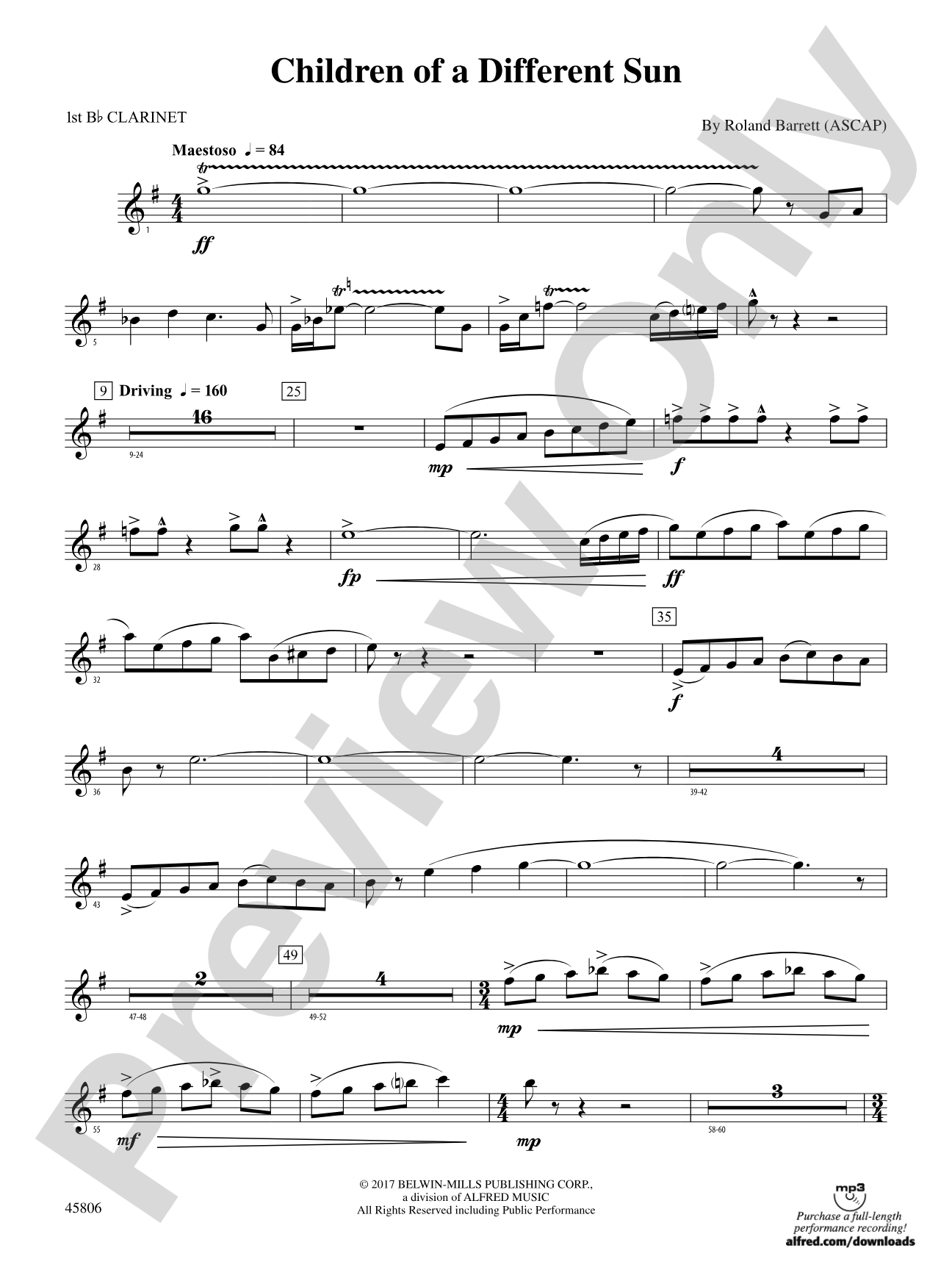

Children of a Different Sun: 1st B-flat Clarinet
By Roland Barrett
Grade: 3.5 (Medium Easy to Medium)
Item: 00-PC-0017612_C1
$3.00
Pickup currently not available
Description
Opening with a heroic fanfare, this stunning original composition was inspired by the 15th century Inca citadel Machu Picchu and specifically the Intihuatana stone in what is now southeastern Peru where sun worship was favored. Many historians have come to refer to the Inca Empire as "Children of the Sun." The work continues with an intense, almost frenzied, component that sets the stage for an active interplay of contrasting themes featuring a melodic statement interrupted by accented percussive statements. A pensive and lush moment builds with strong percussion contribution to a bold and satisfying conclusion. Skillfully arranged by Roland Barrett. (4:45)


Don't just read it, hear it, play along with it, and watch your students grow with it. In MakeMusic Cloud, Children of a Different Sun: 1st B-flat Clarinet comes alive with professional accompaniment, adjustable tempo, and built-in practice tools that turn solo practice into real progress.
Open in the Player
Jump straight in and assign it today.
Start Your Free Trial
Open this title and explore the full library in minutes.
Sample Audio
1
Audio File
--:--
0:00
0:00
Sample Video
Additional Details
Series:
Belwin Concert Band
Publisher:
Alfred Music
Page Count:
140
SKU:
00-PC-0017612_C1
More about this title
About the Composer: Roland Barrett

Roland Barrett joined the University of Oklahoma's music theory and composition faculty in 2001, where he teaches 20th century topics across undergraduate and graduate courses. Beyond the classroom, he continues as the musical arranger for the Pride of Oklahoma marching band and has established himself as a prolific composer and arranger with over two hundred published works for symphonic band, chamber ensembles, and marching band.
His compositions have earned performances by the Dallas Wind Symphony and countless All-State and All-Region Honor Bands, with broadcasts on National Public Radio and appearances at major conventions including the Midwest Band & Orchestra Convention and the International Trumpet Guild. Barrett is a multiple recipient of the ASCAPlus award and holds deep roots in the Oklahoma composition community through his formal training and sustained contributions to band literature.
Why we love this
Barrett crafts a piece that delivers genuine dramatic arc without asking for virtuosity beyond your ensemble's reach. The heroic opening hooks listeners immediately, the contrasting middle section keeps energy high, and the confident conclusion leaves audiences satisfied. At Grade 3.5, this works as a festival selection that sounds far more sophisticated than its difficulty level suggests.
What to expect
Children of a Different Sun opens with ceremonial grandeur and early excitement before settling into a more introspective, almost restless middle ground where melodic ideas and sharp percussive gestures trade places. The final movement builds with mounting intensity and strong rhythmic drive, culminating in a bold, satisfying resolution that feels earned rather than rushed.
Who it's for
Directors seeking an original concert band work that programs well at festivals and builds confidence in Grade 3 and 3.5 ensembles. The piece suits bands with solid fundamentals who are ready for a work with genuine compositional substance rather than technical showiness.
How to get the most out of it
- Establish the heroic fanfare with clear articulation and unified dynamic shape; this opening sets the listener's expectation for the entire work.
- Balance the accented percussion statements so they interrupt and enliven the melodic passages without overwhelming them; these are color and punctuation, not the main event.
- Build the pensive section gradually, allowing the stronger percussion contribution to emerge organically rather than suddenly; this creates the lush quality Barrett intends.
- Shape the closing passage with confidence; the bold conclusion rewards clean attacks and a unified release.
How to use it
Program this as a strong opening number to establish a high-energy tone for your concert, or position it mid-program to anchor a thematic set exploring world music or historical inspiration. Its clear sectional design and confident conclusion make it effective both for festival adjudication and for concert programming where you want to demonstrate your ensemble's musicality.
Skills your students will build
- Balancing solo melodic lines against harmonic accompaniment
- Responding to sudden changes in articulation and dynamic within sustained passages
- Coordinating rhythmic precision with expressive phrasing in the opening fanfare
- Maintaining ensemble blend while independent percussion parts add textural interest
- Building toward and executing a confident, unified climax