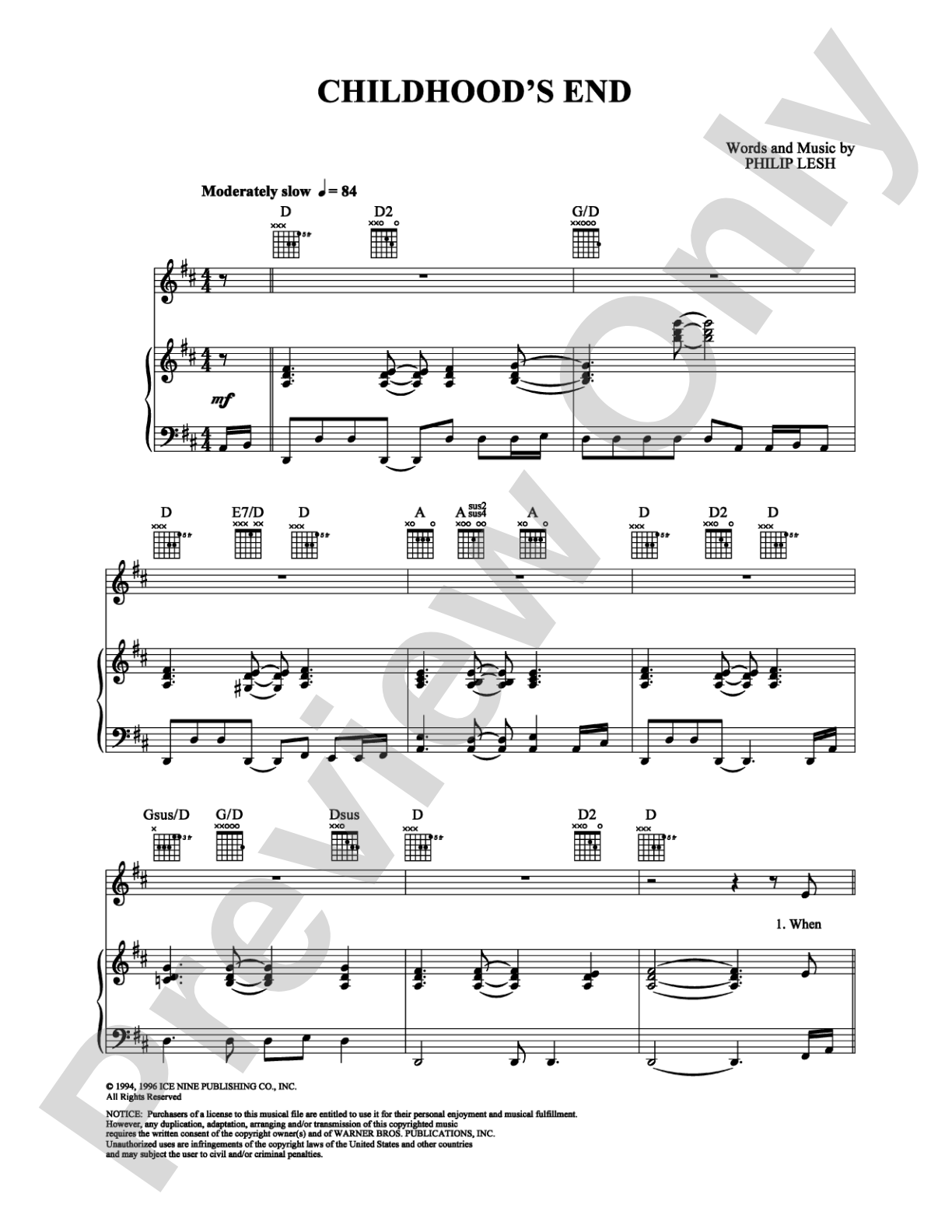
Childhood's End: Piano/Vocal/Chords Digital Sheet Music

Childhood's End: Piano/Vocal/Chords Digital Sheet Music

Grateful Dead, Phil Lesh

Item: 00-PS-0004624

Digital Download
$2.95
Description

Childhood's End: Piano/Vocal/Chords Digital Sheet Music isn't in MakeMusic Cloud just yet...but it could be. Let us know you'd like to see it, and you'll help shape what comes next. In the meantime, start a free trial and dive into thousands of interactive titles your students can play along with today.

Sample Audio
No sample audio found.
Sample Video
Additional Details
SKU: 00-PS-0004624

More about this title

About the Artist: Grateful Dead

The Grateful Dead shaped American rock music by refusing to settle into a single style. From their San Francisco roots in the 1960s, they blended folk, blues, country, and psychedelia into something altogether their own, creating a body of work that rewarded deep listening and repeated encounters. Their songwriting, particularly Jerry Garcia and Robert Hunter's partnership, produced melodies that stick with you long after the jam ends, making their catalog ideal for musicians seeking songs with real emotional substance.

Why we love this

Grateful Dead songs offer singers and pianists a chance to explore the intersection of folk sensibility and rock sophistication without requiring a full band setup. The piano/vocal/chord format lets you see the harmonic architecture clearly, revealing how the Dead built emotional depth through interesting chord progressions and voice leading that work beautifully at an acoustic piano.

What to expect

"Childhood's End" carries a reflective, wistful quality characteristic of much Grateful Dead material. The progression moves with a patient, almost meditative pace, allowing space for lyrical introspection while maintaining the harmonic interest that keeps listeners engaged.

Who it's for

Pianists and singers working through popular repertoire who want to understand how rock and folk traditions intersect, as well as vocalists preparing material for recitals, coffeehouse performances, or studio work. Anyone exploring the Grateful Dead's compositional approach will find the chord symbols and vocal line essential for learning how the band balanced accessibility with harmonic richness.

How to get the most out of it

  • Study the recorded version to hear how the melody sits against the harmony; the Dead often place phrases slightly ahead of or behind the beat in ways that create pocket and swing.
  • Use the chord symbols as a starting point for comping rather than a strict roadmap. Leave space for the voice to breathe, and don't feel obligated to play every harmony note.
  • Pay attention to key moments where the chords shift unexpectedly. These moments often carry the emotional weight of the song, so let them land with clarity.
  • If accompanying a vocalist, listen for their phrasing preferences and adjust your rhythmic approach to support their interpretation rather than imposing a metronomic grid.

How to use it

Include this in a program exploring popular songwriting across decades, pairing it with other songs that blend folk and rock sensibilities. It works well as a standalone recital piece for pianists with vocal accompaniment, or as part of a set devoted to singer-songwriter traditions in American rock.

Skills your students will build

  • Reading and interpreting chord symbols in a contemporary context
  • Balancing melody and harmony in piano/vocal arrangements
  • Understanding phrasing and rhythmic nuance in rock and folk idioms
  • Accompanying singers with sensitivity to their vocal line and interpretive choices
  • Analyzing harmonic movement and voice leading in popular song structures

You May Also Like