
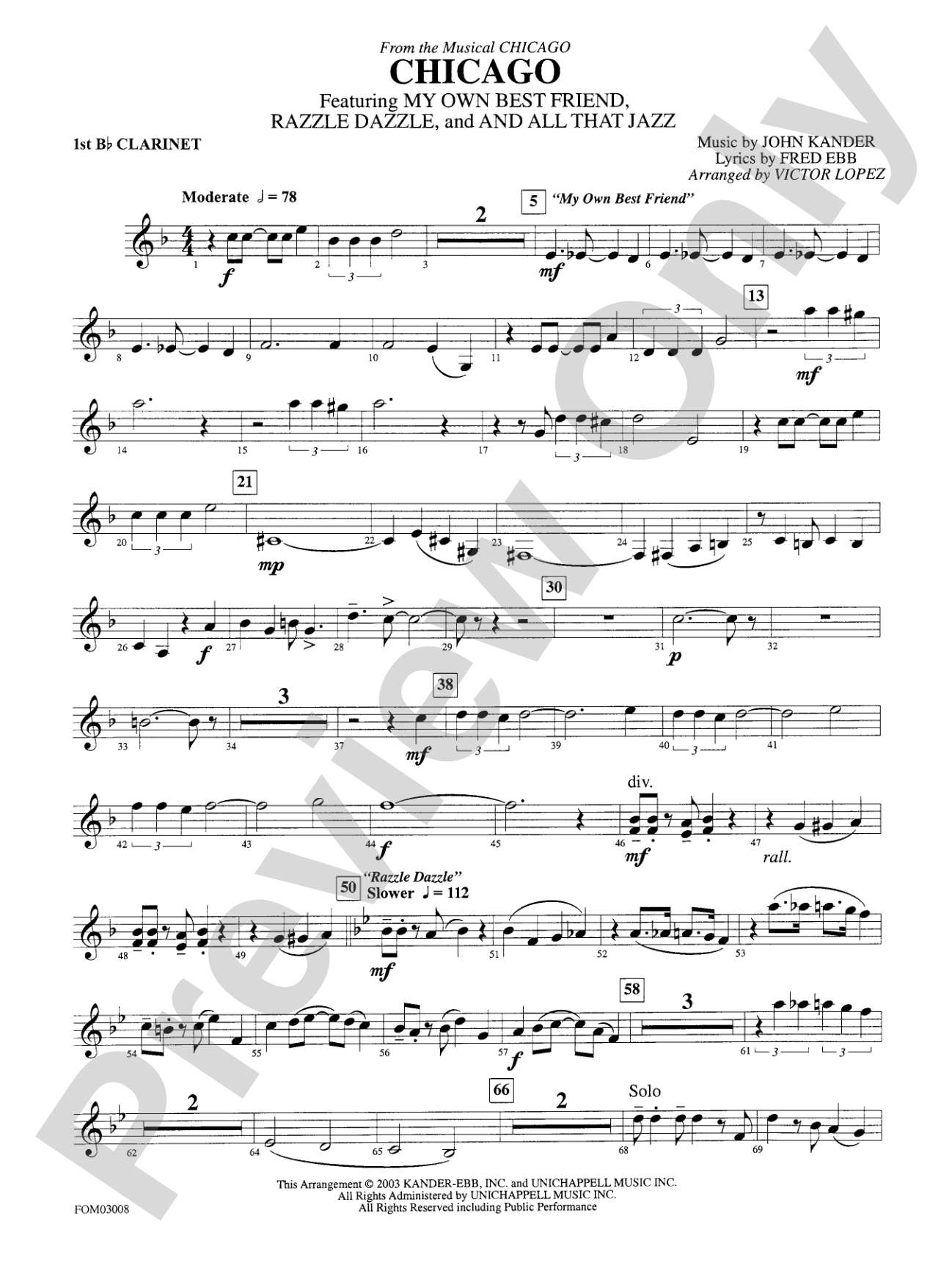

Chicago (from the musical Chicago): 1st B-flat Clarinet
Featuring: My Own Best Friend / Razzle Dazzle / And All That Jazz
Words and music by Fred Ebb and John Kander / arr. Victor López
Grade: 3.5
Item: 00-PC-0016106_C1
$3.00
Pickup currently not available
Description
This Broadway sensation keeps drawing the crowds and it's an award-winning movie as well. Victor López has scored a home run with his fresh new medley of all of your favorite selections from the show including: "My Own Best Friend," "Razzle Dazzle," and, of course, "And All That Jazz." Don't miss this new arrangement scored at the concert orchestra level. It's hot! A certain audience pleaser. (4:04)


Don't just read it, hear it, play along with it, and watch your students grow with it. In MakeMusic Cloud, Chicago (from the musical Chicago): 1st B-flat Clarinet comes alive with professional accompaniment, adjustable tempo, and built-in practice tools that turn solo practice into real progress.
Open in the Player
Jump straight in and assign it today.
Start Your Free Trial
Open this title and explore the full library in minutes.
Sample Audio
1
Audio File
--:--
0:00
0:00
Sample Video
No sample videos found.
Additional Details
Series:
Pop Concert Full Orchestra
Publisher:
Alfred Music
Page Count:
142
SKU:
00-PC-0016106_C1
More about this title
About the Composer: John Kander
John Kander is an American composer whose work for the stage has defined Broadway music since the 1960s. His collaboration with lyricist Fred Ebb produced some of the most enduring theatrical scores of the modern era, including Cabaret, Chicago, and Kiss of the Spider Woman. Kander's melodies are instantly recognizable and dramatically sophisticated, marked by jazz-inflected harmonies, rhythmic vitality, and an instinctive sense of what an orchestra can do to amplify a story.
Why we love this
Victor López's concert orchestration captures everything that makes Chicago magnetic without losing the swagger and edge of the original. This medley hits the sweet spot for orchestras that want to program something audiences recognize immediately while still demanding real musicianship from your ensemble. At Grade 3.5, it's accessible enough for strong high school orchestras but arranged with enough sophistication to hold the attention of advanced players.
What to expect
The piece pulses with the confidence and theatrical flair of 1920s Chicago reimagined for the stage. Expect sleek, propulsive rhythms, bright brass punctuation, and the kind of harmonic sophistication that reminds you why Kander's music has staying power. It's glamorous and sassy, with moments of genuine sophistication beneath the surface sheen.
Who it's for
Orchestras looking to program something contemporary and recognizable that still feels musically substantial. This arrangement works for schools seeking a concert piece with popular appeal, community orchestras wanting to engage audiences, and any director who needs a sure-fire crowd-pleaser that doesn't sacrifice artistry.
How to get the most out of it
- Emphasize the syncopated rhythms in the brass and woodwinds to maintain the show's propulsive energy; these riffs need clarity and snap rather than weight
- Balance the solo lines that will emerge from your first chairs against the ensemble texture; the arrangement is written to feature individual voices within the full orchestration
- Shape the transitions between selections so each tune feels like a distinct moment rather than a medley rush; let audiences land on the new melody before moving forward
- Record a practice run to check tempo consistency across the four-minute span; momentum is everything in keeping this arrangement cooking
How to use it
Use this as a spring pops concert anchor or as a finale that sends audiences out smiling. It pairs naturally with other Broadway or musical theater selections and works equally well as a standalone feature or the closing gesture of a larger program. The duration and accessibility make it ideal for concerts where you want maximum audience engagement without compromising your orchestra's credibility.
Skills your students will build
- Executing syncopated rhythms with precision in ensemble context
- Balancing solo lines and melodic ideas against full orchestration
- Maintaining consistent tempo and momentum through connected sections
- Shaping jazz-influenced harmonies and articulation
- Responding to theatrical interpretation and stylistic nuance in concert settings