
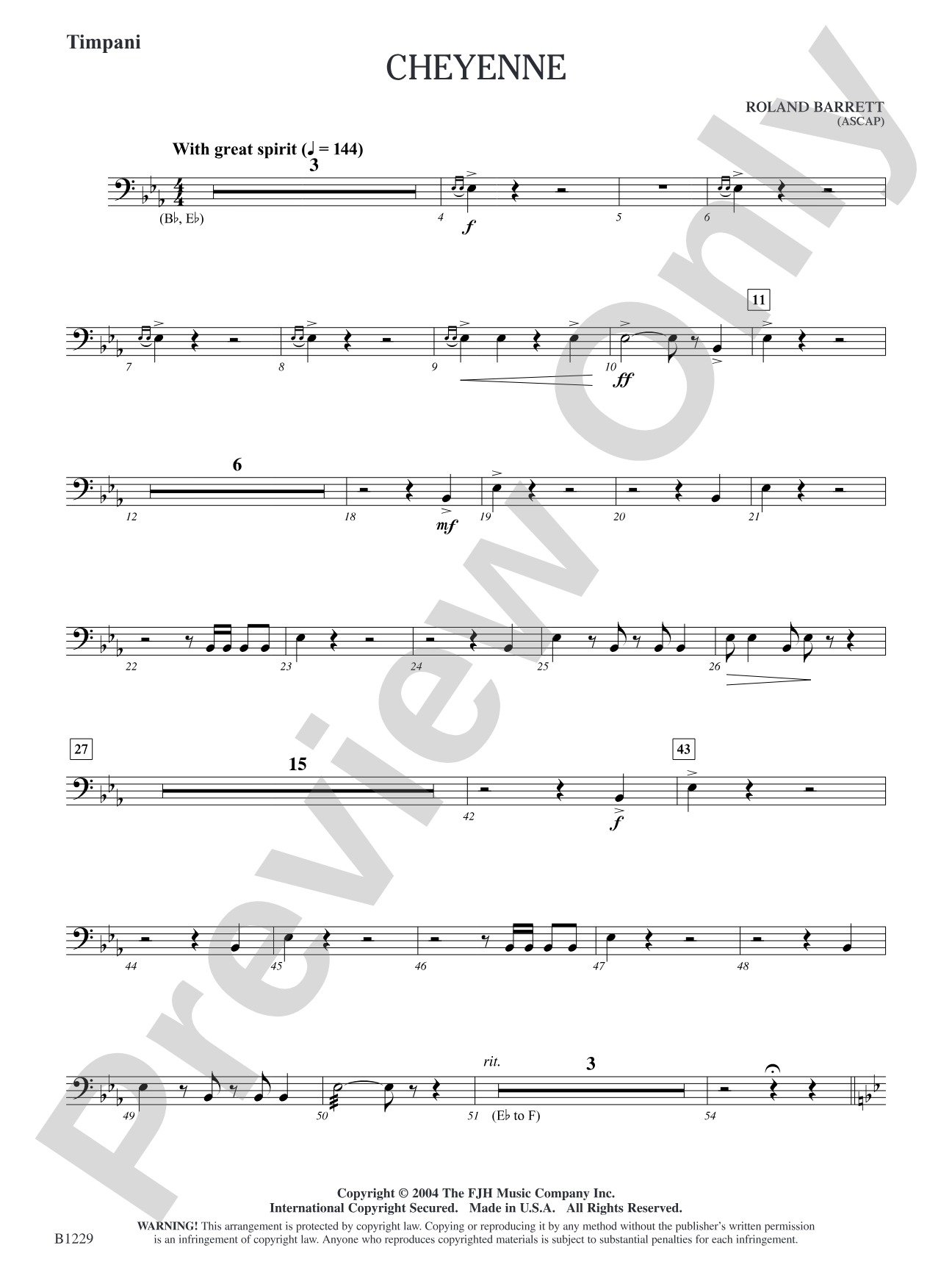

Cheyenne: Timpani
By Roland Barrett
Grade: 2.5
Item: 98-PC-DB1229_TMP
$7.00
Pickup currently not available
Description
The opening woodwind trills and brass fanfares will immediately engage your audience as they experience the spirit and exuberance of the great American West during the peak of its frontier days. The tuneful melody is quite memorable and lends itself perfectly to young bands. A beautiful lyrical section builds to a powerful climax before the piece moves into an exciting key change and grandiose ending. Superb writing!


Cheyenne: Timpani isn't in MakeMusic Cloud just yet...but it could be. Let us know you'd like to see it, and you'll help shape what comes next. In the meantime, start a free trial and dive into thousands of interactive titles your students can play along with today.
Request This Title
Tell us you want it.
Start Your Free Trial
Explore everything that's ready to play right now.
Sample Audio
1
Audio File
--:--
0:00
0:00
Sample Video
No sample videos found.
Additional Details
Series:
FJH Young Band
Publisher:
The FJH Music Company, Inc.
SKU:
98-PC-DB1229_TMP
More about this title
About the Composer: Roland Barrett

Roland Barrett has shaped generations of student musicians through his dual roles as composer and educator. Since joining the University of Oklahoma's faculty in 2001, he has taught music theory and composition at both undergraduate and graduate levels, with special emphasis on 20th century techniques. Beyond the classroom, he continues to arrange music for the Pride of Oklahoma marching band and maintains an active presence at major conferences including the Midwest Band & Orchestra Convention and the International Trumpet Guild.
Barrett's catalog includes more than two hundred published works for symphonic band, chamber ensembles, and marching band. His compositions have earned multiple ASCAP awards and have been performed by the Dallas Wind Symphony, countless All-State and All-Region Honor Bands, and featured on National Public Radio and USA network television. His work reflects a deep understanding of what young and developing musicians can achieve when given thoughtfully written, engaging music.
Why we love this
Barrett's writing for young bands strikes a rare balance between accessibility and genuine musical substance. The piece opens with character and energy, features a memorable melodic core that sits naturally on your players' instruments, and builds with real architectural purpose rather than relying on difficulty alone. Your students will sound accomplished performing this.
What to expect
Cheyenne captures the sweep and vitality of frontier America through orchestral storytelling. The music moves from spirited announcement through reflective singing sections to triumphant resolution, inviting listeners to follow a clear emotional journey. Young musicians experience what it means to shape a cohesive musical narrative rather than simply reading notes.
Who it's for
Grade 2.5 concert bands looking for repertoire with genuine appeal and narrative arc. This works equally well for bands preparing for festivals or contests, or simply wanting to program something that students will remember long after the concert season ends.
How to get the most out of it
- Shape the opening woodwind trills to float over the brass fanfares rather than compete with them; the texture works best when the upper winds have lightness and the brass anchors below.
- Give the lyrical section time to breathe and allow dynamics to swell naturally toward the climax; resist rushing the harmonic progression as it builds tension.
- Emphasize the key change as a moment of arrival by adjusting your conducting clarity and inviting the band to sit up slightly; this structural pivot deserves attention from both podium and stands.
- The grandiose ending rewards a slight broadening of tempo to let the full band sound; bring out inner harmonic lines in the brass to prevent the final moments from feeling one-dimensional.
How to use it
Position this as a centerpiece in your concert lineup where it can anchor a thematic set (American composers, patriotic works, or single-composer explorations). Its Grade 2.5 level makes it ideal for demonstrating what your program has accomplished mid-year without overwhelming younger or newer students, and its contest-friendly designation means it can serve multiple purposes across your performance calendar.
Skills your students will build
- Shaping lyrical phrases across longer melodic lines
- Balancing texture when multiple sections play simultaneously (woodwind trills against brass fanfares)
- Managing dynamic growth through a multi-section build toward climax
- Responding to key changes as structural landmarks rather than surface events
- Executing rhythmic clarity and ensemble cohesion at moderate tempos